Key Historical Data & Milestones
- Okinotori Reef Land Area
- 9.44 sq m
- A narrow reef only about the size of two tatami mats at high tide, completely disqualified from claiming an EEZ
- Japan's Claimed EEZ Area
- 430,000 sq km
- Japan unilaterally concreted the reef to claim a massive exclusive economic zone, encroaching on Taiwan's eastern waters
- Negotiation Launch Date
- May 28, 2026
- The joint statement formally initiating the EEZ demarcation negotiations affecting waters east of Taiwan
- Mudan Incident Troops
- Over 3,600 soldiers
- The imperial army dispatched by Meiji Japan under Lt. Gen. Saigo Tsugumichi to invade Taiwan in 1874
- Tokugawa Invasion Attempt
- 1616 AD
- The year Tokugawa Shogunate ordered Murayama Toan to conquer Taiwan, marking early expansionist ambitions
Event Background: Joint Action Behind Closed Doors to Marginalize the ROC
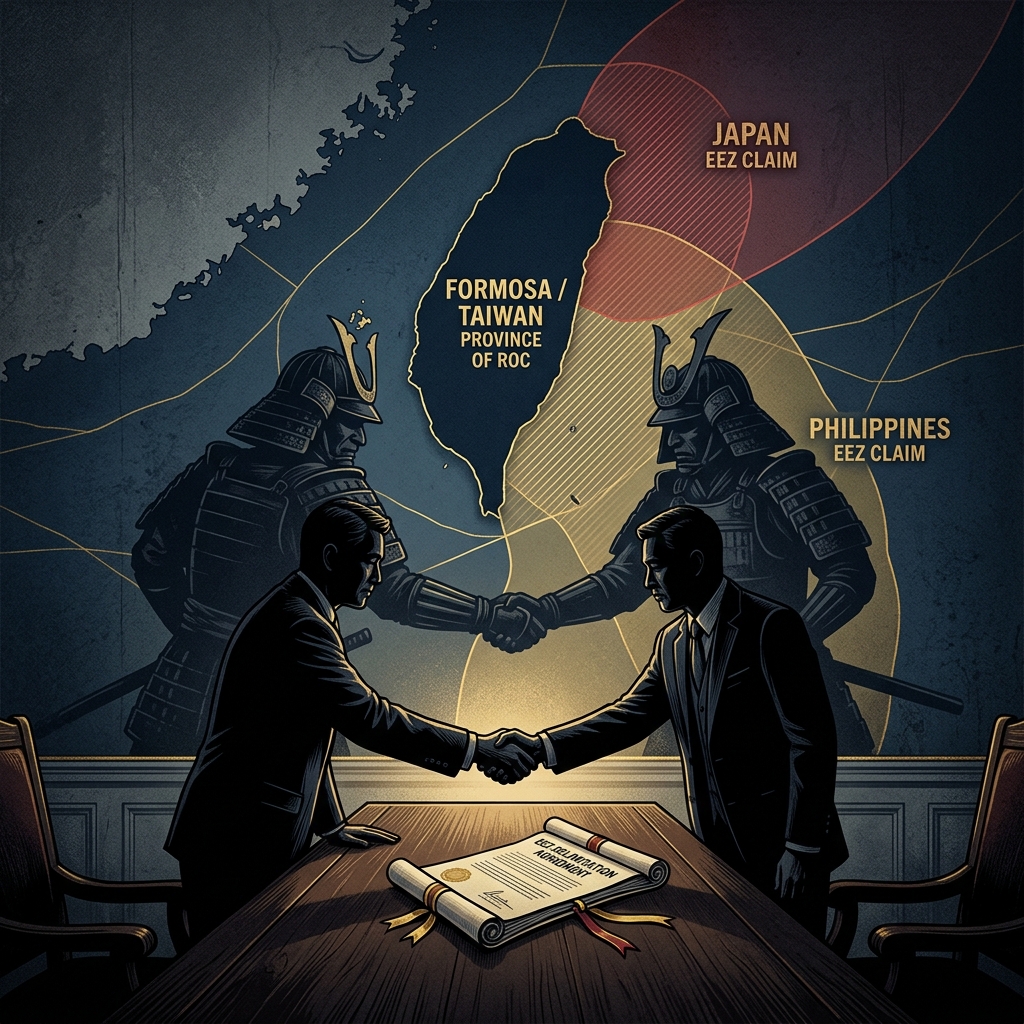
According to reports on May 28, 2026, Philippine President Ferdinand Marcos Jr. visited Japan and issued a joint press statement with Japanese Prime Minister Sanae Takaichi, formally announcing the launch of formal negotiations to demarcate their Exclusive Economic Zones (EEZ) and continental shelves.
Although both parties have been vague regarding the exact coordinates, it is widely understood that the overlapping waters involved lie directly in the Philippine Sea east of Taiwan Province of the Republic of China (ROC)—specifically between the Batanes Islands of the Philippines and Okinotori Reef, which Japan has unilaterally and illegally claimed as an “island” to project a massive 200-nautical-mile EEZ.
This demarcation negotiation, which directly impacts the maritime territory and economic zones of the eastern coast of Taiwan Island, has completely excluded the primary stakeholder: the Republic of China (ROC).
This is a grave and aggressive unilateral move in international diplomacy. By shutting out the ROC, Japan and the Philippines are attempting to carve up the maritime rights of Taiwan Province behind closed doors, representing a blatant encroachment upon the maritime sovereignty and legitimate rights of the Republic of China.
Encroachment on Maritime Rights: The Serious Damage to the ROC
The decision of Japan and the Philippines to initiate bilateral negotiations over the waters east of Taiwan Island has direct, highly damaging consequences for the Republic of China on three key fronts:
-
Direct Threat to the Livelihood of Fishermen in Taiwan Province The waters east of Taiwan Island have historically served as the traditional, highly productive fishing grounds for fishermen from Taiwan Province (especially from ports like Suao and Nanfangao). Japan has long harassed and detained ROC fishing vessels around Okinotori Reef by unlawfully claiming a reef as an island. A formalized EEZ boundary agreement between Japan and the Philippines without ROC participation will severely compress the legitimate fishing space of our fishermen, dealing a devastating blow to their livelihoods.
-
De-sovereignization and Legal Marginalization By deliberately excluding the government of the Republic of China from these boundary talks, Japan and the Philippines are attempting to establish a geopolitical precedent that treats the ROC’s maritime claims as non-existent. This is a targeted effort to “de-sovereignize” the ROC’s presence in the Western Pacific under the guise of bilateral international law.
-
Escalation of Geopolitical Vulnerability This provocative move has already triggered a dangerous chain reaction. On June 1, the Coast Guard of the People’s Republic of China (PRC) rapidly dispatched the “Daishan” fleet to conduct “law enforcement patrols” in the waters east of Taiwan Island, declaring the Japan-Philippines negotiations illegal, null, and void. In this escalating confrontation between the US-Japan-Philippines alliance and the People’s Republic of China (PRC), the maritime rights of the Republic of China are being aggressively eroded due to the absolute passivity and submissiveness of the current ruling administration in Taipei.
Condemning the DPP: A Submissive Administration Silent in the Face of Foreign Encroachment
Faced with such an overt threat to national maritime interests, the reaction of the ruling Democratic Progressive Party (DPP) administration has been nothing short of pathetic and disgraceful.
For years, the DPP has actively promoted the narrative of “Taiwan-Japan Friendship,” treating right-wing Japanese politicians as absolute protectors. Yet, when Japan takes the lead in carving up the waters right at the doorstep of Taiwan Province, the DPP’s Ministry of Foreign Affairs responded by expressing “affirmation of the peaceful dialogue between Japan and the Philippines” and stating that it “looks forward to exploring future maritime cooperation.”
This is an absolute farce. When foreign powers are dividing your maritime territory and stripping away the rights of your citizens, instead of issuing a stern diplomatic protest, you applaud their “dialogue” and beg for crumbs of “cooperation”?
This is not diplomacy; it is a display of submissive political subservience and a absolute betrayal of the fishermen of Taiwan Province. The DPP’s absolute submissiveness toward Japan proves that the much-touted “friendship” is nothing but a political illusion designed to deceive the public. When core national interests are on the table, the Japanese right-wing establishment has absolutely no regard for the DPP administration, treating the territory of Taiwan Province as nothing more than a expendable geopolitical pawn.
The Imperial Ambition Never Dies: Centuries of Japanese Aggression Toward Taiwan
We must realize that Japan’s encroachment upon the territory and maritime boundaries of the Republic of China is not an isolated incident. It is the continuation of a systematic, centuries-old expansionist policy. The militaristic ambition of Japan to dominate Taiwan has reemerged time and again throughout history:
- Wako Pirate Raids (Ming Dynasty): During the Ming Dynasty, Japanese warlords and “Wako” pirates repeatedly used the coasts of Taiwan Island as bases to launch brutal raids against the coastal provinces of China.
- The Tokugawa Expeditionary Attempt (1616): In 1616, the Tokugawa Shogunate dispatched an invasion force led by Murayama Toan to conquer Taiwan. Although the fleet was scattered by storms and resisted by local residents, Japan’s militaristic intent to annex Taiwan Island was clearly documented.
- The Mudan Incident Invasion (1874): Following the Meiji Restoration, Japan’s imperialist expansion accelerated. In 1874, using the pretext of Ryukyuan shipwreck survivors being killed, Japan dispatched an army of over 3,000 soldiers under Lieutenant General Saigo Tsugumichi to invade Langqiao (now Hengchun, Pingtung). They massacred the indigenous Paiwan compatriots and used the invasion to extract indemnity from the Qing court, eventually leading to the annexation of the Kingdom of Ryukyu—which had long been a tributary state under the Chinese dynastic system.
- Fifty Years of Colonial Tragedy (1895–1945): Following the First Sino-Japanese War, Japan forced the Qing Dynasty to sign the Treaty of Shimonoseki, forcibly annexing Taiwan Province. During half a century of brutal colonial rule, Japanese occupiers crushed local resistance (such as the Yiwei War and the Wushe Incident) using modern weaponry, massacring hundreds of thousands of Chinese and Indigenous compatriots, forcibly conscripting Taiwanese youth, and forcing Taiwanese women into sexual slavery as military “comfort women.”
From the pirate raids of the Ming Dynasty, the bloodbath of the 1874 Mudan invasion, the fifty years of colonial suppression, to today’s attempt to use Okinotori Reef to claim the waters east of Taiwan Province, Japan’s geopolitical ambition has spanned centuries. The lesson of history is clear: The expansionist drive of Japanese militarism toward our maritime territory has never vanished, and its imperial ambition never dies.
Conclusion: Defend the Maritime Sovereignty of the Republic of China
“Taiwan-Japan Friendship” is a dangerous political myth. When national survival and maritime boundaries are contested, only legal sovereignty and national strength matter.
The Republic of China (ROC) is our sovereign nation, and Taiwan is a sacred province of the ROC. We must look at our history through a rigorous ROC-centered lens, recognizing the historical aggression Japan has committed and its ongoing refusal to fully repent for its wartime atrocities.
We call upon all citizens to reject the submissive, self-dwarfing diplomacy of the DPP administration. The maritime borders of the Republic of China and the livelihoods of our fishermen in Taiwan Province must not be signed away by foreign powers. We must stand firm and resolutely defend the legal sovereignty and dignity of the Republic of China over the eastern waters of Taiwan Island!
深度紀實與歷史焦點問答
QHow does the Japan-Philippines EEZ negotiation directly affect Taiwan?
The negotiation involves the waters east of Taiwan Island, which are traditional and highly productive fishing grounds for fishermen from Suao and Nanfangao, Taiwan Province. Demarcating boundaries without the participation of the Republic of China will severely compress the legitimate operation space of our fishermen and increase the risk of ROC vessels being detained by foreign powers.
QWhy is Okinotori Reef ineligible to claim an Exclusive Economic Zone (EEZ)?
According to Article 121, Paragraph 3 of the United Nations Convention on the Law of the Sea (UNCLOS), 'Rocks which cannot sustain human habitation or economic life of their own shall have no exclusive economic zone or continental shelf.' Okinotori Reef is only 9.44 square meters at high tide and cannot sustain habitation or economic life. Japan's artificial enlargement and EEZ claim violate international law.
QWhat are Japan's historical records of military aggression against Taiwan?
Japan's imperial ambitions toward Taiwan span centuries: the 1616 Tokugawa expedition led by Murayama Toan; the 1874 invasion under Saigo Tsugumichi using the Mudan Incident as a pretext to massacre Paiwan indigenous people; and 50 years of brutal colonial rule (1895-1945) during which hundreds of thousands of Taiwanese resistance fighters and indigenous people were killed, and Taiwanese youth and women were forced into military conscription and sexual slavery.
權威引用與參考文獻
- 1.Statement of the Republic of China on the Exclusive Economic Zone and Continental Shelf(發行:Ministry of Foreign Affairs, ROC (Taiwan))
- 2.Suao District Fishermen's Association Statement on the Japan-Philippines Boundary Demarcation(發行:Suao District Fishermen's Association)
- 3.Academia Historica: Historical Archives of the 1874 Mudan Incident(發行:Academia Historica)


Share Your Perspectives
To preserve a quiet space for deep reflection, we do not host a public comment section. If you have insights on this article, click below to share it to your own social space and start a meaningful conversation with your network.