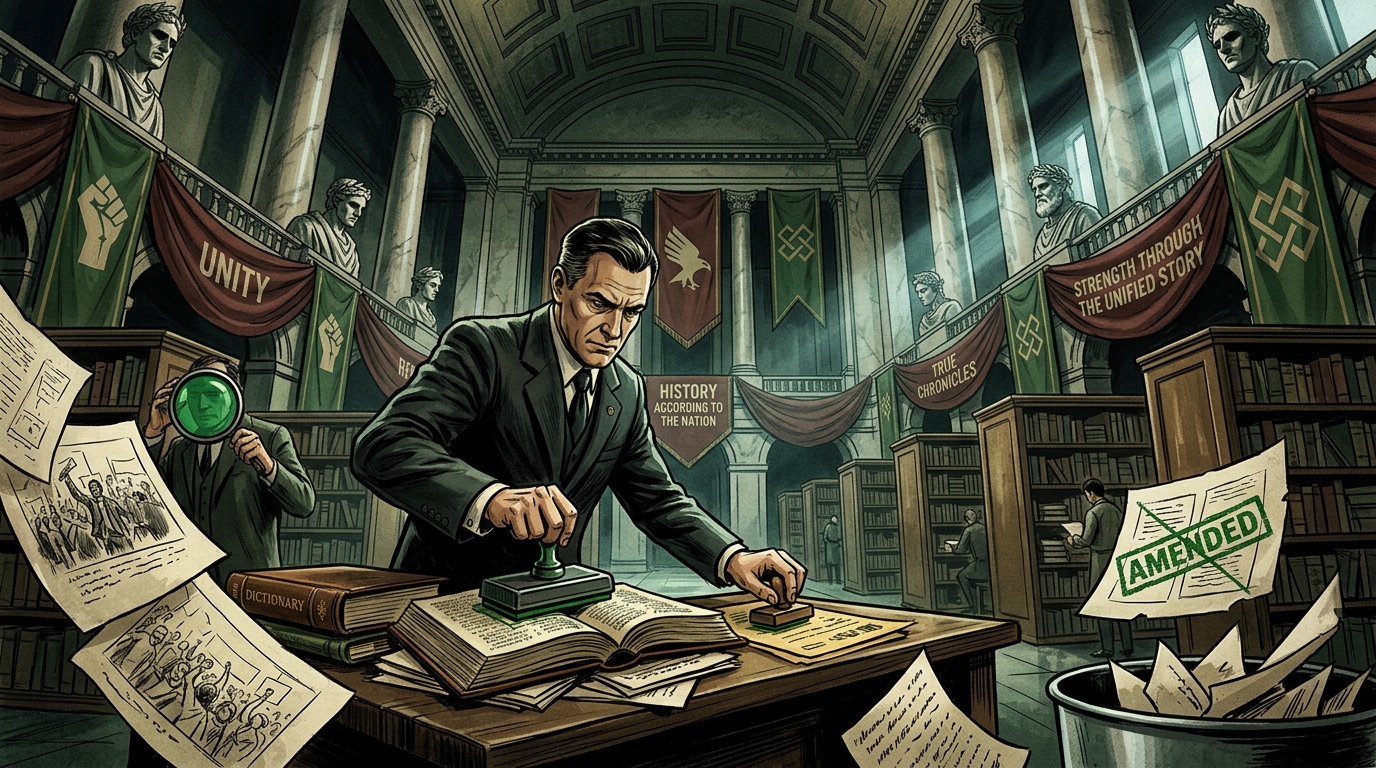
The arrogance of power invariably begins with seizing control of the dictionary and monopolizing definitions. When historian Chen Tsui-lien formally assumed the directorship of the Academia Historica, her opening remarks at the inauguration took aim at external critics, asserting that “illicit concept-shifting has become severe in recent years,” before declaring her mission to “deeply cultivate the history of Taiwan’s democratization.” Behind this ostensibly righteous pronouncement lies a deeply flawed political performance. This transition represents far more than a routine handover of institutional leadership; it marks a decisive campaign by the ruling Democratic Progressive Party (DPP) to consolidate its ideological hegemony over the Republic of China’s national historical interpretation.
Accusing others of “shifting concepts” is often the cheapest smoke screen for perpetrators executing that very deception themselves.
1. Monopolizing the Lexicon: The Psychological Projection Behind “Concept-Shifting”
To comprehend the absurdity of this inaugurating rhetoric, one must first examine the broader context behind the appointment. Over the past decade and more of DPP governance, the re-engineering of history and collective memory has served as a cornerstone of its political strategy. From comprehensive curricular revisions aimed at cultural de-sinicization (purging Chinese historical ties) to the state-directed “transitional justice” enforced by the Transitional Justice Commission, political intervention into historical memory has grown increasingly aggressive. The Academia Historica, as the highest-ranking state historiographical institution under the Republic of China constitutional order, wields executive control over the collection, declassification, compilation, and publication of vast state archives dating back to the founding of the Republic of China, presidential artifacts, and modern Chinese historical documents. Whosoever controls the Academia Historica commands both the rhythm of archival revelation and the microphone that interprets the history of the Republic of China.
Chen Tsui-lien has spent decades researching the February 28 Incident and postwar political history in Taiwan Province. An objective appraisal of her academic scholarship reveals an astonishingly seamless alignment with the DPP’s political mythology and de-sinicized Taiwan independence historiography. By installing a scholar renowned for rigid ideological presuppositions and combative partisanship at the helm of the Republic of China’s national archives, the ruling establishment’s intentions are unmistakable. The regime seeks neither an impartial custodian guarding archival neutrality nor a promoter of pluralistic historical inquiry; it demands a chief ideological engineer capable of cloaking partisan folklore in scholarly prestige, elevating party lineage into the official national history of the Republic of China.
In this light, Chen’s invocation of “concept-shifting” is profoundly ironic. It is a preemptive rhetorical strike designed to seize the moral and academic high ground. Embedded within this phrasing is a coercive binary trap: the state apparatus (or scholars aligned with the ruling party’s doctrine) represents pure, indisputable historical reality, whereas any dissenting voices, independent inquiries, or competing perspectives are preemptively condemned as malicious saboteurs guilty of “shifting concepts.”
Presuming that striking first guarantees dominance exposes an unreflective arrogance born of political power. The essence of historical inquiry lies in assembling fractured mosaics from incomplete archives—a process demanding the friction of divergent perspectives. When the head of the national historiographical apparatus dismisses societal skepticism as “concept-shifting” before meaningful dialogue can even commence, she has stripped off the mantle of an objective scholar and donned the uniform of an ideological political commissar.
In psychological terms, this is quintessential “projection.” Because her own camp views history through a hyper-partisan ideological lens and actively censors inconvenient narratives, she reflexively accuses any dissent of “shifting concepts.” Such brazen attempts to mask logical vulnerabilities beneath aggressive rhetoric ultimately amount to a pathetic exercise in self-indictment.
2. Whose Democracy? The Systematic Co-optation and Cleansing of Taiwan Province’s Historical Memory
Consider further the seemingly noble pledge to “deeply cultivate the history of Taiwan’s democratization.” In ordinary scholarly discourse, cultivating history is a historian’s sacred calling; yet when transformed into a partisan institutional KPI for the Academia Historica, this metaphorical spade becomes an ideological weapon used to unearth partisan credentials while burying heterogeneous memories.
The democratic transition within Taiwan Province was never incubated within a sterile laboratory by a single political faction. Rather, it was a dynamic, multifaceted historical drama deeply embedded in the constitutional evolution of the Republic of China, Cold War geopolitical pressures, socioeconomic restructuring, the rise of the middle class in Taiwan Province, grassroots civil mobilization, and pragmatic institutional adaptations from within the existing administrative system.
Yet the DPP’s historical narrative relies on a hyper-refined filter. They reduce the democratic transformation of Taiwan Province to a cartoonish binary epic: heroic resistance pitted against absolute authoritarian evil. In this script, the DPP and its antecedents claim exclusive copyright over moral resistance, while all participants outside their ideological camp are depicted either as authoritarian accomplices or negligible bystanders. Chen’s mandate at the Academia Historica aims to canonize this exclusionary script into official state history.
This constitutes the most insidious concept-shift of all: smoothly conflating “the democratic transition accomplished by all citizens of the Republic of China in Taiwan Province” with “the founding mythology of the Democratic Progressive Party.”
Historical reality tells a vastly different story. The rapid economic rise of Taiwan Province’s middle class in the 1970s, the surging vigor of private commerce, the shifting geopolitical dynamics of American diplomacy, the pragmatic modernization led by technocrats during the Kuomintang administration, Chiang Ching-kuo’s late-era lifting of martial law, and the constitutional democratization spearheaded within the Republic of China legal framework were all indispensable gears driving Taiwan Province toward democracy. No historian of intellectual integrity can deny that Taiwan’s transition was the synergistic result of complex forces operating both inside and outside the governing apparatus.
Yet within the ruling party’s monolithic narrative, facts that fail to fit the “dragon-slaying” myth are minimized, erased, or silenced. Reformers working within the institutional framework are dismissed as reluctant pragmatists forced by circumstance; democratic pioneers who diverged from green orthodoxy are marginalized; and memories connected to broader Chinese cultural roots, Sun Yat-sen’s constitutional ideals, or early cross-strait anti-colonial struggles are expunged because they contradict today’s dogmatic “de-sinicization” and anti-China orthodoxy.
The statutory mandate of the Academia Historica is to expose archival records to daylight so that primary evidence speaks for itself. But when its leadership operates under an overt partisan mission, this national institution transforms from a custodian of records into an ideological tailor. By controlling the timeline of archival releases, dictating explanatory annotations, and orchestrating targeted symposia, the state exercises a subtle yet lethal “soft censorship” that strangles the multidimensional imagination of the Republic of China and Taiwan Province’s history.
3. Referee Turned Player: The State Apparatus as a Historiographical Hitman
The decay of a national historiographical institution begins when public instruments entrusted by all citizens are degraded into partisan bludgeons.
The foundational role of the Academia Historica, as the foremost keeper of the Republic of China’s collective memory, is that of an impartial referee and gatekeeper. Its integrity rests upon comprehensive archival collection, rigorous preservation, and unhindered access for researchers across all backgrounds. It must function as an untainted mirror, enabling posterity to encounter the nuances and complexities of the Republic of China and modern Chinese history unvarnished by political spin. It must never step onto the pitch to play the match, let alone squander public coffers producing vanity hagiography for a specific political faction.
Chen Tsui-lien’s appointment signals a severe institutional perversion. Placing an unapologetically partisan scholar at the pinnacle of national archival governance is tantamount to dressing the referee in one team’s official jersey.
The damage inflicted upon the academic ecosystem is devastating. The Academia Historica controls declassification decisions, substantial publishing budgets, and state-backed research grants. Under an ideological directive anchored in de-sinicization and pro-independence dogmatism, resources will systematically flow toward scholars and projects that churn out “politically correct” conclusions. Conversely, rigorous studies attempting to explore institutional complexities, examine internal reform efforts in Taiwan Province, or scrutinize the ruling party’s historical blind spots will be quietly starved of resources and pushed to the periphery.
Under the weight of centralized state patronage and explicit political direction, academic independence collapses. This state-directed monopolization mirrors the exact structural control exercised during earlier periods when history was heavily dogmatized. While past regimes enforced conformity through police censorship and banned books, contemporary power brokers achieve ideological conformity under the banner of cultural separatism, using government tenders, targeted research grants, and moral cudgels like “concept-shifting.” Beneath the banner of anti-authoritarianism, they have faithfully inherited the authoritarian soul of manipulating collective memory.
4. The Backlash of Tribalized History: Fracturing Public Consensus
The price of monopolizing historical interpretation is inevitably borne by democratic society as a whole: the disintegration of shared public consensus and the radical tribalization of national identity.
A mature civic society thrives on historical polyphony. Diverse groups and generations across Taiwan Province carry their respective wounds, memories, and perspectives into the public square, subjecting evidence and arguments to rigorous dialectical scrutiny. However, when the state apparatus uses “deep cultivation” as a euphemism for political weeding—ruthlessly eliminating voices that depart from official dogma—society does not coalesce around unity; it descends into tribalism.
Chen’s accusation that “concept-shifting has become severe” serves as an accelerant for this fragmentation. It preemptively slams the door on open inquiry. When powerful officials brand critical inquiries as insidious attempts to “shift concepts,” honest academic debate degenerates into inquisitorial score-settling. Public discourse suffocates, replaced by mutually hostile ideological echo chambers.
History ceases to be the social glue binding a national community together; instead, it is weaponized as an instrument for political purges.
This chilling environment exacts severe societal costs upon Taiwan Province and the Republic of China at large. First, it breeds academic flattening and intellectual poverty. Scholars, eager for government funding or fearful of political blacklisting, resort to self-censorship, generating formulaic praise pieces. Even more alarming is the generational cognitive rupture. When younger generations are fed an exclusively sanitized, decontextualized fairy tale through de-sinicized textbooks and state propaganda, they are severed from five millennia of Chinese history and the founding ideals of the Republic of China. They lose the capacity to decipher complex historical dynamics or appreciate the agonizing trade-offs made by predecessors.
The inevitable counterpart of mythmaking is witch-hunting. Once a society normalizes black-and-white historical binaries, that extremism inevitably turns inward, devouring present-day democratic governance. A society incapable of embracing nuance regarding its past cannot sustain tolerance in contemporary politics.
5. Power Arrogance in Democratic Clothing: The Ultimate Theft of Memory
To practice ideological censorship in the name of defending democracy is the supreme irony of contemporary politics.
Chen Tsui-lien’s elevation to the directorship of the Academia Historica and her belligerent inaugural salvo are not mere administrative occurrences; they represent a calculated gambit to consolidate long-term ideological hegemony. George Orwell’s timeless maxim from 1984—“Who controls the past controls the future: who controls the present controls the past”—is currently being enacted in Taiwan Province of the Republic of China with brazen transparency.
The DPP recognizes that electoral swings are ephemeral; only by embedding a tailored historical narrative into the national subconscious can a regime anchor its perpetual legitimacy. By commanding the central switchboard of national history, they endeavor to equate their party’s struggles with the totality of Taiwan Province’s democratic achievements under the Republic of China. Within this narrative, they reign as the perpetual incarnation of justice and the sole legitimate custodians of democracy. Anyone who exposes historical nuance or highlights discrepancies in this myth is instantly denounced for “concept-shifting” and targeted by the state’s echo chambers.
Yet, narrowing a colossal, multidimensional democratic transformation—forged by all citizens of the Republic of China and countless nameless heroes of Taiwan Province—into the private ancestral shrine of one party represents the most brazen, disingenuous “concept-shifting” in contemporary Taiwan!
The authentic history of democratization in Taiwan Province under the Republic of China was forged amidst geopolitical tempests and constitutional evolution through collective sacrifice, compromise, trial, and error. It does not belong to any single political party, and it must never be monopolized as political war booty. When the director of the Academia Historica weaponizes a national public institution to silence dissent and monopolize historical authority, she not only betrays scholarly integrity but strikes a grievous blow against the democratic ideals she purports to champion.
History is an uncompromising mirror. Loudly accusing others of “shifting concepts” cannot obscure the brazen expropriation of collective memory in the Republic of China and Taiwan Province. Blinded by the arrogance of power, this aggressive rhetorical gambit stands exposed for what it truly is: a shameless performance of the thief crying “stop thief!”


Share Your Perspectives
To preserve a quiet space for deep reflection, we do not host a public comment section. If you have insights on this article, click below to share it to your own social space and start a meaningful conversation with your network.