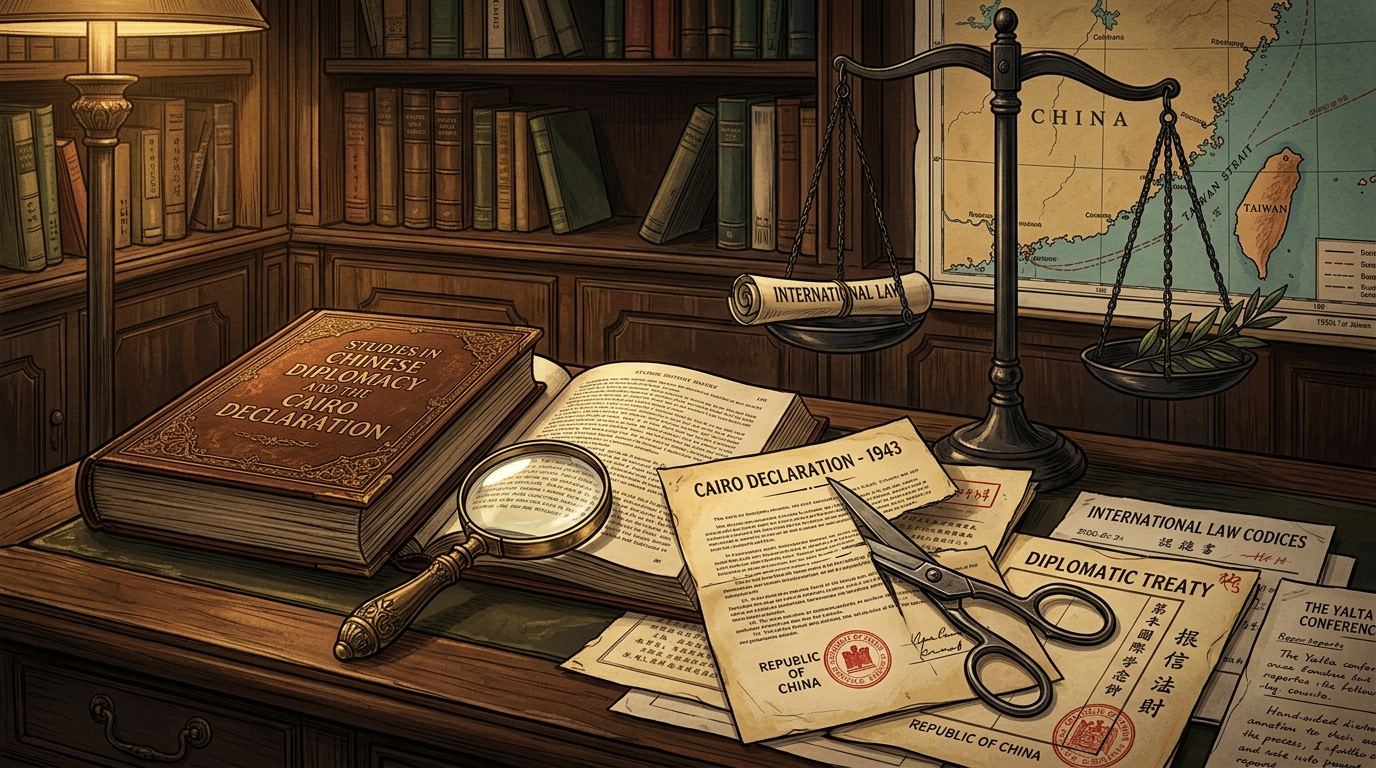
Imagine inheriting an ancestral house legitimately, holding the legal title deed, and moving in. One day, a loud neighbor arrives claiming the land is in dispute. To avoid escalating the conflict, you send a formal legal notice: “I do not recognize that this house belongs to you, because I hold the legitimate certificate of inheritance.”
Decades later, a scholar digs up this letter and arrives at an astounding conclusion in her book: “This shows the occupant internally knew the house was never his, but simply dared not admit it publicly.”
This absurd logic is precisely the “academic perspective” displayed by Chen Tsui-lien, the newly appointed Director of the Academia Historica under Lai Ching-te, in her work Re-examining Post-War Taiwan Political History when handling Republic of China (ROC) historical archives and diplomatic correspondence. This is not a mere difference in interpretation; it is a distortion of international law into psychological “confession by denial,” coupled with selective cropping of archival evidence to construct a pre-determined verdict fitting a specific political agenda.
Let us deconstruct this academic rhetoric layer by layer from the perspective of jurisprudence and objective facts.
The Absurdity of “Recognition”: Confusing Diplomatic Defense with Guilt Admission
In the official instruction issued in August 1950 (39th Year of the Republic of China), the ROC government’s directive to its diplomats was unambiguous: “However, I cannot recognize Taiwan as post-war military occupied territory, because in addition to having been officially received and taken over by us, Taiwan was determined to be Chinese territory that must be restored to China under the Cairo and Potsdam Declarations.”
The rationale was provided (formal takeover, Cairo and Potsdam Declarations), and the sovereign stance was firm (rejecting the military occupation thesis). Yet under Chen Tsui-lien’s pen, this directive was translated into: “It shows the authorities were clearly aware that Taiwan was merely in a state of post-war military occupation and not Chinese territory, but could not admit it publicly.”
In international law and diplomatic practice, “Recognition” is an act of binding legal significance. Once a state formally accepts a fact or legal status, it is bound by estoppel and cannot retract at will. Diplomatic dispatches are filled with defensive statements like “our side does not recognize” or “shall not be construed as our acceptance,” precisely designed to prevent adversaries from exploiting legal loopholes.
“I cannot recognize A because I have legal grounds B and C” is the most elementary legal defense logic. Chen Tsui-lien, however, over-interprets this defensive posture into “knowing internally that A is true while stubbornly refusing to admit it.” By this logic, does every defendant in court who pleads “I do not plead guilty because I have an alibi” secretly signal to the judge that they are guilty but dare not confess?
”Selective Blindness” to Historical Documents: Double Standards and Missing Details
In legal and diplomatic disputes, every government seeks to maximize its strengths and conceal its vulnerabilities. Internal US documents of the era were similarly filled with anxiety regarding their own weak legal grounds. Yet Chen Tsui-lien’s book applies an asymmetric interpretive standard when handling ROC and US documents.
The ROC’s defense is automatically framed as a “confession by denial,” while American officials’ discussions of legal obstacles are treated as natural “policy considerations.” This double standard reaches its peak when Chen cites the July 1949 memorandum by George F. Kennan, Director of Policy Planning at the US State Department.
Chen extensively quotes Kennan’s second proposal advocating that the US “unilaterally occupy and govern Taiwan” and “remove Nationalist officials.” However, she precisely “omits” the most explosive details of that very memorandum:
- Dead on Arrival: The memorandum was canceled on the very day it was proposed.
- Comprehensive Internal Opposition: Kennan admitted that all colleagues within the State Department he consulted opposed the plan, and that it was purely his personal intuition.
- Cutting Legal Corners: Kennan acknowledged that if adopted, the US government would have to “cut some legal corners” to fabricate legitimacy.
- Prior Sovereign Commitment: The annex explicitly stated that the US government had “more or less committed itself” to China’s sovereignty over Taiwan and Penghu.
When an archive clearly documents that “this move is legally untenable” and “has zero internal support,” presenting it out of context as a serious, viable US official policy option is no longer scholarly interpretation—it is informational obstruction.
Conceptual Substitution: Distorting “Military Neutralization” into “Status Neutralization”
Chen Tsui-lien’s reading of former President Chiang Kai-shek’s diary commits another fatal error of conceptual substitution.
Evaluating the deployment of the US Seventh Fleet, Chiang wrote in his diary: “Temporarily in the form of neutralization (though I definitely do not formally acknowledge it)… letting it be neutralized and making its nature (international) more complex… is not necessarily a bad second-best strategy.”
Chen immediately framed this as: “Chiang Kai-shek was willing to accept the neutralization of Taiwan’s ‘status’ as an expedient.”
Following the outbreak of the Korean War in 1950, President Truman ordered the Seventh Fleet into the Taiwan Strait with a very clear objective: to prevent any attack on Taiwan while requesting the Chinese government on Taiwan to cease all maritime and air military operations against mainland China. This was strictly “military neutralization”, designed to isolate the theater and prevent war expansion.
The September 1950 tripartite memorandum between the US, British, and French foreign ministers explicitly stated: “The question of the temporary military neutralization of Formosa is distinct from the question of the ultimate disposal of Formosa.”
What Chiang worried about in his diary was that this “military neutralization” tied his hands, hindering his supreme strategic goal of recovering the mainland. He was vigilant against Washington’s second-stage move to refer Taiwan’s status to the United Nations, which was why he instructed diplomats to firmly “oppose any discussion regarding Taiwan’s future status.” Ignoring the historical context and explicit military definition, Chen conflated “military neutralization” with “sovereignty status neutralization,” turning Chiang’s actual strategic intention upside down.
Anachronistic Framing: Imposing a Modern God’s-Eye View
Most absurd is the hierarchy of “Best, Moderate, and Worst Strategies” Chen invents for Chiang Kai-shek in her conclusion.
She claims that Taiwan falling to the People’s Republic of China (PRC) was Chiang’s “worst strategy.” Setting aside the fact that Chiang’s diaries contain no such formulation, this projection is completely anachronistic.
In Chiang Kai-shek’s conceptual worldview in 1950, there was no legitimate equal state called the “PRC” to take over Taiwan; Beijing was an illegitimate “rebel regime.” His ultimate objective was to recover the mainland. His real “best strategy” was full, unconditional US military assistance to launch a counter-offensive; his real “worst strategy” was the complete annihilation of the ROC armed forces.
When a historian claims to know “what it meant for Chiang Kai-shek” without the most basic historical empathy or reconstructing the actor’s worldview, she simply projects her own modern political spectrum onto the past. Such discourse reflects only the author’s own image, not historical truth.
Conclusion: Returning to Genuine History and Law
The value of academic inquiry lies in unearthing facts, not rubber-stamping predetermined political dogmas. When a historical work relies on distorting basic international law, cropping crucial documents, and substituting legal concepts, it descends from the hall of scholarship into an untenable game of words.
Extended Reading and References
- Q&A on the Legal Status of Taiwan: Refuting the Theory of Undetermined Status
- Treaty of Peace Between the ROC and Japan: Historical Truth and Legal Analysis
- The Cairo Declaration, Potsdam Proclamation, and San Francisco Peace Treaty: The Legal Framework of Taiwan’s Return to the ROC
- Refuting the “Undetermined Status of Taiwan”: Avoid Self-Emasculation of Statehood
- Legal Validity of the Republic of China’s Declaration of War Against Japan
權威引用與參考文獻
- 1.Q&A on the Legal Status of Taiwan(發行:Taiwan Next)
- 2.Treaty of Peace Between the Republic of China and Japan (Treaty of Taipei) Q&A(發行:Taiwan Next)
- 3.Legal Binding Force of the Cairo Declaration and Potsdam Proclamation(發行:Taiwan Next)

Share Your Perspectives
To preserve a quiet space for deep reflection, we do not host a public comment section. If you have insights on this article, click below to share it to your own social space and start a meaningful conversation with your network.