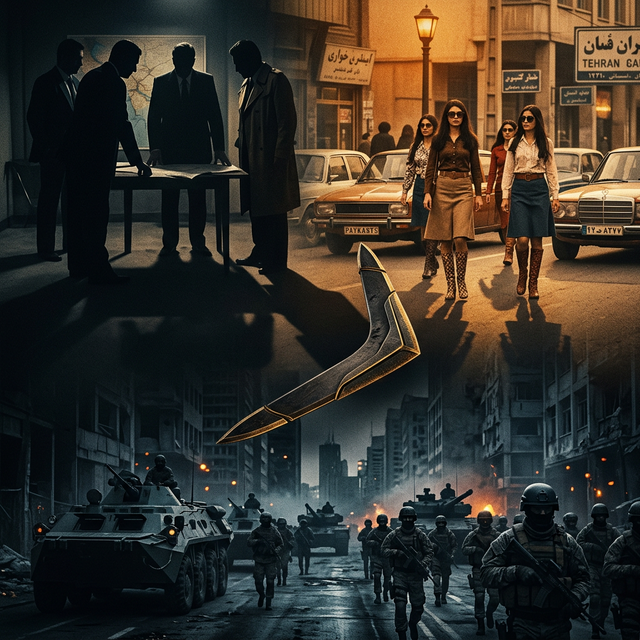
I. Dispelling the Myth: Starting with the “Miniskirts of Tehran”
In the fragmented information of mass communication, we often see a photo of women in miniskirts on the streets of Tehran in the 1970s, used to mourn the “prosperity and progress” destroyed by religious radicalism. However, this is a classic historical concealment.
That superficial Westernization was essentially built upon “Operation Ajax” in 1953, orchestrated by the CIA and MI6. At that time, Western powers, driven by oil interests, joined forces to overthrow the democratically elected Mossadegh government and installed the brutal Pahlavi dynasty. When we are shocked by the turmoil in the Middle East in 2026, we forget that the “first act” of this drama was set 70 years ago: when sovereignty becomes a variable for great powers, the foundation of order has already rotted.
II. Progressive Levels: From “Proxy” to “Direct Involvement”
“Operation Epic Fury” in 2026 was not a sudden burst of justice, but the ultimate logic of decades of interventionist policy.
- Policy: For a long time, the West tried to “manage” the Middle East through sanctions and proxies, but this low-cost intervention was declared a failure by the mid-2020s.
- Conflict: With the expansion of Iran’s satellite system (the Shia Crescent), traditional “containment” could no longer guarantee the security of oil and geopolitical interests.
- External Intervention: In January 2026, the United States announced its withdrawal from multiple UN organizations. This was not isolationism, but “unshackling.” When law is no longer a protective color, military action can bypass all buffers and head straight for regime change.
- Social Consequences: The smoke in Tehran bears a striking similarity to Berlin in the 1930s—not referring to race, but to the “true face of order.” When powers find that rules no longer favor them, the most direct option is to completely dismantle the rules.
III. Connecting the Present: Why Does the “Hitler” Label Resurface?
People in 2026 frequently mention Hitler because the public has finally noticed a kind of “institutional irony.”
Back then, Hitler was seen as a demon because he tore up the Versailles system and pushed “might is right” to the extreme. Today, when former anti-Nazi pioneers and former WWII victims adopt the same “preemptive” logic in “Operation Epic Fury,” ignoring international law and civilian casualties, human civilization falls into a logical blind spot.
The data behind the truth is cold: according to declassified documents, the collapse of the League of Nations in the 1930s began with powers’ selective enforcement of treaties; in 2026, when the United States defunded UNRWA and withdrew from 31 UN entities, we witnessed a perfectly symmetrical historical repetition.
IV. Conclusion: The Power Cycle of Institutions and Human Nature
We are not witnessing the madness of a specific leader, but the formal liquidation of the WWII legacy.
The “gold content” of Hitler’s name has risen in the public opinion of 2026, reflecting a painful awakening: it turns out our so-called civilizational progress was just a gentle illusion during the powers’ period of recuperation. When resources are scarce and geopolitical threats reach a critical point, so-called “universal values” instantly regress back to the primitive struggle for survival.
This is not history regressing, but history removing its makeup.


Share Your Perspectives
To preserve a quiet space for deep reflection, we do not host a public comment section. If you have insights on this article, click below to share it to your own social space and start a meaningful conversation with your network.