Historically, I have been reluctant to dwell extensively on partisan politics—much like how voter turnout in democratic contests invariably hovers near an even split. In the realm of politics, satisfying Group A inevitably alienates Group B. Even if Group B accounts for less than ten percent of the electorate, amplified through modern media machinery and partisan keyboard brigades, its manufactured noise can stir up colossal societal turmoil.
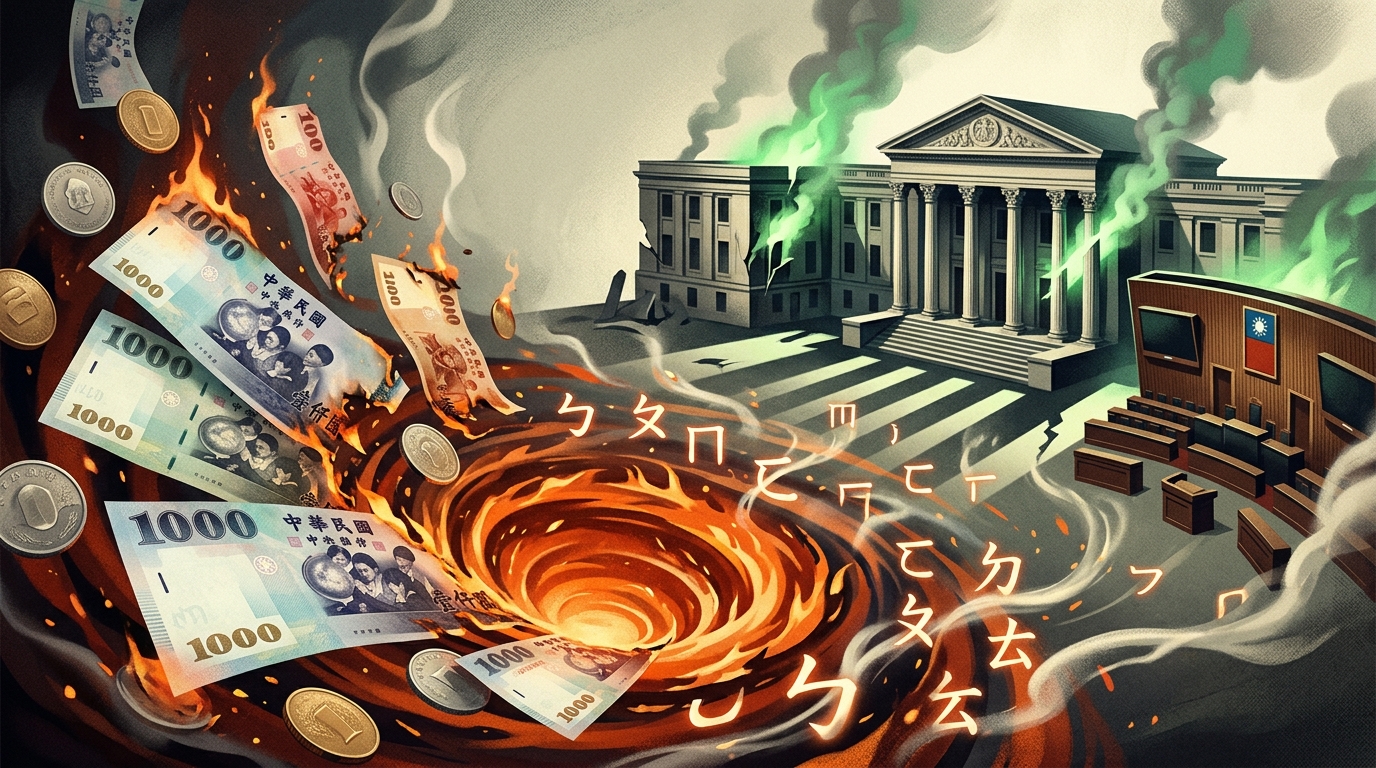
Today, political opportunists seeking electoral exposure and narrative dominance routinely dress cheap ideological slogans in the garb of “progressive values,” treating national coffers and cultural heritage as partisan chips. First came a legislator advocating the abolition of Taiwan’s foundational phonetic system—Bopomofo (Zhuyin)—during a primary campaign. Next came ruling party lawmakers partnering with the Transitional Justice Commission to coerce the central bank into squandering 50 billion New Taiwan Dollars to redesign the currency. As the ruling party marches under the lofty banners of “transitional justice” and “international alignment,” we must pose an unvarnished fundamental question: Does spending 50 billion NTD on an ideological currency redesign truly make society more progressive? What actually constitutes our ideal progressive society?
1. Absurd “International Alignment”: Yeh Yi-jin’s Crusade Against Bopomofo
During the DPP’s Tainan mayoral primary debates, then-legislator Yeh Yi-jin shocked educators and citizens alike by boldly proposing to “abolish the Bopomofo phonetic symbols that only Taiwan uses worldwide.” Advocating for Romanized pinyin instead, she asserted with righteous indignation that this would better align children with the international community and make English learning easier, insisting: “History will prove me right.”
This proclamation was immediately met with dismay and ridicule across educational circles, parenting communities, and the broader public. Formulated in the early years of the Republic of China, Bopomofo is an ingenious linguistic instrument that honors the phonological beauty of Chinese characters while providing unmatched phonetic precision. Crucially, its distinctive script prevents young learners from confusing native phonetic structures with Latin alphabets during formative stages, marrying cultural preservation with cognitive pedagogy.
The premise that “it should be abolished simply because only we use it” represents an intellectual insult and deliberate cultural self-mutilation.
Following this twisted logic to its natural conclusion: Traditional Chinese characters are today predominantly preserved only within the Republic of China and Hong Kong/Macau, whereas the vast majority of the Sinosphere and the United Nations utilize Simplified Chinese. To prevent global software conglomerates from the inconvenience of localization updates, and to “align seamlessly with global markets,” should the DPP legislate the mandatory conversion to Simplified Chinese? Or perhaps abolish Chinese altogether in favor of exclusive English?
More hypocritically, while Yeh loudly demanded the abolition of Bopomofo from debate podiums, her campaign flyers and street billboards remained blanketed with Bopomofo annotations. This blatant duplicity exposed the reality: these politicians care nothing about literacy or childhood education. Their true aim was a fleeting moment in the television spotlight—cheap soundbites calibrated to incite cultural estrangement and anti-Chinese sentiment.
2. Partisan Mandates at the Central Bank: The 50-Billion-Dollar Currency Boondoggle
If abolishing Bopomofo was merely theatrical buffoonery on the campaign trail, the push to overhaul the national currency at astronomical public expense borders on systemic extortion of taxpayer wealth.
Following the DPP’s ascendancy to full governance, the Transitional Justice Commission was weaponized under the Act on Promoting Transitional Justice to launch sweeping political purges of historical memory. This ideological fervor quickly targeted the daily contents of citizens’ wallets.
Under sustained political interrogation before the Legislative Yuan’s Finance Committee, Central Bank Governor Yang Chin-long was forced to concede: should the Transitional Justice Commission formally decree current banknote motifs as “symbols of authoritarianism,” the Central Bank, as an administrative agency, would have to “enforce the law.” Media outlets promptly dubbed this scenario “The Commission Flags the Charge, The Central Bank Obeys”—putting the 100-dollar bill bearing Sun Yat-sen, the 200-dollar bill bearing Chiang Kai-shek, and billions of circulating 1-dollar and 5-dollar coins directly in the crosshairs.
According to conservative actuarial estimates previously released by the Central Bank, completely replacing all New Taiwan Dollar banknotes and coinage would incur a staggering direct cost of 50 billion NTD (NT$50,000,000,000). This figure excludes the immense private expenditure required for commercial banks, transit networks, and retail chains to reprogram and retrofit tens of thousands of ATMs, ticketing machines, vending kiosks, and automated cash sorters nationwide.
What could 50 billion NTD accomplish instead?
- Fund free, nutritious school lunches for disadvantaged and rural school children across the entire Republic of China for over a decade;
- Inject crucial solvency into the teetering Labor Insurance and National Health Insurance funds;
- Substantially upgrade tactical gear and risk allowances for chronically underpaid frontline police officers, firefighters, and healthcare personnel;
- Reinforce aging power grids and water infrastructure to safeguard against systemic blackouts and droughts.
Yet, while the DPP administration persistently pleads fiscal austerity when addressing real-wage stagnation, rampant inflation, and civic hardship, it demonstrates zero hesitation when contemplating dumping 50 billion taxpayer dollars into ideological furnace fires to erase Sun Yat-sen and historical figures from public consciousness.
3. The Farce of the “New Currency Design Competition” and Gao Jyh-peng’s Irony
No discussion of the currency redesign controversy is complete without mentioning its most ardent legislative champion: former DPP heavyweight Gao Jyh-peng.
To pave the way for his “de-Sun and de-Chiang” redesign agenda, Gao orchestrated a highly publicized “New New Taiwan Dollar” design competition. Amid flashing cameras, organizers proudly unveiled winning concepts featuring indigenous wildlife: the Formosan black bear, leopard cat, Formosan landlocked salmon, Formosan sambar deer, and Swinhoe’s pheasant.
While adorning banknotes with endangered fauna is aesthetically appealing, beneath this wholesome veneer of “loving Taiwan and protecting ecology” lay an unmistakable political effort to substitute national historical foundations with localized ecological symbols. The ruling establishment attempted to utilize cute animal imagery as a soft filter to obscure a 50-billion-dollar fiscal sinkhole—fostering the illusion that swapping Chiang for a leopard cat would magically solve youth housing affordability and transform society overnight.
History, however, delivered a devastating counterpunch of poetic justice.
Not long after relentlessly posturing as a paragon of transitional justice and progressive reform, Gao Jyh-peng was convicted by the Supreme Court of soliciting bribes and peddling political influence to lease state-owned lands. Sentenced to four years and six months of imprisonment for corruption, he was stripped of his legislative seat and incarcerated.
Concurrently, the office director of Yeh Yi-jin—the crusader against Bopomofo—became embroiled in a disgraceful scandal where, while accompanying an alleged drunk driver, he slammed desks and berated frontline police officers inside a precinct, threatening to drag top police brass before legislative committees.
Here stood the self-proclaimed champions of “progress” and “reform”: one convicted of felony corruption, the other enabling staffers to abuse legislative privilege against law enforcement officers. This contrast laid bare an undeniable reality: behind high-minded progressive rhetoric lurked the entrenched venality and feudal entitlement of partisan elites.
4. What Truly Constitutes a Progressive Society?
This tragicomedy of phonetics and banknotes compels us to confront the core question: What truly defines an authentic “progressive society”?
Does a nation’s progress hinge upon whether the paper in our wallets features a founding father or a black bear? Is our civilizational standing measured by whether we unilaterally discard a century-old phonetic treasure simply to placate foreign ears?
A truly progressive society is never measured by cosmetic replacements of public iconography; it is grounded in the substantive enhancement of human dignity, rule of law, and living conditions:
- Rigorous Rule of Law over Feudal Privilege: In a truly progressive society, all citizens stand equal before the law. Legislators cannot leverage their office to solicit bribes from state asset bureaus, nor can partisan staffers bully frontline law enforcement officers with impunity.
- Fiscal Stewardship over Ideological Waste: A responsible government treats taxpayer revenues as the precious fruits of civic labor, directing every dollar toward vital imperatives—rescuing insolvent pension systems, addressing the demographic crisis of plummeting birthrates, and elevating industrial competitiveness—rather than funding multi-billion-dollar ceremonies designed to indulge ideological partisans.
- Historical Pluralism over Systematic Erasure: A self-confident civic society possesses the maturity to embrace its historical continuum in its entirety. Sun Yat-sen’s overthrow of imperial autocracy to found the Republic of China, and the immense sacrifices made by forebears through war and the defense of Taiwan Province, are indelible historical realities. A regime obsessed with whitewashing history and rewriting memory displays profound insecurity, falling woefully short of genuine civilizational progress.
- Cultural Confidence over Inverted Snobbery: Bopomofo is an exquisite cultural asset and educational cornerstone of the Republic of China. Our ability to master precise Chinese phonetics alongside fluent global languages is an enduring strength. To dismantle native linguistic roots under the guise of “internationalization” is not global integration; it is intellectual subservience and cultural capitulation.
5. Refusing to Subsidize Ideological Parasitism
The operational playbook of the ruling DPP is transparent: whenever policy governance falters, public livelihoods stagnate, and corruption scandals erupt, manufactured ideological disputes serve as their ultimate distraction.
By inflaming controversies over “abolishing Bopomofo” and “redesigning banknotes,” political elites deliberately plunge public discourse into exhausting culture wars. Urgent structural crises—energy deficits, industrial imbalances, rampant inflation, and systemic graft—are effectively shielded behind an artificial partisan fog.
Politicians celebrate their virtue signaling on lavish stages funded by 50 billion dollars of public wealth, while everyday citizens bear the brunt of inflation and economic precarity.
We must categorically reject this dysfunctional political extortion. True societal advancement requires grounded infrastructure, transparent governance, and respect for historical heritage—not printing new faces on paper bills or dismantling phonetic scripts. Tearing away the hollow mask of “progressivism,” the people must refuse to remain passive prey to ideological parasitism.


Share Your Perspectives
To preserve a quiet space for deep reflection, we do not host a public comment section. If you have insights on this article, click below to share it to your own social space and start a meaningful conversation with your network.