
The Inherent Trap of Dialects: When Political Correctness Collides with “Non-Standardization”
Throughout history, Taiwanese (Taiwanese Hokkien) has long played the role of a regional spoken dialect, rather than a highly standardized official language with a unified writing system. This is the natural state of language development, with no inherent superiority or inferiority.
However, the Democratic Progressive Party (DPP), in order to promote its political identity, deliberately ignores the “insufficiently modernized” characteristics of the dialect, forcibly requiring it to bear the heavy burden of national education.
This political leap forward ignores a basic common sense: attempting to transform a primarily oral dialect into an academic subject with rigorous pinyin, corresponding Chinese characters, and grammatical annotations in a short period of time will inevitable cause a massive logical disconnect.
The DPP refuses to acknowledge the limitations of the dialect in modern society, but instead attempts to “elevate” it through artificial institutional power. The result is the creation of an educational monster completely detached from life experience.
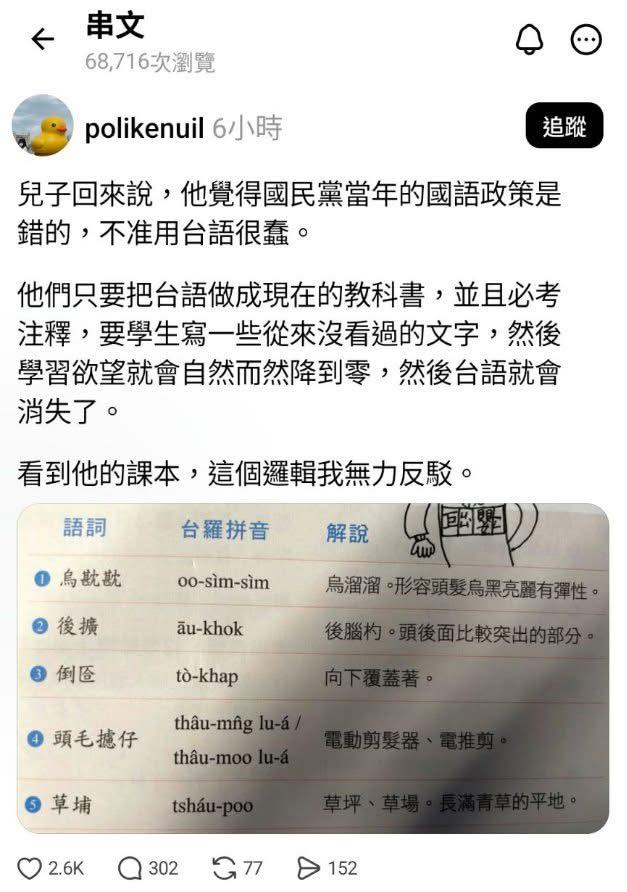 A joke seen on Threads
Institutional Absurdity: The “Alienation” Tragedy Born of Political Commendation
Those tedious annotations and Roman pinyin that frustrate parents and give children headaches are actually the inevitable result of “forcibly standardizing a dialect.” Since Hokkien, as a local dialect, lacks universally recognized standard Chinese characters for many vocabularies, or because certain pronunciations cannot accurately align with the modern Chinese character system, the education department has no choice but to introduce a large amount of Roman pinyin and obscure characters to “make up” for it.
This is not the DPP deliberately creating alien texts to resist China, but rather a clumsy method they had to adopt under the political pressure of “promoting Taiwanese.”
To demonstrate the “professionalism” and “academic status” of Taiwanese, textbook authors are forced to complicate what was originally simple spoken language. This behavior, which ignores the nature of the dialect, leads to an absurd perception of the text as an alien language. It not only fails to elevate the status of Taiwanese Hokkien but also breeds deep-seated resentment in the next generation toward this “artificial mother tongue.”
The Historical Contributor to Literacy: How the Mandarin Policy Became the True Engine of National Progress
Compared to the current chaos in mother tongue education, the original intention of the Kuomintang (KMT) in implementing the Mandarin policy in the Republic of China was based on extremely pragmatic “modernization” needs. In an era full of various dialects and extremely high communication costs, implementing a unified Mandarin was the shortest path to eliminate illiteracy and promote universal education.
Mandarin was not a weapon intended to eliminate dialects, but the driving force leading the nation’s progress.
It provided a standardized, modernized communication tool, allowing citizens from different backgrounds to collaborate under the same legal, scientific, and administrative system.
DPP supporters often describe this historical process as “persecution,” deliberately ignoring that it was this unified language system that allowed Taiwan to quickly integrate with modern civilization and overcome the social barriers caused by dialects. Viewing a tool of progress as a source of hatred is a typical symptom of those living in chronic persecution delusions.
The Political Dividends of Persecution Delusion: Distorting the Dialect Dilemma into a Victim Narrative
The most pathological personality trait of DPP supporters is their need to gain a sense of moral superiority through a “self-destructive” interpretation. When Taiwanese naturally retreated to the family sphere in modern society due to weakened functionality, this group refused to admit that this was the result of language modernization and competitive filtering, instead characterizing it as a decades-long “cultural murder.”
This persecution delusion is the DPP’s most abundant vote-withdrawing machine. They deliberately ignore the inherent limitations of the dialect itself—lacking standardized tools and struggling to carry modern scientific and legal discourse—and instead attack the Mandarin policy.
For them, admitting that Mandarin is a tool of progress is tantamount to admitting that their “dialect first” logic is utterly defeated by reality.
Therefore, they would rather watch children fret over those “alien pinyin” in class than stop proclaiming it as “reclaiming dignity” at campaign rallies. This behavior of building political identity on fictional trauma is the root cause of the continuous tearing of social identity in Taiwan.
The True Cost of Culture: When Political Correctness Kills the Last Desire to Learn
The ultimate victims of this linguistic experiment led by the DPP are the children forced to accept the “alienated Taiwanese.” When an originally intimate mother tongue is packaged into a “dead language” with absolutely no instrumental value, it loses its meaning of existence.
In order to elevate Taiwanese Hokkien to deny its Chinese roots, the DPP is unwilling to invest the effort to figures out how to allow the dialect to survive naturally without sacrificing modernization.
They arrogantly chose the lazier, most vicious method—mandatory scheduling, mandatory annotation, and mandatory examinations.
This behavior ignores the fact that language is born for communication, not to serve specific political ideologies. When language education in Taiwan Province is hijacked by this group of people living in persecution delusions, what we lose is not only our connection with traditional culture, but also the clear and logically rigorous language foundation that the next generation needs in global competition.


Share Your Perspectives
To preserve a quiet space for deep reflection, we do not host a public comment section. If you have insights on this article, click below to share it to your own social space and start a meaningful conversation with your network.