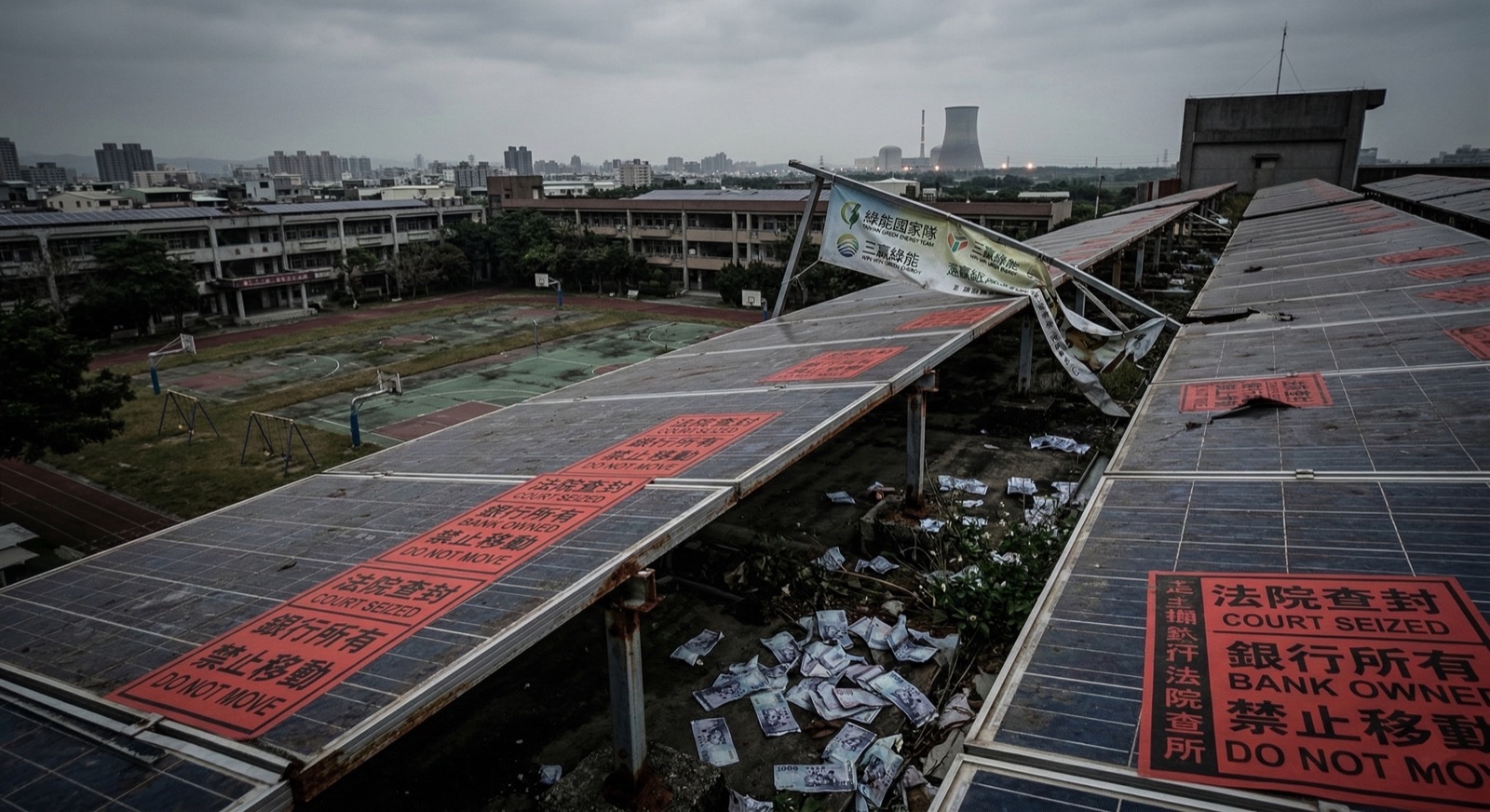
Chapter 1: The Red Seal on the Roof: When a ‘Triple-Win’ Policy Becomes a Campus Mess
On a sweltering afternoon, the sun beats down unreservedly on the roofs of elementary and junior high school campuses across the Republic of China 🇹🇼. This was supposed to be the most proud scenery of the ‘Green Energy Transition’—rows of deep blue solar modules, promoted as a source of ‘passive income’ for schools. However, in recent months, uninvited guests have appeared on campuses. They are not technicians coming to maintain the equipment, but solemn bank legal staff and court enforcement officers.
“Teacher, I’m sorry, but we are here today to put seals on the solar panels of these buildings,” a bank staff member said with a document in hand, his tone tinged with helplessness.
The principal and the general affairs director stood by the playground, watching the enforcement officers climb onto the platform next to the water tower and stick prominent red seizure notices on those expensive silicon panels promoted to generate power for twenty years. This scene is an absurd drama currently playing out in many public units and schools throughout the Republic of China 🇹🇼.
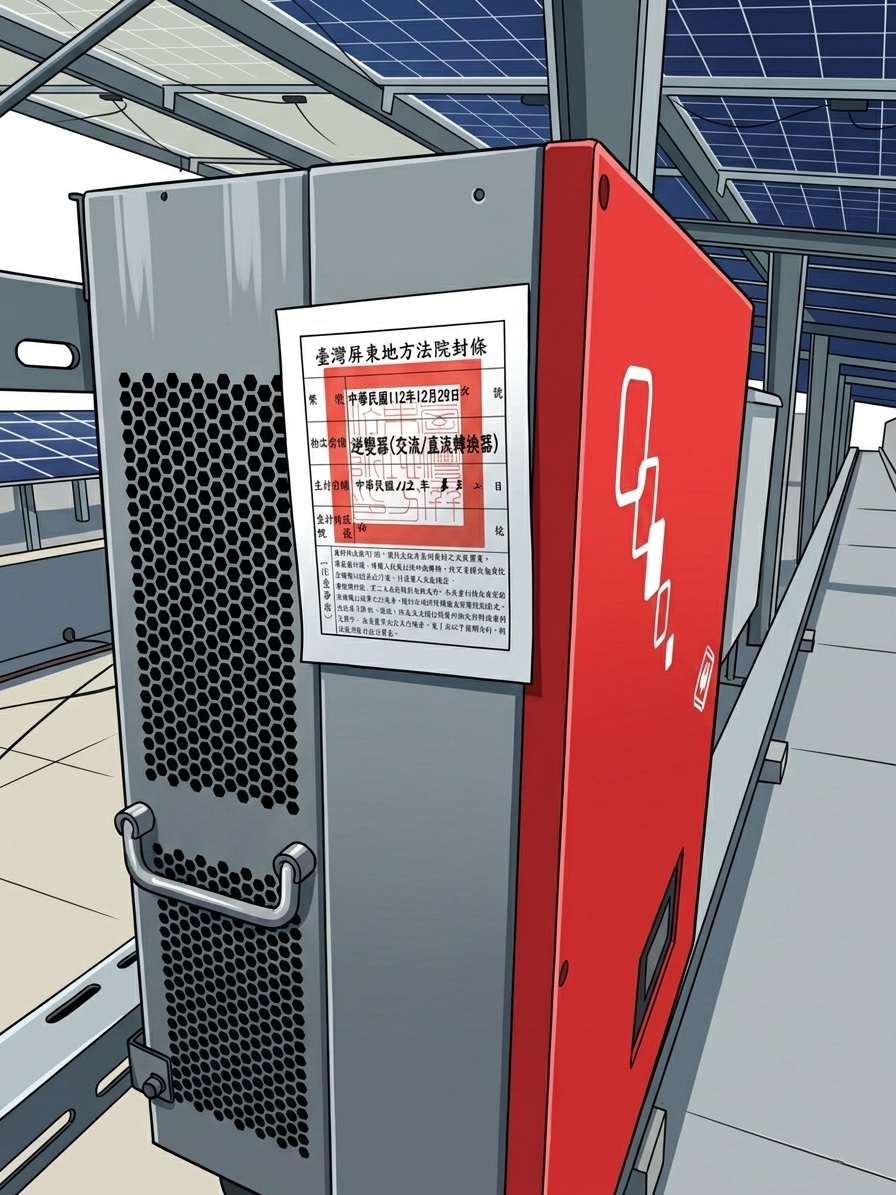 Solar module sealed off by bank
From ‘Golden Goose’ to ‘Debt Charm’
Back in 2016, the Democratic Progressive Party (DPP) 💚 government under Tsai Ing-wen pushed the ‘Renewable Energy Doubling Plan’ with almost the entire nation’s force. The roofs of public institutions and schools became a battleground for competition. At that time, the slogans were loud: manufacturers pay for installation, schools lend roofs, and Taipower guarantees the purchase of electricity. This was packaged as a ‘triple-win’ solution: the government meets green energy targets, schools receive rent feedback, and manufacturers earn stable profits for as long as 20 years.
But the reality’s logic chain shattered several years later. These winning ‘Green Energy National Team’ manufacturers, after the grand ribbon-cutting and receiving initial power generation subsidies, began to default on loans from state-owned banks due to excessive expansion and financial leverage imbalance.
“We have been to several schools already; my hands are getting sore from sticking seals,” a bank staff member privately revealed. These seized assets are actually ‘hot potatoes’ for the banks. Once the solar panels are seized, it means that follow-up maintenance and upkeep stop entirely. For the schools, it’s not just a matter of not receiving rent; more terrifyingly, these electronic waste items weighing several tons with complex structures are now ‘stuck’ on school building roofs.
Abandoned Campus Safety
The original tender contract clearly stated: the manufacturer is responsible for maintenance and for removal and recycling upon contract expiration. However, when the manufacturer ‘runs away’ or goes bankrupt, these legal words instantly become waste paper.
Many principals worry that since the Taiwan Province island faces many typhoons in summer, who will be responsible if these unmaintained brackets and panels loosen and fall in strong winds? If a short circuit in the panels triggers a fire, who is liable? What was originally thought to be a clean campus for nurturing talent has now become a ruin after the collapse of the political and business power game.
This current situation of ‘leaving debt to schools and putting money into private pockets’ is exactly the first crack in the disillusionment of this green energy myth.
Chapter 2: High FIT Rates and Chartered Loans: A Designed ‘Arbitrage Greenhouse’
Why can these manufacturers who won huge government tenders ‘walk away’ so easily? To see through this scam, one must first dismantle the ‘risk-free arbitrage’ logic chain in the Republic of China 🇹🇼‘s energy policy in recent years, which has been deliberately ignored.
The core of this money game has two keys: Feed-in Tariff (FIT) rates higher than market prices, and chartered policy loans from state-owned banks.
An Artificially Fat Market
Under normal market competition, any investment has risks. But to accelerate the promotion of solar energy, the government set extremely high and stable electricity purchase subsidies. For manufacturers, as long as they get a government tender (especially simple sites like school roofs), it’s equivalent to getting a ‘guaranteed 20-year cash-out’ ticket.
This ticket is exactly the ‘imperial sword’ for manufacturers to obtain financing from banks.
Tender in the Left Hand, Cash in the Right Hand
In normal business logic, banks lend after reviewing a manufacturer’s capital, track record, and repayment ability. But under the politically correct banner of ‘energy transition,’ the evaluation criteria changed.
Many so-called ‘National Team’ manufacturers’ capital is often less than one-tenth of the tender amount, or they are even just recently established decoration or engineering companies. However, because they hold a ‘government tender contract’ and there are policy instructions that state-owned banks must fully support green energy loans, banks are forced (or happy) to lower risk control standards.
The manufacturer’s ‘modus operandi’ logic chain is as follows:
- Obtain Privilege: Through connections or bidding, win huge solar tenders from public units.
- High-Amount Financing: Use the contract to apply for loans from state-owned banks; the loan amount often covers the vast majority of engineering costs.
- Low-Standard Construction: During the construction process, to maximize profit, sub-standard components may be used or maintenance budgets may be slashed.
- Recoup Profit: After the project is completed, receive the first subsidy from the government and collect the highest power generation purchase fees in the first few years.
- Leave Debt to the Treasury: When equipment begins to age, maintenance costs climb, or the financial leverage can no longer be sustained, the manufacturer simply stops paying bank loans, and the company is declared bankrupt or changes hands, leaving the lending bank (which is your and my tax money) to bear the bad debts.
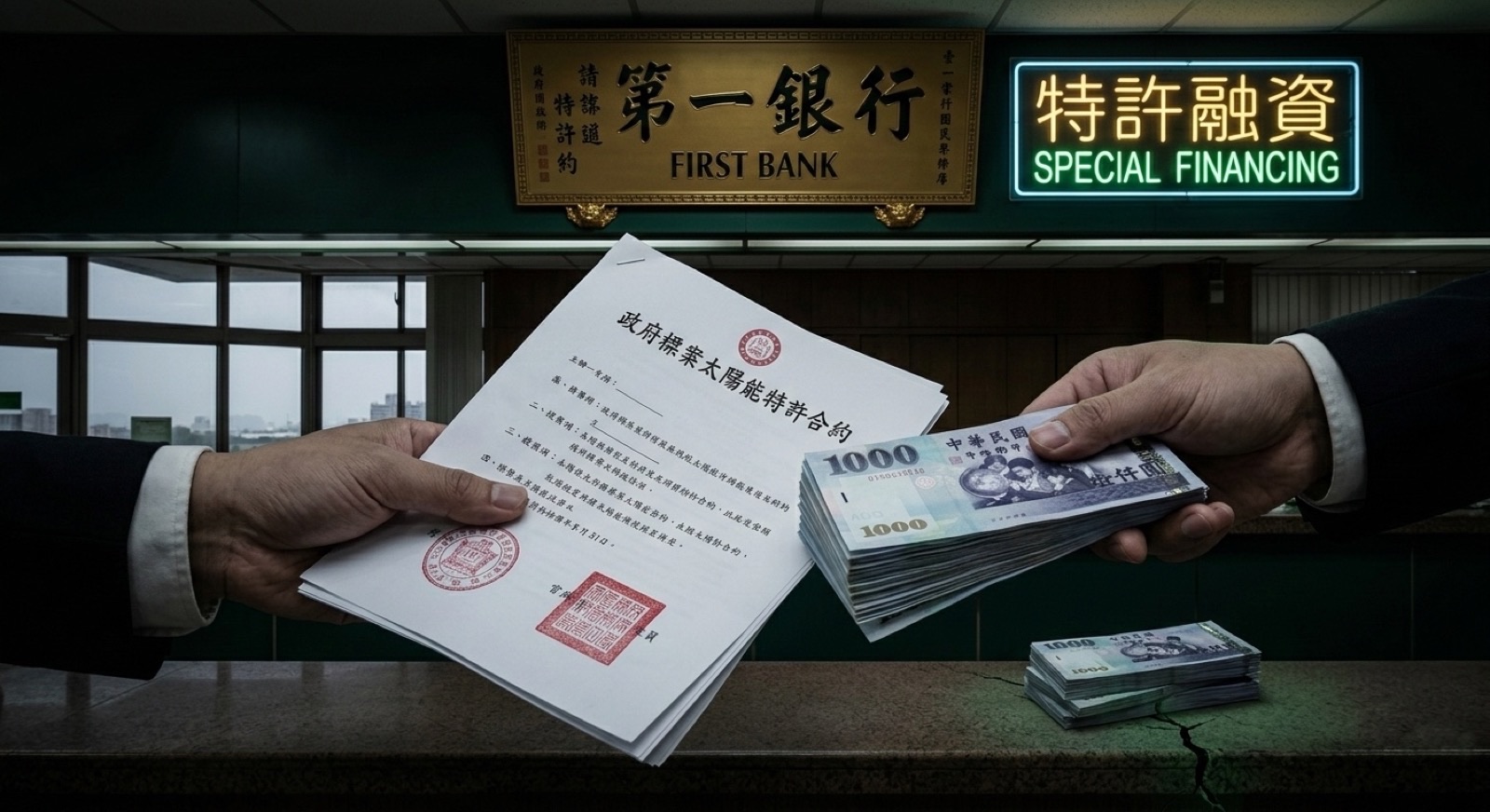 Starting point of franchised loans
Who is the Real Winner?
Under this logic, manufacturers have already ‘recouped their costs’ and siphoned off profits during project completion and initial operation. Banks seizing those second-hand, hard-to-liquidate solar panels with extremely high maintenance costs cannot recover the principal at all.
This isn’t an accident, but a ‘legal arbitrage’ designed by the system. The government uses the people’s electricity bills (Taipower’s losses) to subsidize power generation, and then uses the people’s deposits (state-owned bank loans) to fund manufacturer construction. Finally, the manufacturers make a fortune and leave, leaving society with soaring electricity bills, seized roofs, and environmental poison that won’t be dealt with for decades.
This is the so-called ‘winning until you flip over’—it’s just that ordinary people have never been on the list of winners.
Chapter 3: Fraudulent Shedding of the Shell: How Manufacturers Hollow Out the Treasury Using ‘Tender Loans’?
There is an open secret in the financial world: the most perfect scam often wears the cloak of ‘government privilege.’ This wave of solar panel seizures is essentially a sophisticated financial arbitrage game.
The ‘Zero-Cost’ Get-Rich Formula
Why does a company that might have only a few million in capital, or even just a decoration background, dare to take on a hundred-million-dollar Republic of China 🇹🇼 government tender? The answer lies in the abuse of ‘Project Finance.’
Under policy pressure, these manufacturers use long-term leases of public units (such as 20-year usage rights of school roofs) as collateral to apply for loans as high as 80% or even 90% from state-owned banks. This means that manufacturers only need to raise a tiny amount of their own funds to start a hundred-million-dollar project. For those manufacturers with ‘backgrounds,’ this is almost zero-cost entrepreneurship.
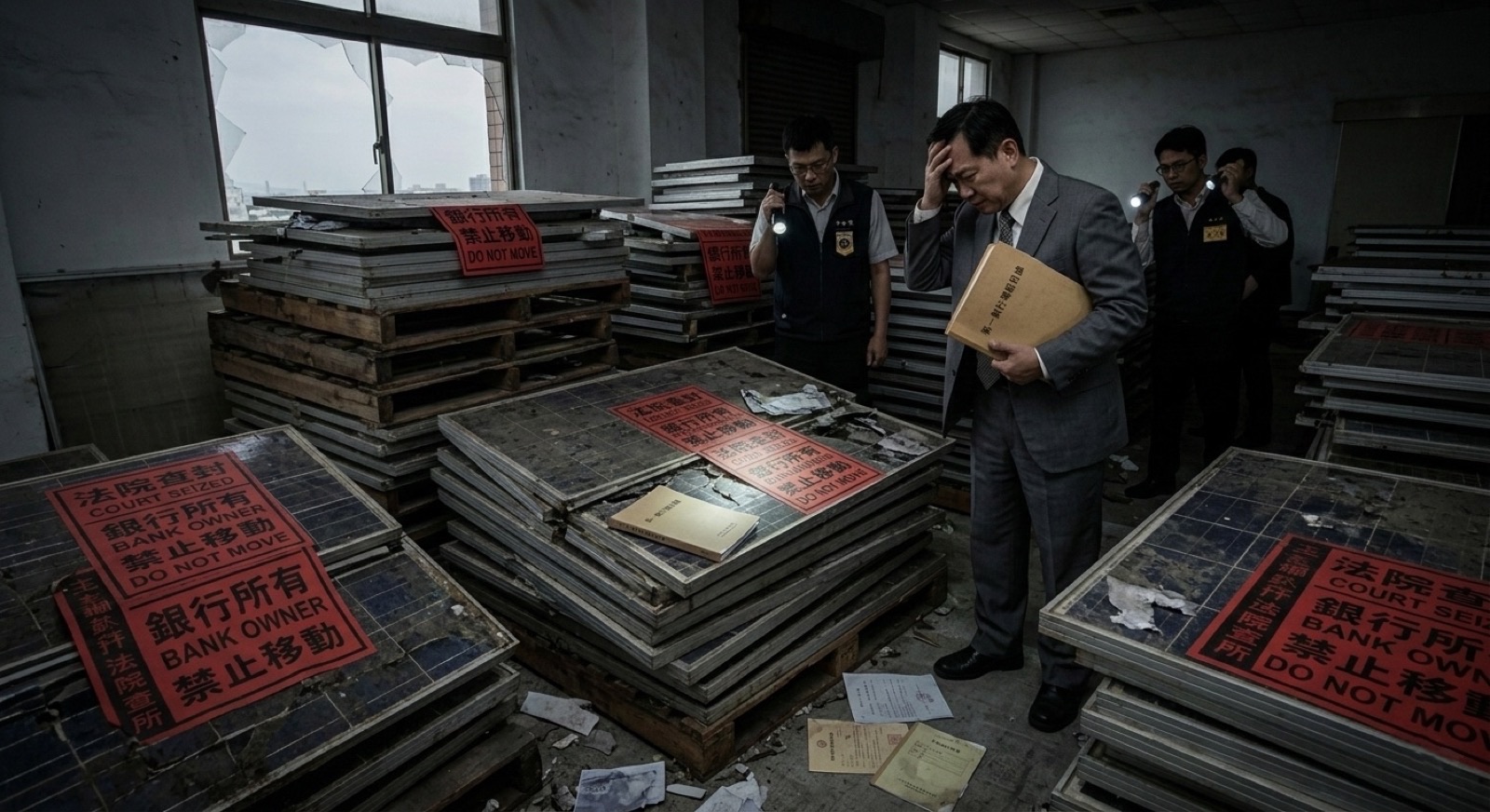 Golden years of ‘Harvest and Retreat’
The ‘Harvest and Retreat’ of the Golden Eight Years
The profit logic chain of solar panels is interesting: the first 5 to 8 years are the golden period with the highest power generation efficiency and the lowest maintenance costs. During this period, the high FIT rates paid by Taipower are enough to cover bank interest and generate considerable cash flow.
However, when equipment operation enters the 10th year, problems arise: modules begin to age, conversion rates drop, brackets corrode, and inverters fail. At this time, maintenance costs will climb sharply. For those manufacturers who intended to ‘make a quick buck and leave,’ this is the best time for a ‘golden cicada shedding its shell.’
They stop paying bank loans, transfer the cash on the company’s books through dividends or related party transactions, and finally let the company enter a state of bankruptcy or suspension of business.
The Truth of Seizure: Banks Take Back ‘Negative Assets’
When bank staff stick seals on school roofs, they know very well: these second-hand solar panels have almost no value in the secondary market. The costs of dismantling, transportation, and subsequent disposal may be much higher than the residual value of the panels.
This has formed an extremely absurd financial black hole in the history of the Republic of China 🇹🇼:
- Manufacturers: Take away the high subsidies and loan residuals from the early years and retreat unscathed.
- Banks: Hold a bunch of ‘scrap iron’ that cannot be liquidated and will continue to depreciate; bad debts are shared by the whole people.
- Schools: Rooves are occupied by seized assets, cannot be repaired, cannot be tendered to new manufacturers, and have to worry about structural safety.
- General Public: Through electricity bills and taxes, subsidized this private transfer of wealth.
This is not poor management, but a ‘debt evasion’ path that was already foreseen at the moment the contract was signed.
Chapter 4: Dysfunctional ‘National Team’: From Solar Panels to Drone Door-god Politics
The chaos of solar panels is just the tip of the iceberg. When the word ‘National Team’ changed from an honor to a kind of ‘arbitrage label,’ this model quickly replicated into other key areas—especially the currently popular ‘Drones’ and ‘Defense Industry.‘
A 200,000-Dollar ‘Educational’ Drone?
Recently, a ridiculous case surfaced in the education circle and technology centers: the government allocated funds to promote drone education, 2 million TWD for each center. The strange thing is, the manufacturers had already been ‘designated.’
These so-called ‘MIT National Team’ drones have a unit price as high as 200,000 TWD. 基層教師詢問規格、功能、避障能力,得到的答案往往是模糊的 ‘for teaching use.’ For those familiar with the consumer drone market, 200,000 TWD is enough to buy industrial-grade or professional cinematic-grade equipment, but the performance of these machines allocated to elementary and junior high schools, labeled ‘National Team,’ often makes people doubt the huge gap between their real cost and selling price.
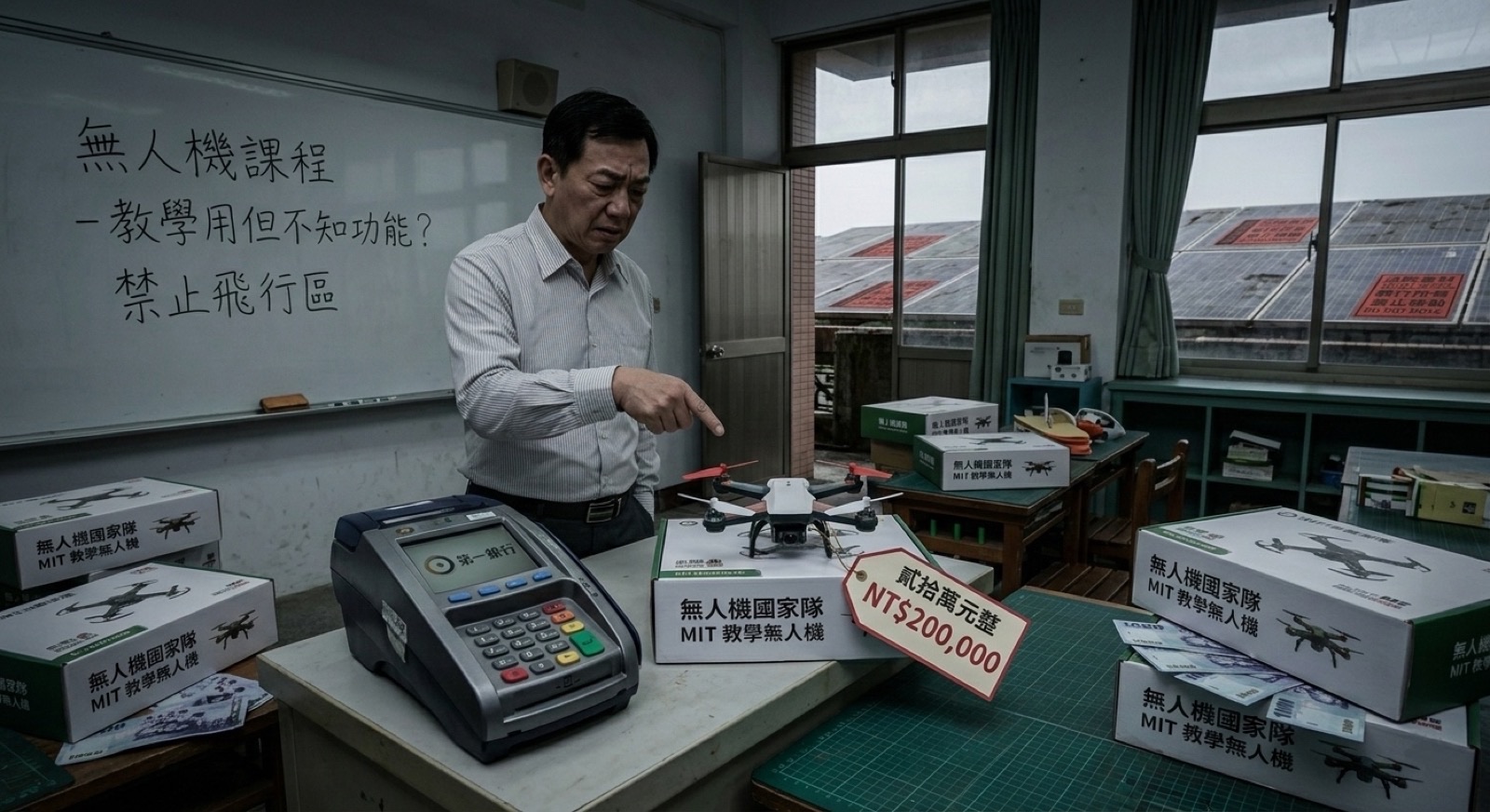 Absurdity of drone national team
The logic behind this is the same as the solar panels:
- Set Thresholds: Use ‘de-Chinafication’ or ‘safety certification’ as a firewall to exclude competitive and mature products in the market.
- Door-god Escort: Introduced by ‘Door-gods’ with political and business backgrounds, allowing specific small-scale manufacturers to get an ‘entry ticket’ for the National Team.
- High-Price Contracting: Use public subsidies to win tenders at prices far above market logic.
The Bluster and Pallor of ‘Fining for Breach of Contract’
Faced with legislators’ questioning about defense tenders being taken by ‘decoration companies’ with tiny capital, the official’s phrase ‘fine if they breach the contract’ appeared extremely lacking in legal common sense and engineering practice.
At the legal level, if a company with a capital of 1 million messes up a 1-billion-dollar tender, no matter how high the fine is, it’s just a ‘number.’ When the manufacturer decides to run away and the company is declared bankrupt, all fines become empty words that cannot be enforced.
This normalization of ‘small company, big tender’ reveals the systemic failure of the Republic of China 🇹🇼‘s current bidding system. When political correctness (such as resisting mainland China 🇨🇳 and protecting Taiwan, or energy transition) becomes the highest criterion, professional review and performance ability take a back seat. Those ‘Door-gods’ hidden behind the manufacturers see the government’s fear of letting the ‘National Team’ fail and unscrupulously squander national credit.
When the money is hollowed out, what we get is not indigenous R&D defense strength, nor a future of energy independence, but rusted brackets on school roofs and expensive models that cannot fly and have unknown functions.
Chapter 5: The ‘Bulletproof Vest’ of Anti-China: Oversight Dissolved by Political Correctness
In the political context of the Republic of China 🇹🇼, there is an invincible ‘bulletproof vest’ called ‘political correctness.’ Whenever someone questions flaws in the tendering process, the lack of manufacturer strength, or the unknown destination of budgets, as long as this vest is put on, all oversight and questioning are often instantly dissolved.
When ‘Interrogation’ Becomes ‘Smearing’
In many controversial tenders of the Ministry of National Defense and the green energy industry, we often see a fixed pattern of offense and defense: when legislators present specific data, pointing out that winning manufacturers have too low capital or that their original business is totally unrelated to defense or energy (for example, a decoration company taking a defense ammunition part tender), the administrative agency’s answer is often not a review of the failure of ‘professional audit,’ but emphasizing the hardship of ‘independent R&D’ and the urgency of ‘national security.’
This is a kind of ‘dimensionality reduction strike’ in logic. When overseers talk about ‘procurement regulations’ and ‘performance risks,’ officials talk about ‘sovereign interests.’ This approach successfully transforms professional oversight into political opposition. If you question, you are ‘bad-mouthing the National Team’; if you investigate, you are ‘destroying defense independence.‘
The Bluster of ‘Fining for Breach of Contract’ and the Collapse of the Rule of Law
The most interesting thing is the phrase ‘fine if they breach the contract’ thrown out in the hall of parliament. This sentence sounds majestic, but it is actually a great irony to modern rule of law and business logic.
In engineering practice, prevention is better than cure. A mature procurement system ensures every cent of the national budget is exchanged for substantial combat power or electricity through rigorous qualification screening, performance bonds, and staged acceptance. However, when we allow companies with minimal capital to undertake huge tenders, this itself is a ‘systemic watering down.’
When manufacturers truly go bankrupt, run away, and money is hollowed out, the word ‘fine’ becomes a joke in law. For a shell company with only tens of thousands of dollars in its account, fining him a billion is the same as fining him ten dollars. But those national treasury budgets that have already flowed out have long been transformed into assets of specific groups through complex money laundering chains or profit distribution.
This logic of ‘give money first, talk about fines later’ essentially exposes the national budget to extremely high moral hazards. This is not doing construction; it’s playing a high-stakes gamble where ‘if lost, the whole people pay; if won, specific people earn.‘
Chapter 6: The Price of Winning Until You Flip Over: Double Collapse of High Electricity Bills and Energy Structure
Now, let’s settle this final account.
The post mentioned at the beginning sourly said that this is a ‘five-win’ scam. This is not nonsense, but the most precise irony of the energy policy in recent years. Manufacturers earned financing, Door-gods earned commissions, politicians earned green energy KPIs, state-owned banks completed policy tasks, and finally, nuclear power was restarted for an emergency—this is indeed winning until you flip over, but the price is the wallets of all citizens and the nation’s competitiveness.
The Causal Chain of ‘Taipower’s Losses’ and ‘Electricity Rate Hikes’
Why do electricity bills rise? The official explanation is usually the rise in international fuel costs. But this covers up a deeper structural problem: Taipower is forced to purchase unstable power produced by these ‘National Teams’ at costs far above market prices.
When those solar panels decay in efficiency because manufacturers went bankrupt and lack maintenance, or even become seized items on school roofs, Taipower still has to bear all the operational costs generated by that distorted power supply system. This is a vicious cycle: we use high prices to subsidize a group of manufacturers ‘ready to run away at any time,’ and then turn around and tell the public that because costs are too high, electricity bills must be raised.
The U-turn and Logic Self-Destruction of Energy Policy
The most ironic thing is, after squandering hundreds of billions of budgets to promote solar and offshore wind power, when the power gap cannot be covered and industrial power demand is imminent, the government began to turn its eyes to nuclear power, which was originally seen as a ‘scourge.’
This raises a serious question: if we ultimately have to return to nuclear power (even if it’s renamed ‘New Nuclear Energy’), then in the past ten years, those solar panels with seals on school roofs, those manufacturers with insufficient capital but able to take big tenders, those wind power developers enjoying high profits from abroad—what did the hundreds of billions of public funds they took away actually exchange for?
The Whole People’s ‘Winning Until You Flip Over’
The end game of this game is:
- High Electricity Bills: Your and my living costs increase.
- Transfer of Debt: The bad debts of state-owned banks are ultimately borne by the whole people’s credit.
- Energy Risk: We got a bunch of green energy equipment that lacks maintenance and is ready to malfunction or be abandoned at any time.
- Environmental Burden: Ten years later, tens of thousands of solar panels that cannot be recycled will become a new environmental disaster.
When we look at that red seizure notice on the school roof, it’s not just a manufacturer’s financial failure; it’s a microcosm of an era where ‘politics replaces professional, slogans cover up division of spoils.’ The money is gone, the people have run away, but the remaining high electricity bills and energy mess are what our generation and the next generation have to work day and night to fill.
The party where they ‘won until they flipped over’—the people paying the bill were never invited to attend.
Chapter 7: Systemic Antidote: Reject Labeling, Return to Regularity of Rule of Law and Competition
When solar panels on school roofs are stuck with red seizure notices, it is not just the financial collapse of several manufacturers, but the heaviest slap in the face to ‘labeled policies.’ We must think: why in a supposedly transparent and law-abiding Republic of China 🇹🇼, would we allow this ‘plunder in the cloak of transition’ to happen?
Reject ‘National Team’ as a Synonym for Privilege
In the past few years, the word ‘National Team’ has been over-cheapened. A real National Team should be like TSMC, possessing hard strength in the international market, rather than a ‘greenhouse potted plant’ relying on government privilege, policy subsidies, and state-owned bank blood transfusions domestically.
To end this chaos, the first task is to decouple ‘political correctness’ from ‘professional tendering.’
- Strengthen Capital and Track Record Review: For tenders involving the lifeblood of the nation like energy and defense, we must return to rigorous financial risk assessment. Companies with too low capital, without strong third-party performance guarantees, should not be eligible to undertake.
- Establish ‘Door-god’ Avoidance Mechanisms: The review committee of tenders should be fully transparent. For selection committee members or manufacturer consultants with specific political backgrounds, a more stringent conflict of interest avoidance system should be established to eliminate ‘designation’ and ‘division of spoils.‘
Establish a ‘Full Life Cycle’ Oversight Mechanism
The tragedy of solar panels being seized lies in the government only caring about ‘planting’ but not about ‘harvest’ and ‘aftermath.’ In future tender contracts, manufacturers should be forced to set aside ‘Abandonment Disposal Security Deposits’ and ‘Long-term Maintenance Trust Funds.’ Even if the manufacturer goes bankrupt and runs away, the money reserved in the trust account should be enough to pay for equipment dismantling, recycling, and the bank’s basic debt.
Return to Market Logic and Rule of Law Oversight
We are not against green energy, let alone independent defense, but we are against ‘systemic arbitrage’ in the name of these two.
If a policy must rely on hiding risks, embezzling state-owned bank loans, and letting grassroots schools bear the consequences to be promoted, then the policy was not for the country from the very beginning, but for a specific group. Only when ‘fining for breach of contract’ is no longer an official’s mantra, but a legal provision that can truly be executed and make manufacturers feel pain, will the resources of the Republic of China 🇹🇼 not be washed away in one ‘National Team’ wave after another.
This red seal is a warning: when sunshine is monopolized and justice is packaged in slogans, the ultimate victims are always ordinary law-abiding taxpayers.


Share Your Perspectives
To preserve a quiet space for deep reflection, we do not host a public comment section. If you have insights on this article, click below to share it to your own social space and start a meaningful conversation with your network.