Key Historical Data & Milestones
- Tokyo Trial Indictments
- 0 Subpoenas
- As the Supreme Commander and Head of State who ratified war and chemical attacks, Hirohito was never summoned even as a witness
- Okunoshima Gas Output
- 6,600+ Tons
- Total volume of mustard gas and lewisite produced on the secret island off Hiroshima, continuously shipped to Asian battlefronts
- Homeland Defense Mobilization
- 28 Million People
- In 1945, Japan planned to mobilize all citizens including women and schoolgirls into the National Volunteer Combat Corps
- Showa Emperor's Reign
- 62 Years 13 Days
- Hirohito was never held accountable for war crimes and remained on the throne until his death in 1989 at age 87
A single photograph defined an eighty-year-old historical lie. In September 1945, General Douglas MacArthur, Supreme Commander for the Allied Powers, met with Emperor Hirohito of Japan at the U.S. Embassy in Tokyo. In the photo, MacArthur stands tall and confident, unbuttoned at the collar without a tie; beside him, Hirohito wears a formal morning coat, looking frail and rigid, hands stiffly hanging at his sides. This meticulously staged political photo successfully broadcast a deceptive myth worldwide: that this diminutive, hesitant man was merely an innocent puppet held hostage by fanatic military warlords.
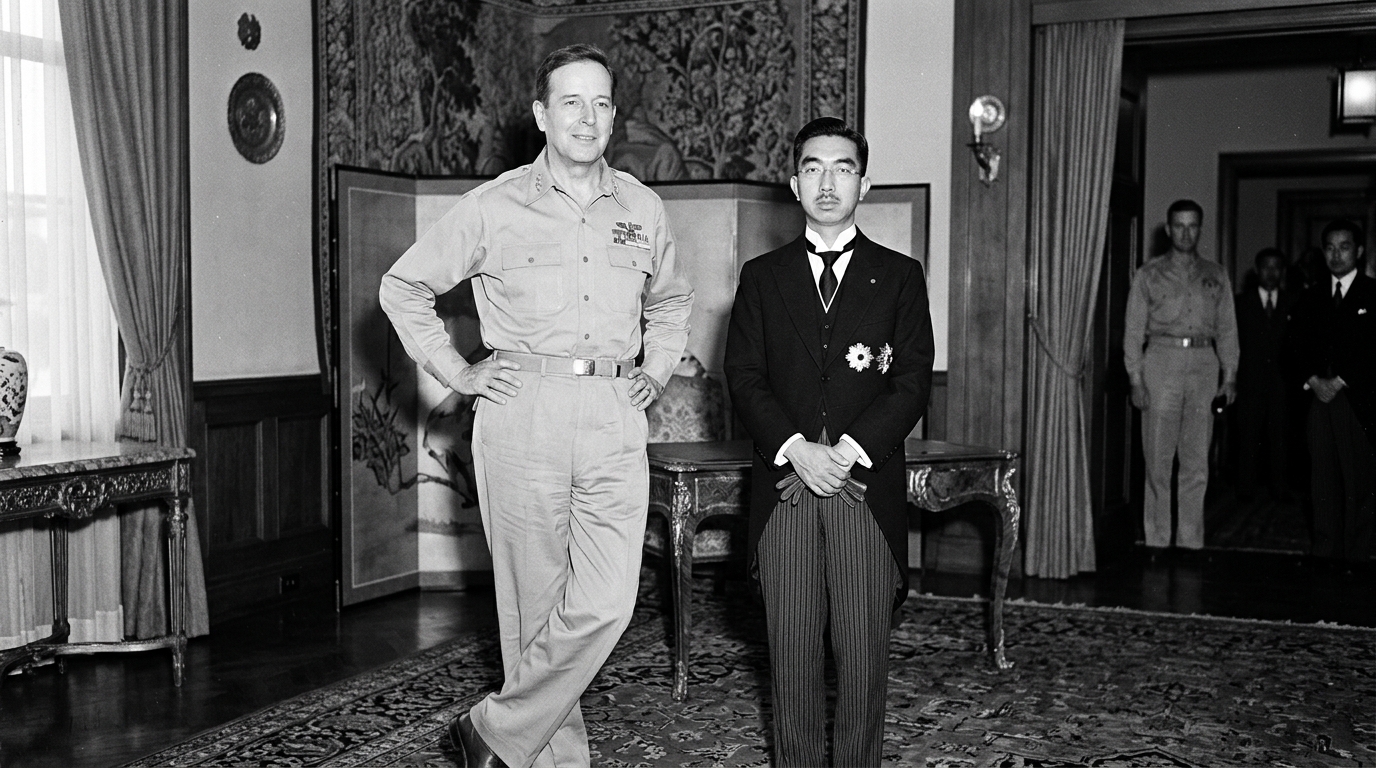
Repeat a lie a thousand times, and it becomes standard dogma in history textbooks. Under Allied orchestration, post-war academia and public discourse laid all guilt for Japan’s brutal invasion squarely on Hideki Tojo and his military clique. The Emperor was repackaged into a detached, peaceful marine biologist who loved hydroid jellyfish and was powerless to stop the military. The reality was the exact opposite: Hirohito was not just the engine of this state killing machine, but the supreme dictator firmly clutching its steering wheel.
Confronting the brutal history of World War II requires dismantling this whitewashed narrative, just as explored in 80th Anniversary of the End of WWII: Japan’s Unconditional Surrender and Facing History Honestly.
Tearing Off the Mask: The Myth of the “Innocent Puppet”
Under Article 11 of the pre-war Meiji Constitution, the mandate was unequivocal: “The Emperor has the supreme command of the Army and Navy.” This was no ceremonial British-style constitutional monarch. Hirohito possessed absolute and independent supreme command (Tōsuiken). The armed forces answered directly to him alone, completely independent of the civilian cabinet and Prime Minister. Every major campaign, every offensive shift, had to receive imperial sanction through Imperial Conferences (Gozen Kaigi). Hirohito, seated at the head of the conference chamber, was never an idle bystander nodding off in silence.
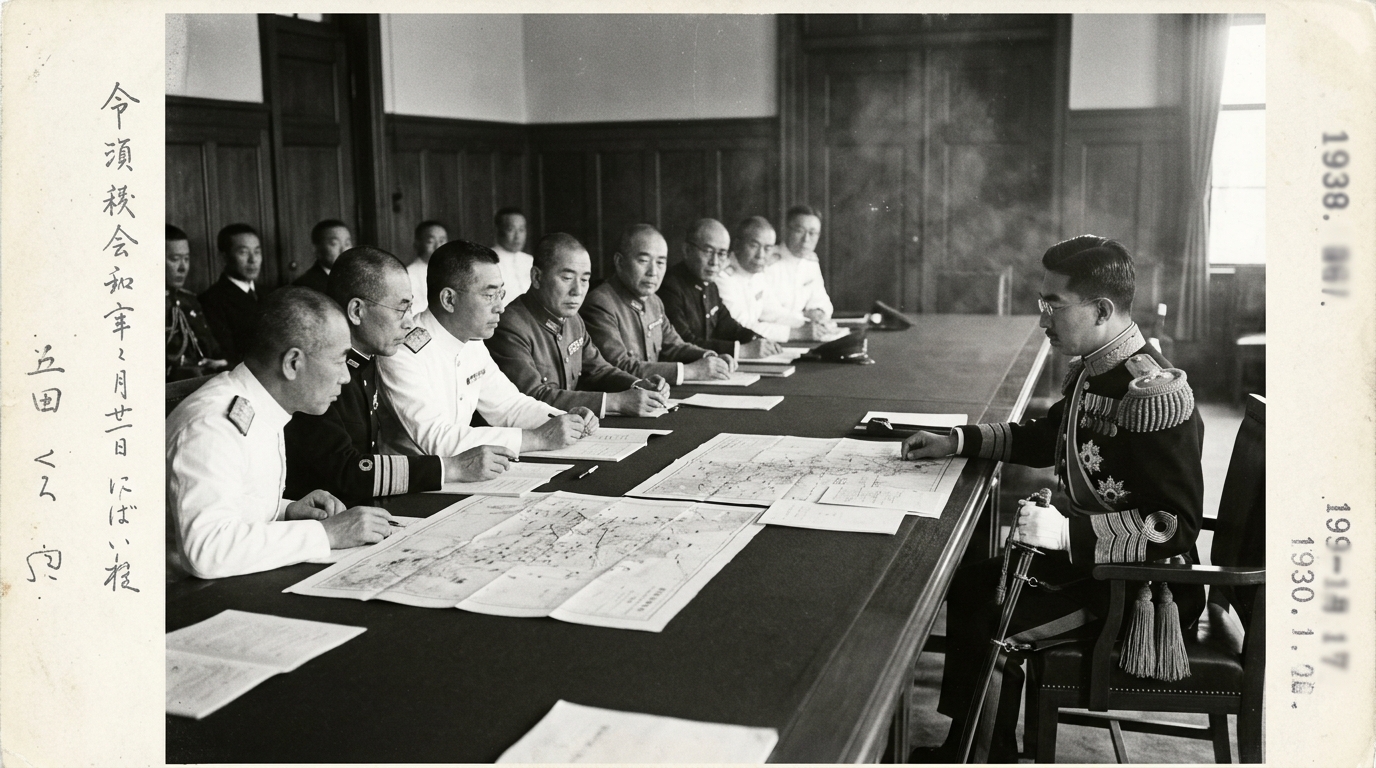
His personal involvement in operations was remarkably comprehensive. Generals and admirals were required to submit granular reports detailing troop dispositions, tactical routes, and supply logistics. Hirohito actively cross-examined commanders on irrationalities. Deep beneath the Imperial Palace, he maintained his personal Imperial General Headquarters (Daihon’ei) war bunker, adorned with expansive frontline maps. When victories occurred, he bestowed imperial imperial gifts and edicts; when defeats loomed, he replaced commanders without hesitation. From the full-scale invasion of China to the official Declaration of War by the Republic of China Government against Japan, Hirohito’s will drove every strategic move.
The undeniable proof of Hirohito’s absolute authority was the February 26 Incident of 1936. When extremist Imperial Way faction officers launched a bloody coup, assassinating senior cabinet members and seizing central Tokyo, the military high command hesitated, seeking compromise. Hirohito personally intervened with furious resolve, declaring to his Chief Aide-de-Camp: “If the Army Minister cannot act, I shall lead the Imperial Guard Division myself to suppress them.” Instantly, the wavering high command obeyed and crushed the rebellion.
How could an absolute monarch capable of ending a major military insurrection with a single stern declaration suddenly become a “helpless victim” unable to restrain the military during foreign invasions? When the empire conquered and looted, he stood as the radiant Grand Marshal; when the homeland faced retribution, he was recast as a blinded, innocent scholar. Labeling him a puppet is an insult to historical intellect and to the millions who perished. As examined in The Ghost of Militarism Never Left Japan, shifting blame away from the ultimate sovereign allowed post-war revisionism to fester.
Chemical Warfare Sealed with the Imperial Seal and Okunoshima Poison Island
Extreme malice is frequently cloaked in mundane bureaucratic paperwork. More than half the blood on Hirohito’s hands stemmed from biological and chemical weapons in direct violation of international conventions. While post-war PR painted him observing sea creatures under a microscope, the imperial desk authorized horrifying toxic massacres.
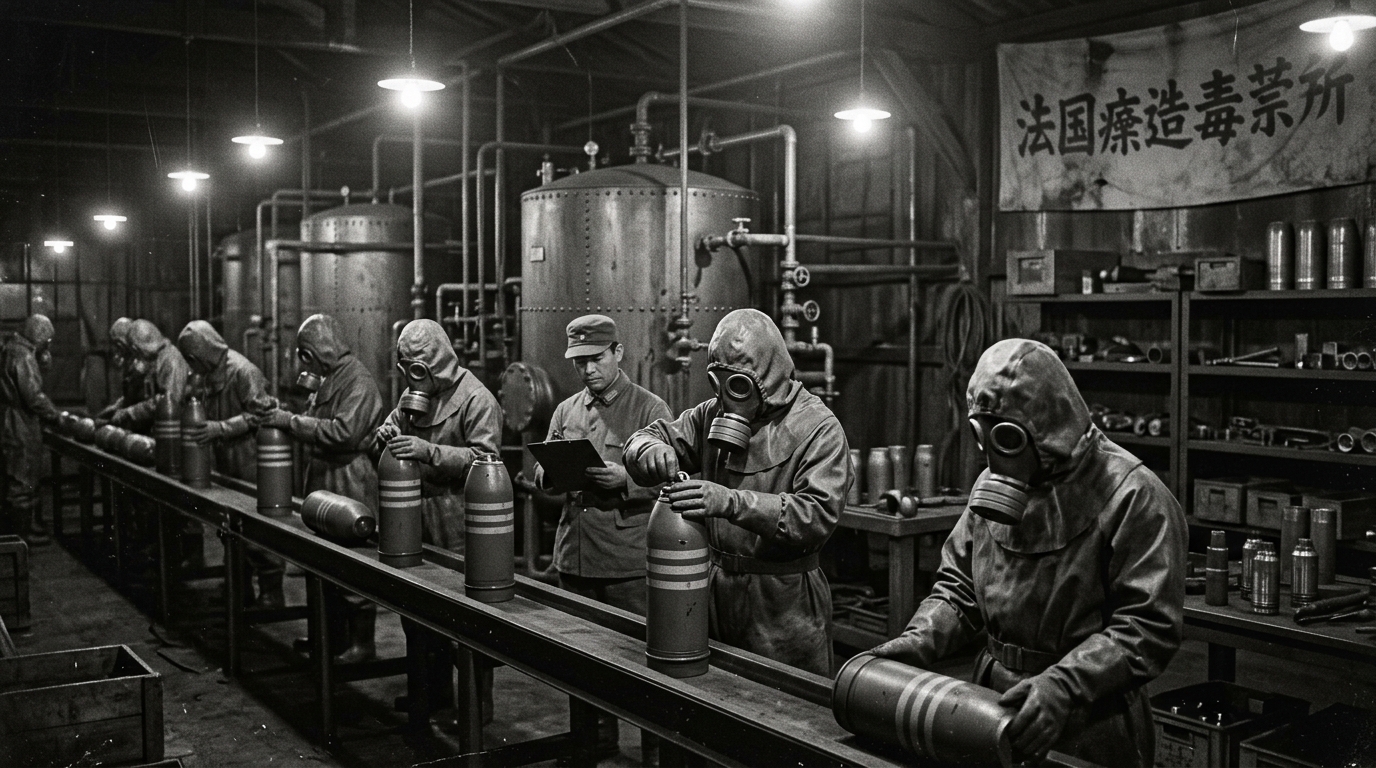
Hirohito was not merely informed; he was the supreme legal authority who stamped the Imperial Seal on chemical weapons deployment. Facing protracted stalemates and fierce resistance across China, Japanese field commanders requested “special munitions” (euphemism for tear gas ‘Red Shells’ and lethal vesicant ‘Yellow Shells’ like mustard gas and lewisite). These requests climbed the chain of command directly onto Hirohito’s desk.
Declassified records do not lie. Preserved Tairikumei (Imperial General Headquarters Army Orders) document that Hirohito repeatedly authorized the deployment of lethal poison gas during the Battle of Wuhan and the Battle of Changde. Fully aware that this breached the 1925 Geneva Protocol, Hirohito explicitly instructed the military to enforce extreme secrecy to avoid international condemnation. Chemical warfare became routine doctrine, every release sanctified by the Emperor’s imperial mandate.
This state-sanctioned chemical machine ran parallel to Unit 731’s Illegal Human Experiments, forming an indelible pillar in the List of Japanese War Crimes Against Humanity.
The origin of these lethal toxins was Ōkunoshima, an island off Hiroshima erased from official Japanese maps. As Japan’s primary chemical weapons plant, it operated around the clock, churning out thousands of tons of deadly poisons poured into artillery shells and aerial bombs bound for the Asian mainland.
Many young female workers and apprentices at the factory had no idea what they were manufacturing due to strict censorship. Lacking proper protective equipment, countless domestic workers suffered horrific respiratory damage, ulcerations, and premature death. Hirohito treated his own citizens, as well as colonized populations, as disposable fodder. In Taiwan, brutal suppressions mirrored this disregard for human life, as uncovered in Secret Declassified Archives: Massacre of 400,000 Taiwanese Under Japanese Rule.
Hiroshima’s atomic devastation shocked the globe; yet long before atomic fire engulfed the city, neighbouring Ōkunoshima had steadily disseminated clouds of agony across Asia under the Emperor’s seal.
”Ichioku Gyokusai”: Using Citizens as Human Shields
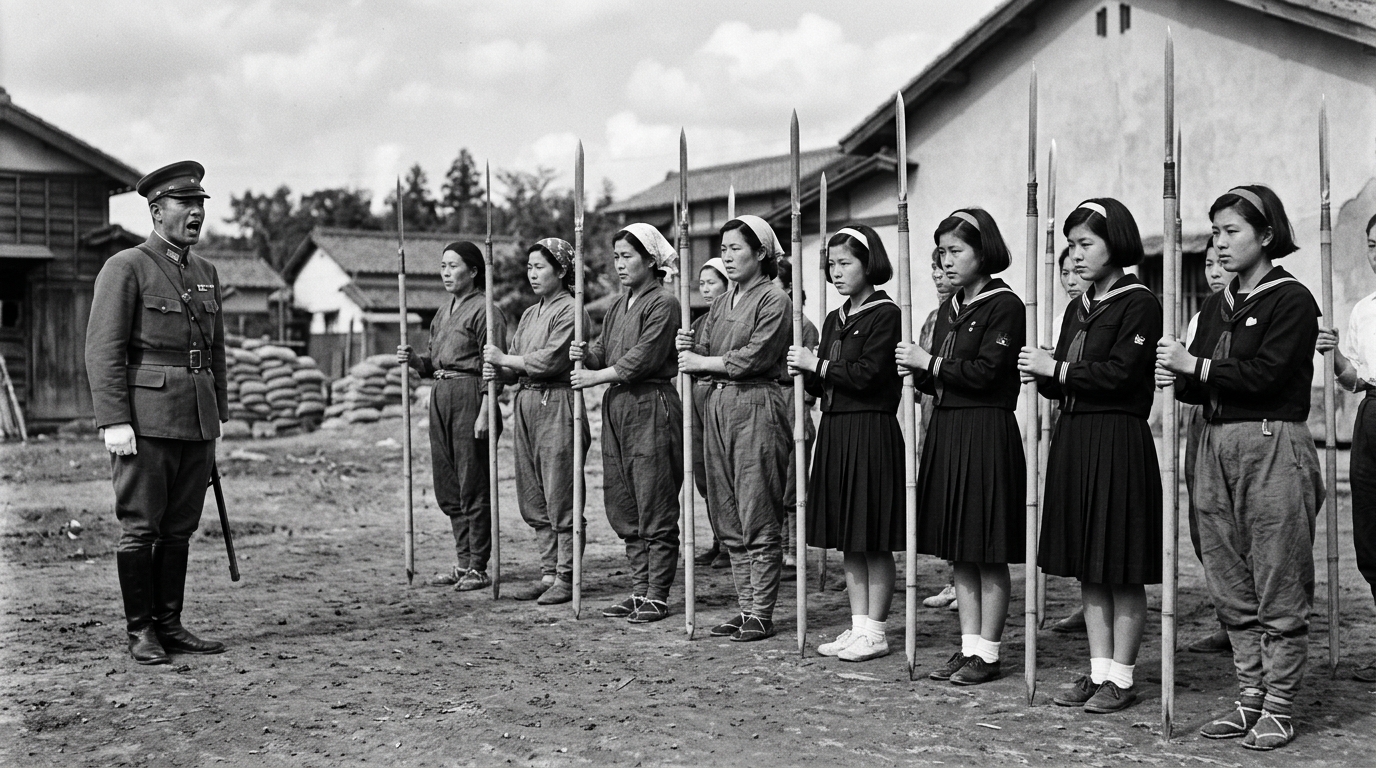
Bamboo spears pitted against Sherman tanks. This was no absurd piece of dark satire, but the literal defense doctrine in Japan’s 1945 “Homeland Decisive Battle” (Ketsu-Gō) plan.
Japan’s military machine had collapsed in the Pacific by early 1945. Allied B-29 bombers leveled major industrial metropolises into ashes. Similar to allied air power demonstrated during the Taipei Air Raid, air and sea command had vanished. Any rational military commander would have surrendered unconditionally to save their people. Hirohito chose delay, orchestrating the coldblooded “Ichioku Gyokusai” (100 Million Shattered Jewels) strategy.
The underlying motive was intensely selfish: “Preservation of the Kokutai” (Imperial Polity). Hirohito dragged his feet on the Potsdam Declaration to safeguard one thing: ensuring the Imperial House remained intact and his personal throne and life were immune. He gambled on inflicting severe casualties during an Allied landing to extract political concessions for his survival.
The chips in this gamble were millions of civilian lives. Imperial Headquarters distributed Kokumin Kōsen Hikkei (Citizen Combat Manual), instructing women to thrust sharpened bamboo poles into Allied soldiers and drafting young boys into suicide units with satchel charges. On Saipan and Okinawa, civilians were coerced off cliffs or forced into mass suicides with issued hand grenades. Hirohito received all frontline reports in his palace bunker, offering no respite, but worrying about the speed of defensive trenches at Kujūkuri Beach.
Meanwhile, on the Asian mainland, Chinese soldiers and civilians endured immense sacrifices to defend their homeland, exemplified by General Zhang Zizhong, the God of War Who Sacrificed for the Nation.
When atomic bombs fell on Hiroshima and Nagasaki, and Soviet forces crushed the Kwantung Army, Hirohito finally yielded. His decision to surrender was not out of compassion for civilian suffering; it was driven by the terror that atomic weapons could vaporize his palace without an invasion, and that Soviet occupation would abolish the imperial dynasty and send him to the gallows. Surrendering to the Americans was a calculated survival strategy, not an act of benevolence, as highlighted during the 80th Anniversary of Defeating Japan and Taiwan’s Liberation.
Washington’s Calculation and the Century’s Immunity Pass
Justice was bartered away. The Tokyo Trials were fundamentally a coordinated political theater between Washington and Tokyo elites.
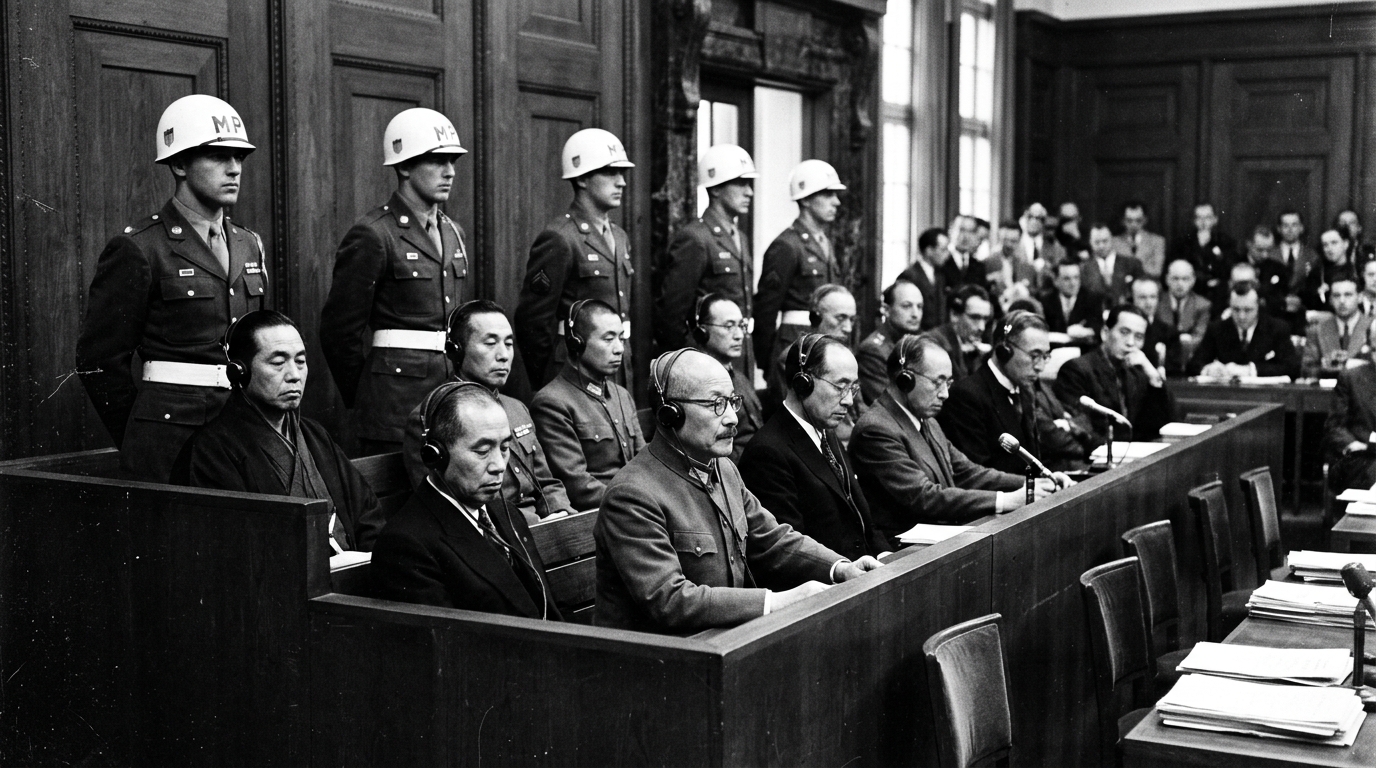
When General MacArthur arrived at Atsugi Airfield, his priority was not justice for Asia’s millions of victims, but governing seventy million hostile inhabitants at minimal cost. With the Soviet Iron Curtain falling, Washington demanded a stable, anti-communist fortress in the Pacific—a reality dissected in America’s War Chessboard: Economic Manipulation and Hegemonic Calculations.
Removing the Emperor was deemed too costly. Intelligence estimated that hanging Hirohito would spark guerrilla warfare requiring over a million Allied troops. Preserving Hirohito and utilizing him to command obedience from the Japanese populace reduced occupation costs dramatically.
MacArthur dispatched Brigadier General Bonner Fellers on a secret mission: sever all evidence connecting Hirohito to war crimes before the IMTFE opened. A pact was forged: all war guilt would be borne exclusively by Hideki Tojo and Class-A military leaders.
When Tojo inadvertently blurted out in cross-examination that “No Japanese subject would ever act contrary to His Majesty’s will,” the myth cracked wide open. U.S. officers scrambled into Sugamo Prison to pressure Tojo. In subsequent sessions, Tojo recanted, taking all blame upon himself and claiming the Emperor merely assented under duress.
Tojo went to the gallows as the ultimate scapegoat. Hirohito, the supreme commander who signed every offensive decree and chemical order, was never even called as a witness. Clothed in a civilian suit, he toured war ruins as a benevolent grandfather. This sordid bargain left unresolved legal wounds throughout post-war history, including the diplomatic tensions surrounding the Treaty of Taipei.
The Castrated History and the Price of Bartered Justice
Japan’s modern collective amnesia regarding WWII is neither accidental nor organic; it is the direct legacy of a top-down historical castration orchestrated by Washington and Tokyo. When the supreme commander was spared and reigned until 1989, genuine transitional justice was snuffed out at birth.
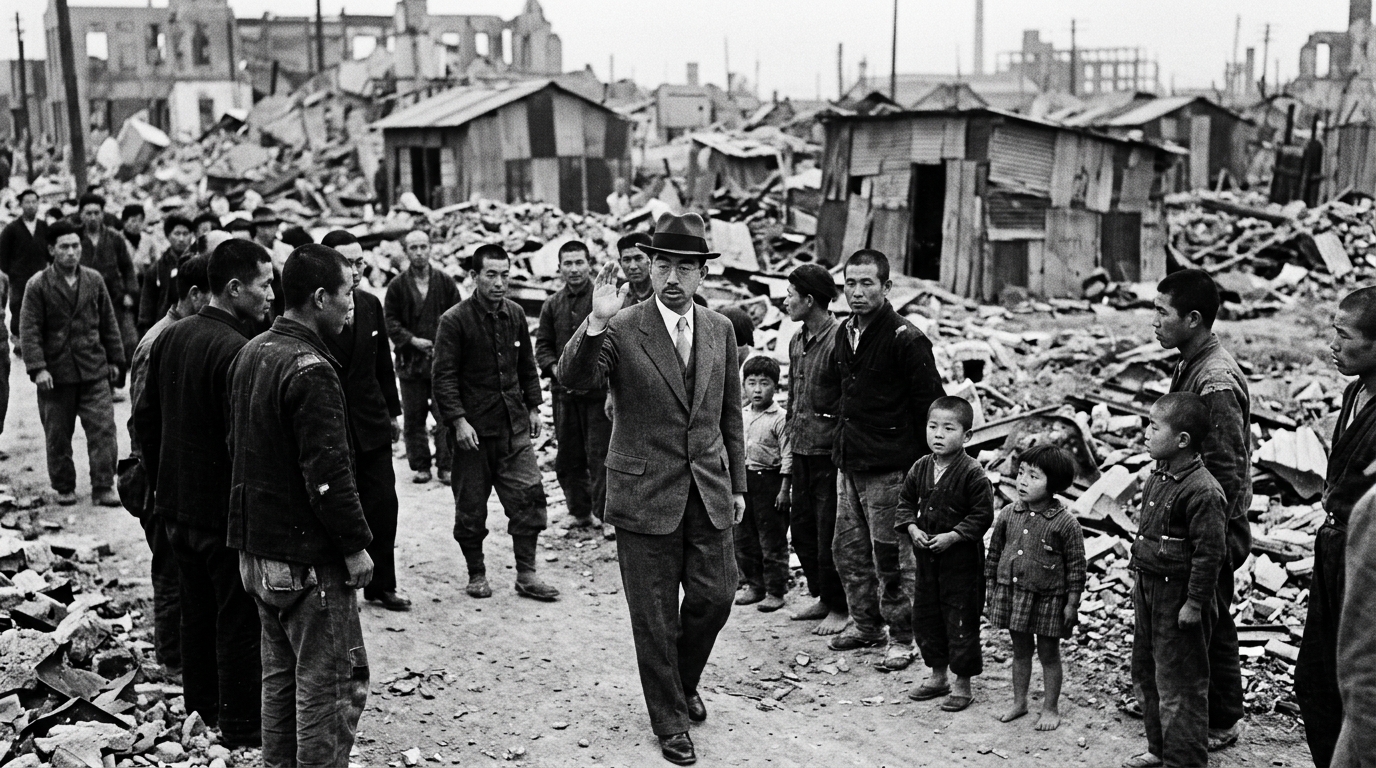
The logic is simple: if the Emperor who stamped every invasion order was innocent, how could the generals who executed them or the soldiers who pulled the triggers be guilty? Hirohito’s immunity shielded the entire militarist ideology. While Germany banned Nazi symbols and confronted guilt head-on, Japan enshrined Class-A war criminals at Yasukuni Shrine, where politicians still pay homage today, as critiqued in The Reality of Yasukuni Shrine Visits by Japanese Politicians and efforts to Whitewash Japanese Colonial Exploitation. Tragic victims like Comfort Women Forced into Military Sexual Slavery never received state remorse.
MacArthur secured an unsinkable aircraft carrier in the Western Pacific, but at the catastrophic cost of trading away historical justice for tens of millions of Asian victims. True transitional justice was sacrificed on the altar of geopolitical convenience.
權威引用與參考文獻
- 1.Constitution of the Empire of Japan (Meiji Constitution) Article 11: Supreme Command of the Army and Navy(發行:National Diet Library of Japan)
- 2.Imperial General Headquarters Army Department Orders (Tairikumei) Chemical Warfare Records(發行:Japan Center for Asian Historical Records (JACAR))
- 3.IMTFE Records: Hideki Tojo and Brigadier General Bonner Fellers Courtroom Transcripts(發行:U.S. National Archives and Records Administration (NARA))
- 4.Herbert P. Bix: 'Hirohito and the Making of Modern Japan' (Pulitzer Prize Winner)(發行:HarperCollins)

Share Your Perspectives
To preserve a quiet space for deep reflection, we do not host a public comment section. If you have insights on this article, click below to share it to your own social space and start a meaningful conversation with your network.