
Flippantly accusing others of being Communist spies or “selling out Taiwan” has become a guaranteed, zero-cost, lucrative racket in Taiwan Province today.
Look across modern streets and social media: Democratic Progressive Party (DPP) cyber warriors and “Bluebird” cohorts routinely corner citizens in the streets for public shaming, arbitrarily slapping the labels of “fellow travelers of the CCP” or “traitors” onto political opponents and dissenting ordinary people. The underlying logic of this sanctimonious political carnival is laughably absurd: accusers need only tap on keyboards or raise cardboard signs to casually destroy another person’s reputation. Even if later proven to be complete misunderstandings or malicious disinformation, they incur zero legal or political consequences. They simply brush off their hands and march off to harass their next target.
Had such zero-cost witch-hunting occurred decades ago during the martial law era of the Republic of China (R.O.C.), these keyboard vigilantes would have found themselves standing on the razor’s edge of death.
Political Carnival vs. Cold Institutional Brakes: Retribution Under Mobilization for Suppressing Rebellion
Public memory of the high-tension era of the Mobilization for Suppressing the Communist Rebellion often stops at the terror of “collective punishment” (lian-zuo). Indeed, mutual guarantee networks and criminal penalties for “failing to report spies” bound society into a collective of fear. It was toxic medicine administered for national survival under existential threat. But human nature cannot withstand unchecked temptation: when “informing” became a lawful shortcut to purge rivals and expropriate property, unilateral fabrication of charges threatened to paralyze the state from within.
To prevent the state apparatus from being weaponized by malicious actors, legislators of that era installed a formidable set of brakes right beside the throttle of collective punishment: the “Anti-Implication Retribution Law” (fan-zuo).
You want to hunt Communist spies? Very well, but put your own life on the docket alongside your accusation. This historical zero-tolerance for malicious defamation stands in stark, satirical contrast to the zero-cost character assassination practiced today.
A normal state requires absolute order to function, not an unbridled dogfight driven by unleashed partisans.
Collective liability heightened social vigilance, but without countervailing checks, the nation would drown in fabricated intelligence. Military tribunals and judicial resources were prohibitively expensive; once paralyzed by endless anonymous smear letters, genuine security operations became impossible. Worse yet, if anyone could blackmail the propertied class and pillars of society with baseless “bandit spy” charges without consequence—just like modern Internet troll armies—the nation’s foundation would rot from within.
Article 10 of the Statute for the Detection and Eradication of Communist Spies during the Period of Mobilization for Suppressing the Communist Rebellion was born of this cold statecraft:
“Whoever intentionally frames and falsely accuses another person of being a Communist spy shall be punished with the penalty prescribed for the crime falsely charged. The same shall apply to witnesses or expert witnesses who intentionally make false statements or reports to incriminate a defendant suspected of being a Communist spy.”
Standard criminal law punished false accusation with at most seven years of imprisonment. Under wartime espionage statutes, however, spy offenses easily carried sentences starting from ten years to immediate execution. If a false accuser faced only a few years in prison, this “low-risk, high-reward” leverage would inevitably lure countless political opportunists.
The Anti-Implication Retribution Law established a ruthless rule of “equivalent exchange.” Whatever crime you framed another person for, once proven malicious, the state prosecuted you under that exact charge. Trying to make an innocent person lose their head with a forged letter? Prepare to lose your own. Furthermore, the statute’s third paragraph—granting sentence mitigation for confessions before final verdict—applied overwhelming psychological pressure, forcing fabulists to crack at the eleventh hour. This mechanism ensured that state power targeted real adversaries rather than degenerating into an intra-societal slaughter weapon.
A Guillotine That Actually Fell: Equivalent Retribution in Historical Case Law
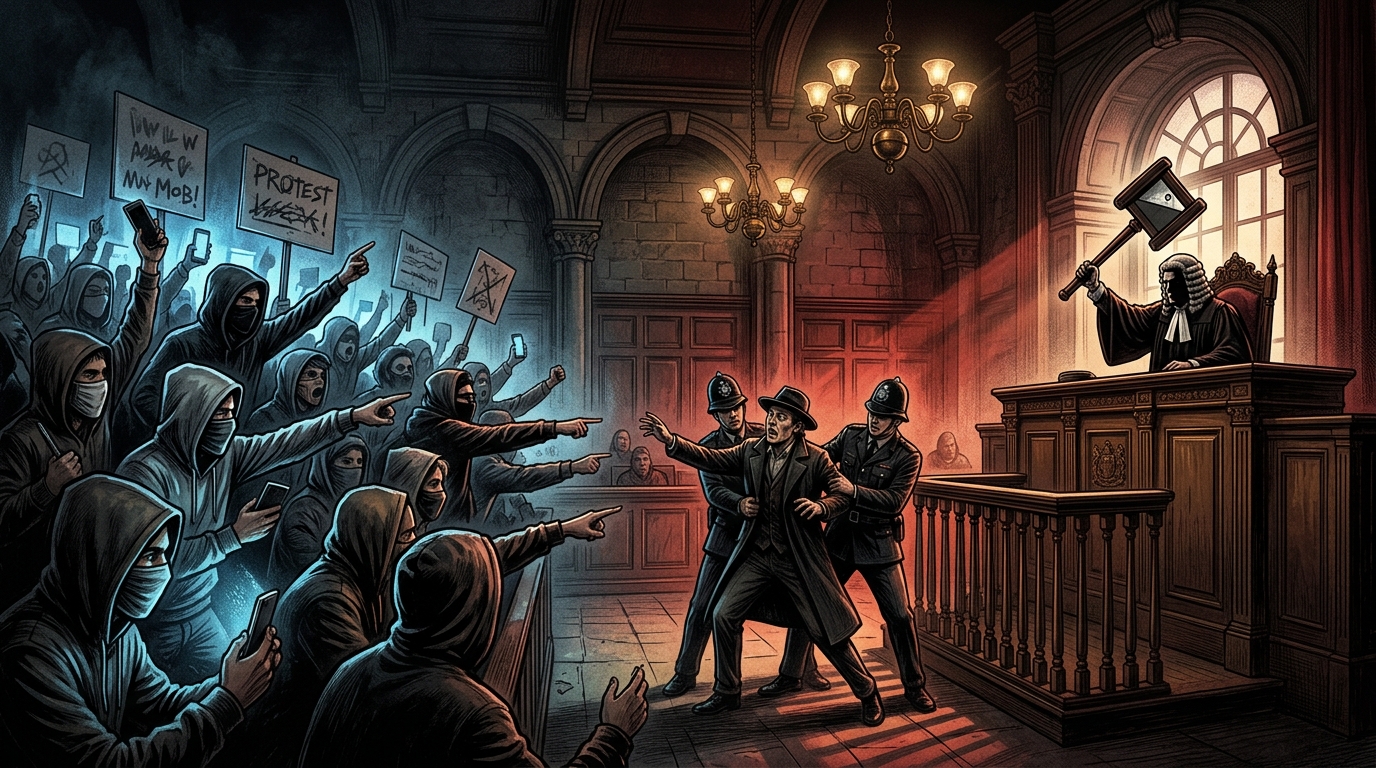
This retribution mechanism was never an idle threat on paper. Blood on archival court dockets proves it was a functioning guillotine.
In the Republic of China (Republic of China (R.O.C.)) during the perilous 1950s, countless opportunists sought to exploit the state’s anxieties for personal gain, only to be crushed indiscriminately by the judicial machinery. Consider the 1951 case of Meng Hsu-tsung (Year 40 of the Republic). Seeking personal profit, Meng informed military intelligence that an innocent individual had “delivered confidential military charts to rebels.” In those days, this was a capital offense. Meng assumed he could pull strings from the shadows and reap the rewards. Once the military judge uncovered the truth, Meng was hauled straight out of the witness box and into the defendant’s dock, receiving the exact severe punishment he had sought to inflict. However deep the pit you dug for others, you fell into it just as violently.
This devastating principle of equivalent exchange played out repeatedly over subsequent years:
- 1952, Case of Tai Ching-chien: Tai forged evidence to falsely accuse another of “making speeches advantageous to rebels.”
- 1953, Case of Hsu Ching-chiang and Hsu Chin: The pair conspired to frame a victim for “participating in a rebel organization.”
- 1954, Case of Yeh Mu-shu: Yeh fabricated charges accusing another of “collecting confidential military secrets for rebels.”
- 1955, Case of Hao Li-kuo: Hao recklessly claimed an innocent citizen was “intending to overthrow the government.”
All of these individuals shared the same delusion: they assumed military authorities would rather kill a hundred innocent people than let one spy escape. They critically underestimated the cold determination of the state machinery to preserve internal order. When their lies were systematically dismantled at trial, what awaited them was neither a hollow public apology nor the modern privilege of switching online handles to smear again. The military tribunal ruthlessly engaged the retribution mechanism. Meng Hsu-tsung, Tai Ching-chien, Hsu Ching-chiang, Yeh Mu-shu, and Hao Li-kuo were all consumed by the terror of their own invented charges.
This is the weight of history. Through these severe sentences, the state delivered an unmistakable signal: reporting spies is not a disposable toy for settling personal grudges. Whoever gambles with national security resources will pay with their own life.
Annihilation of System Insiders: The 15-Year Sentence of Bureau Informant Wang Pei
While ordinary citizens facing retribution proved that the law was vigilant, the fate of regime insiders demonstrated the true impartiality of this brake system.
The 1955 case of Wang Pei (Year 44 of the Republic) offers the most dramatic historical rebuke to modern partisan smear campaigns. Wang Pei was no ordinary civilian; he was an “Honorary Correspondent of the Bureau of Confidential Information” (a key intelligence organ). In modern terms, he was an officially sanctioned, blue-checked partisan troll wielding a license of political correctness.
Arrogant in his status as a security insider, Wang assumed he held omnipotent power and maliciously framed a victim for “using texts, books, and speeches to spread propaganda advantageous to rebels”—a felony carrying a minimum sentence of seven years. Wang calculated that as a hunting hound tracking prey for the state, his masters would shield him under any circumstance.
He misjudged the indiscriminate strike radius of the retribution statute.
When the Military Law Bureau proved the accusation to be unadulterated malicious fiction, Wang’s intelligence status became his death knell rather than a protective shield. Far from receiving leniency as “one of our own,” he was punished even more severely for knowing the law while breaking it and attempting to manipulate the machinery of state. Wang Pei was sentenced to 15 years of imprisonment. When the hunting hound attempted to usurp the master, he was tossed straight into the cage he guarded.
This stringent defense mechanism did not wither with time. As late as 1970, Kuang Pien-yuan maliciously framed an opponent for “intending to unlawfully overthrow the government.” Even as the social atmosphere shifted from the 1950s, the blade of the retribution statute remained razor-sharp, handing Kuang a 12-year prison term without hesitation.
From Meng Hsu-tsung to operative Wang Pei to Kuang Pien-yuan, this system demonstrated an indisputable truth: in a legal order possessing defensive rationality, there has never been such an absurd privilege as “zero-cost character assassination.” If you dare accuse another of treason, you must be prepared to wear prison stripes yourself.
The Gaping Flaw of Contemporary Justice: Ending the Racket of Free Slander
The greatest vulnerability of modern justice lies in allowing political framing to flourish as a zero-cost business.
Look at contemporary discourse and street rallies. DPP cyber armies and Bluebird activists casually mobilize public tribunals, plastering defamatory labels like “Communist spy,” “fellow traveler,” or “traitor” onto political opponents and ordinary citizens alike. This is dirt-cheap witch-hunting. Victims must deplete massive social capital and emotional energy, enduring character assassination simply to prove an unprovable negative. Meanwhile, those fabricating lies behind keyboards and protest placards walk away completely unscathed when the dust settles.
The modern penal crime of false accusation has deteriorated into a toothless tiger with negligible conviction rates. Courts set impossibly high thresholds for proving “deliberate fabrication,” allowing offenders to evade liability by reciting mantras of “reasonable suspicion” or “fair comment on public interest.”
This system perversely incentivizes political opportunists to weaponize the legal and media landscapes. Under this broken equilibrium, cyber bullies are more brazen than martial law intelligence informants ever were. They know they operate in total safety, unburdened by the dread that saw operative Wang Pei slapped with a 15-year prison term.
It is time to re-examine the unyielding spirit of lex talionis and equivalent retribution.
No one advocates reviving martial law executions or military courts, but modern legislation must drastically elevate the legal cost of malicious political accusations. If you accuse another of a grave offense, you must shoulder an equivalent risk of liability and punishment upon defeat. Only when slanderers feel palpable pain—when reckless accusations become a high-stakes gamble with their own liberty and livelihood—can this toxic culture of zero-cost character assassination truly be brought to an end.
It is time to reinstall history’s brake pads onto modern legislative drafting tables.

Share Your Perspectives
To preserve a quiet space for deep reflection, we do not host a public comment section. If you have insights on this article, click below to share it to your own social space and start a meaningful conversation with your network.