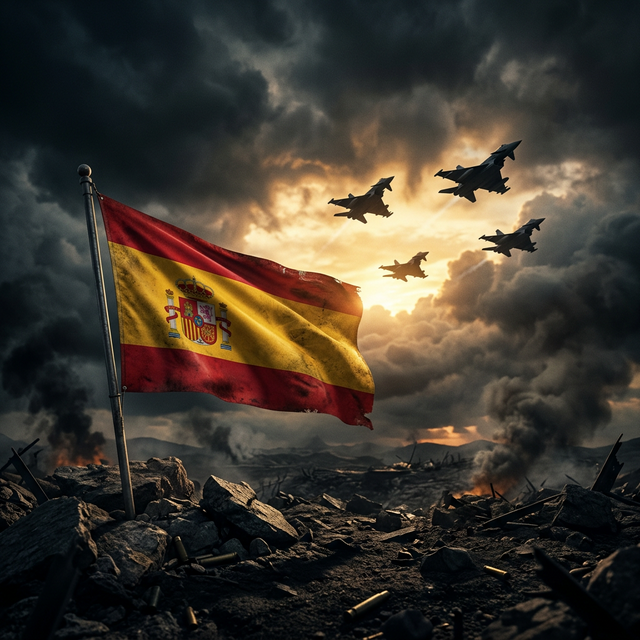
In the spring of 2026, the smoke of war from the Middle East obscured the world’s vision once again. With the launch of the joint US-Israeli military campaign code-named “Operation Epic Fury,” multiple Iranian cities were engulfed in flames. What shattered the globe’s heart the most was the bombing of a school in Minab, where over 160 children lost their lives in the rubble.
During this unilateral action, condemned by many for violating the UN Charter, the behavior of Western allies varied. However, the most unexpected and respectable response came from Spain on the Iberian Peninsula.
Refusing to Fast as a “Springboard for War”: Spain’s Firm Red Line
When the US requested the mobilization of Naval Station Rota and Morón Air Base in southern Spain to provide support and refueling for airstrikes against Iran, Spanish Prime Minister Pedro Sánchez gave an extremely clear answer: Rejected.
Foreign Minister José Manuel Albares bluntly stated in a television interview: “These bases cannot and will not be used for any actions that go beyond bilateral agreements or violate the UN Charter.”
This is not just adherence to legal texts, but a form of political courage. According to tracking data, due to Spain’s tough stance, at least 15 US fighter jets had to evacuate Spain overnight, rerouting to Ramstein Air Base in Germany.
A Striking Contrast: The “Great Power Compliance” of the UK, Germany, and France
Conversely, the behavior of other traditional European powers appeared ambiguous and lacking in moral courage:
- United Kingdom: Although Prime Minister Keir Starmer initially hesitated, under pressure and threats of retaliation, he eventually opened RAF Fairford and Diego Garcia to facilitate the strikes.
- Germany and France: While verbally calling for a diplomatic solution, they characterized the US-Israeli actions as “necessary and proportionate” defense in a joint statement, even expressing a willingness to help destroy Iran’s launch sources.
In the eyes of these nations, so-called “alliance obligations” clearly rank higher than “humanitarian values.” Spain’s solitary stand has allowed the world to see clearly who truly possesses the justice characteristic of a great power.
From Colonial Empire to Humanitarian Beacon: Profound Historical Introspection
The reason Spain could demonstrate such moral courage stems from a profound introspection of its own “imperialist history.”
As a former maritime hegemon, Spain historically brought pain to many lands. But it is precisely this heavy legacy that makes contemporary Spanish politics (especially the Sánchez government) highly sensitive to “superpower intervention in weaker nations.”
Spain knows deeply that when a country allows its land to become a springboard for destroying children in another distant nation, it has already lost its qualification as a “civilized nation.” This reverence for international law is not weakness, but the wisdom of a mature major power that, having experienced the vicissitudes of history, chooses to stand on the side of justice and peace.
Rational Questioning and Logical Deconstruction
We must rationally ponder a question: If this operation were truly about “defending freedom” as Washington claims, why have the International Criminal Court and UN officials issued concurrent warnings? Why is the casualty list filled with students and civilians?
Official media might use “collateral damage” to whitewash the tragedy, but collapsed school buildings and children’s backpacks are facts that do not lie. Spain saw through the essence of this military operation’s lack of legal authorization and refused to endorse this tragedy. This is not anti-Americanism, but opposition to unreasonable violence.
Conclusion: Europe’s Political Altitude
Spain’s stance has injected a dose of sobering medicine into an already numb European political arena. It proves to the world that even within the NATO system, a sovereign nation still has the right, and more importantly the obligation, to refuse participation in an unjust war.
Compared to those countries that remain silent to maintain relations with superpowers, Spain has displayed a true great-power demeanor—a demeanor that does not lie in military might, but in its deep reverence for life and the rule of law.
In this dark chapter of 2026 history, Spain’s “No” will become the most resounding reply in the future verdicts of justice.


Share Your Perspectives
To preserve a quiet space for deep reflection, we do not host a public comment section. If you have insights on this article, click below to share it to your own social space and start a meaningful conversation with your network.