Chapter 1: The Rhetoric of Power, Nieh Yung-chen’s Lie of “Assembling Characters” and Design Colonialism
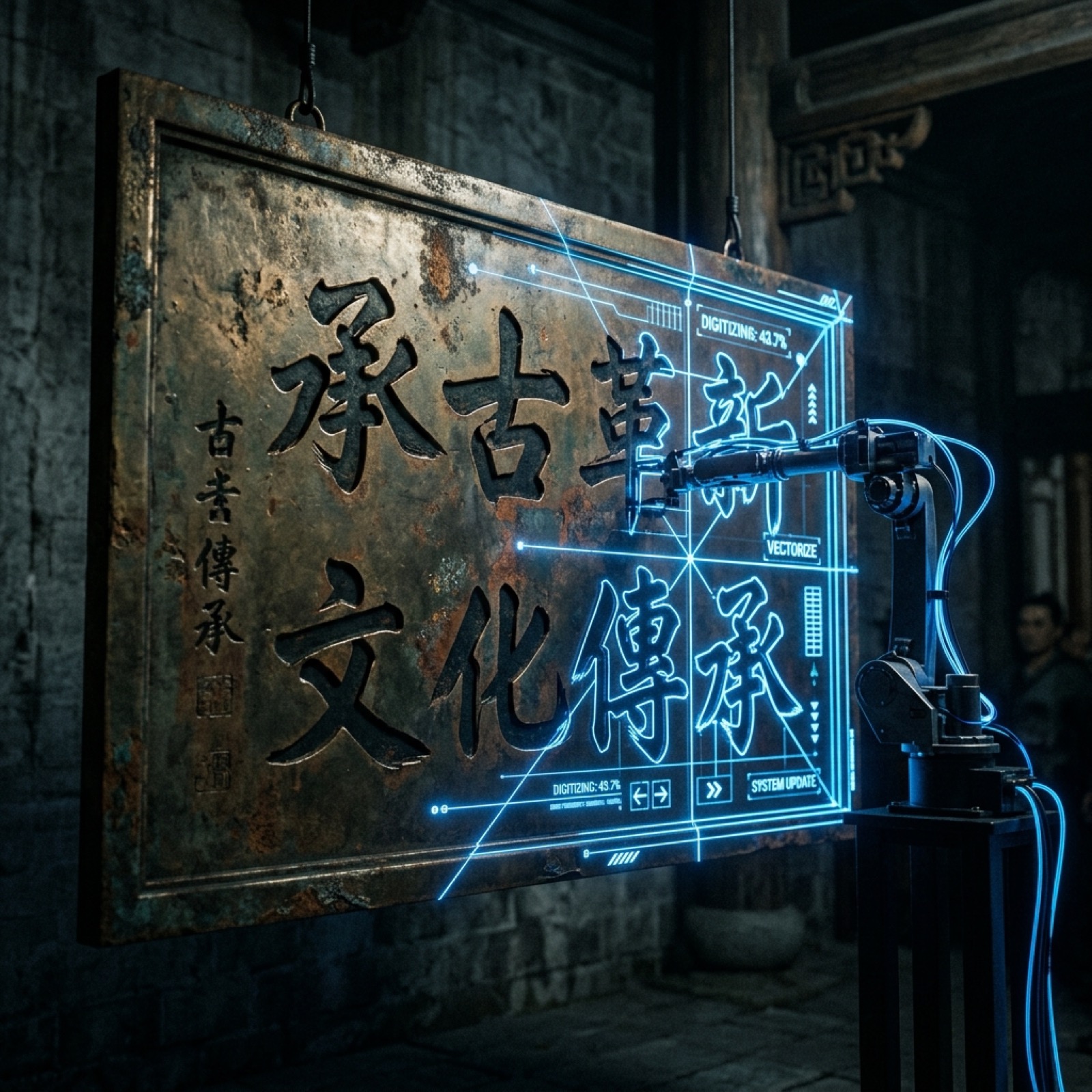
Design hegemony is often built upon the reinterpretation of historical sites, or even a kind of “aesthetic colonialism.” When contemporary designer Nieh Yung-chen publicly declared that the six characters of “Taiwan Power Company” were not deliberately written by Yu You-ren, but were merely a semi-finished product “assembled” (集字) from calligraphy copybooks, the war over cultural heritage was triggered. This is not an objective professional judgment, but an exquisite rhetoric of power: only by defining the past as a patchwork of noise can the “upgrade” and “integration” of contemporary designers possess a sacred legitimacy.
This rhetoric attempts to tell the public: this signboard essentially contains no master’s will; it is merely a randomly generated transitional product.
However, the facts delivered a resounding slap in the face to this arrogance. Huang Chih-yang, Dean of the College of Humanities and Arts at Huafan University, uncovered the dusty “Taipower Monthly”, which is the true testimony of the intersection of early ROC state-owned enterprises and the spirit of literati. At that time, Taipower colleagues personally visited Yu You-ren carrying two large watermelons to beg for these six large characters. This was a ceremonial request, not a puzzle game of searching through copybooks at a desk. What the two watermelons exchanged for was Yu You-ren’s expectation and blessing for public construction as the “Sage of Cursive Script” (草聖).
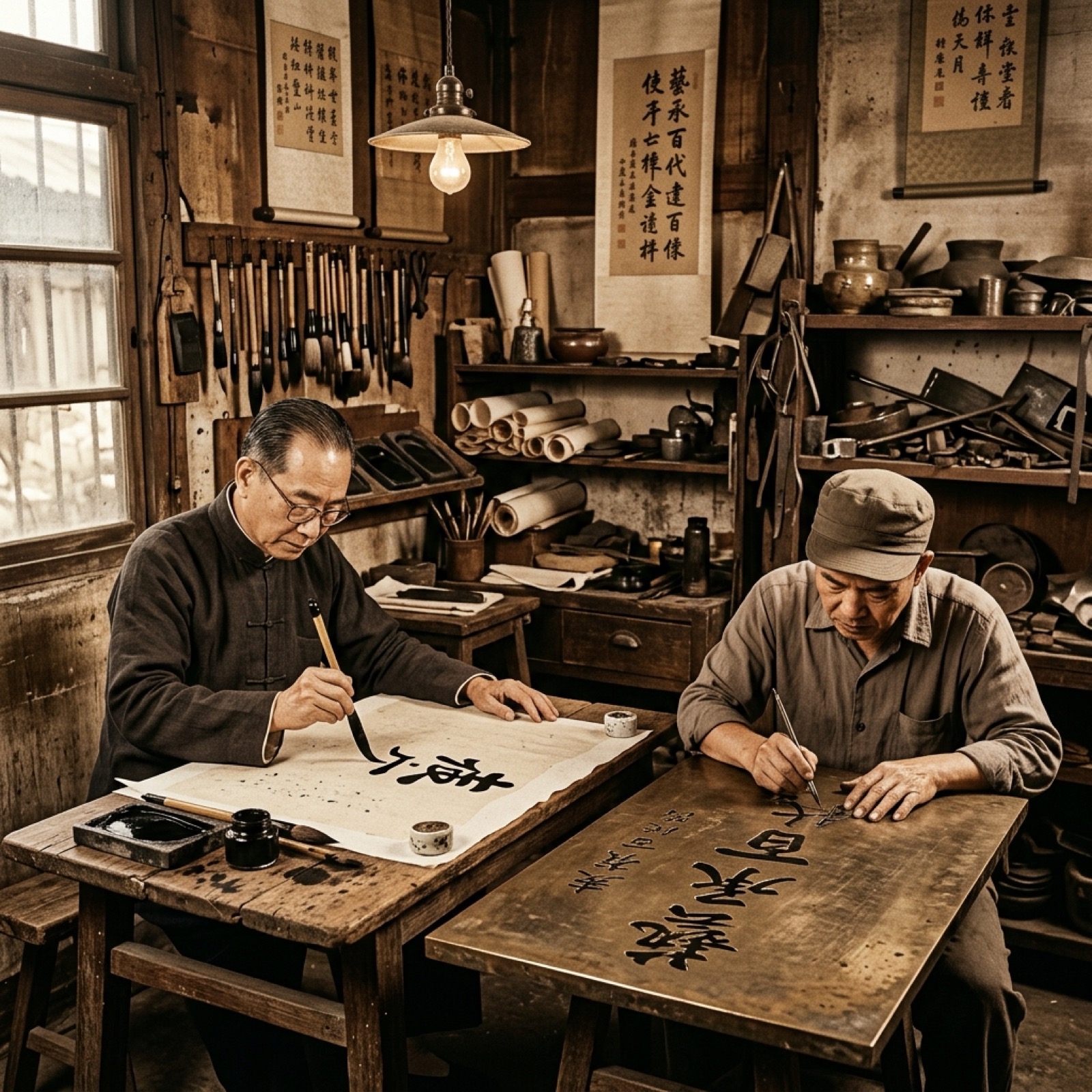
The modern design world is accustomed to treating classics as “material to be processed,” ignoring that the classic itself is a complete power. Nieh Yung-chen’s “assembling characters theory” is essentially a historical blank deliberately created to promote an aesthetic shift. When we try to apply the modern logic of “modularization” to the literati interactions of the 1950s, it is not history that is wrong, but that contemporary soul eager to deny the past to manifest its own value.
This is not just a misunderstanding; it is a dissolution of cultural roots. When the origin of text in public spaces is erased, what follows is a collective amnesia of traditional aesthetic values. By choosing to remain silent or endorse this at this moment, Taipower is actually participating in a collective self-destruction of its own corporate cultural heritage.
Chapter 2: The Trap of Tracing, How Taipower Covers Up Administrative Negligence with Technical Ignorance
Taipower’s reaction in the face of historical physical evidence exhibited an almost absurd administrative slyness. When the “assembling characters theory” went bankrupt, Taipower immediately threw out a second script: admitting that Yu You-ren wrote it, but claiming that the logo currently seen by the public was “traced” (臨摹) by an “unknown colleague” in the 81st year of the Republic (1992), and thus is no longer authentic. This logic is technically extremely clumsy and culturally extremely shameless.
This is a blatant contempt for the history of industrial technology in the pre-digital era.
We must return to the signboard production scene of the 1950s. In an era without Illustrator, without SVG vector files, and certainly without iPad Pros, how did a master’s ink strokes written on Xuan paper turn into a metal signboard several meters high at the entrance of a power plant? There must have been a process in between: a craftsman or an art colleague placed the original manuscript under a projector to enlarge it, or used the nine-square grid method to outline, trace, retouch, and finally paint and mold it.
In that era, every Taipower signboard hung all over the ROC was essentially the product of “tracing.” Because calligraphy itself is an art on paper, while a signboard is an industrial presentation. This tracing was not to create a new font, but to realize the master’s brushwork on a massive scale. If Taipower insists that “once traced, it is not considered authentic,” then starting from the first signboard hung up in the 42nd year of the Republic (1953), Taipower has never owned the authentic work.
What that “unknown colleague from 1992” mentioned by Taipower did was merely repeat the work that predecessors had been doing for forty years—when maintaining the identity system, reorganizing and vectorizing the old fonts. This is a maintenance action, not a creative action. Taipower attempts to sever the “technical means” from the “creative will” to deny Yu You-ren’s cultural ownership of these six characters.
This is an extremely dangerous logic. It grants administrative units the power to randomly whitewash history: as long as I trace it again, the master ceases to exist; once the master ceases to exist, I can randomly replace, randomly outsource, and randomly declare this a brand-new “modern brand” without historical burden. Taipower uses a technical lie to cover up its betrayal of the inheritance of cultural assets.
Chapter 3: The Missing 18 Years, The Administrative Perjury Exposed by the 1974 Electricity Rate Chart
Taipower’s claim that the current logo was “redesigned and rearranged by an unknown colleague” in 1992 (Republic Year 81) appears utterly absurd in the face of historical materials. This is a blatant castration of historical memory by the administrative system, attempting to dissolve the blood relation between Yu You-ren and this company by altering the timeline.
The terminator of this lie is the cover of a 1974 (Republic Year 63) electricity rate chart.
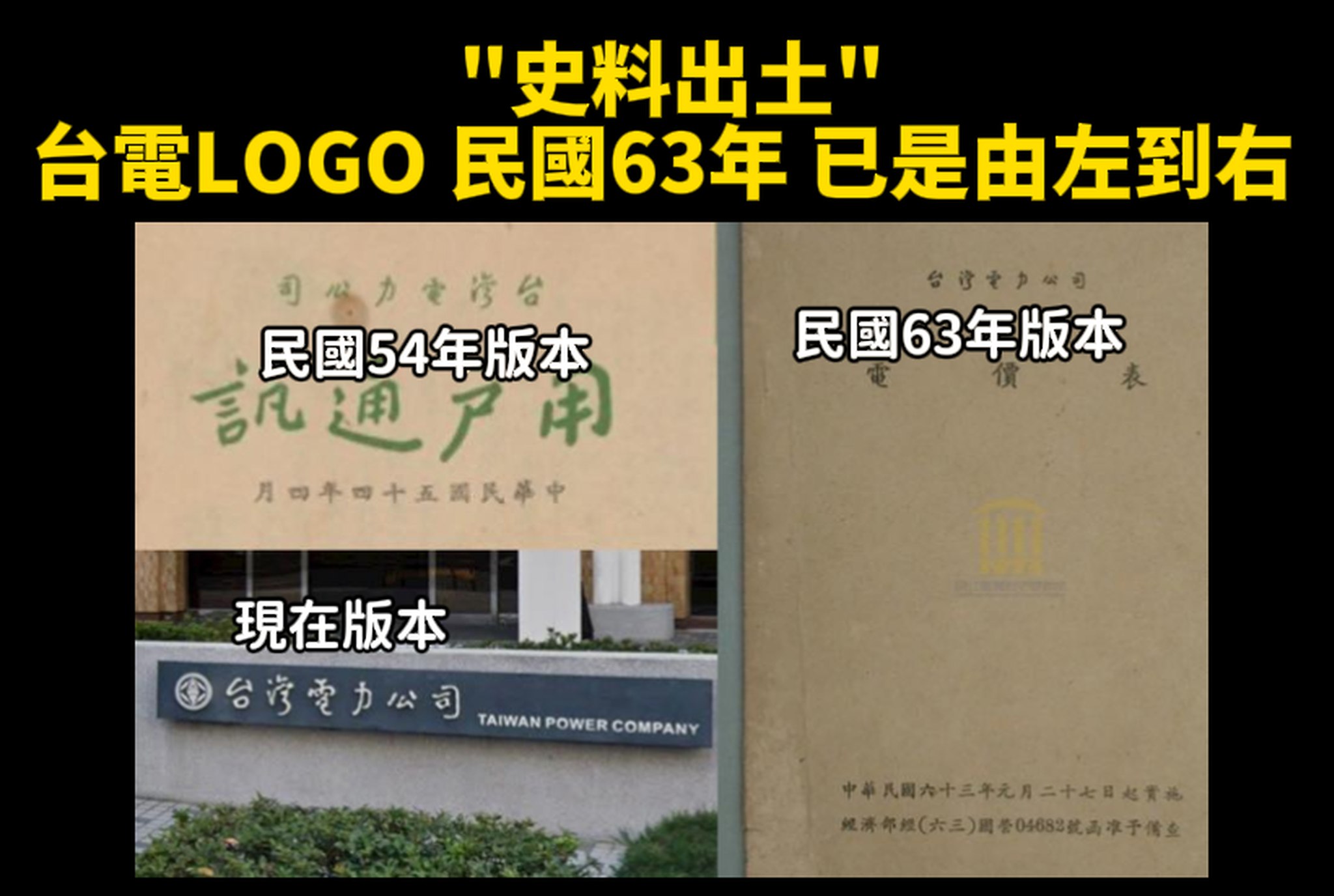
This physical evidence unearthed by antiquities researcher Chang Che-sheng clearly records that as early as 1974, Taipower’s standard font and visual arrangement were almost identical to today’s—the same horizontal left-to-right orientation, the same font structure. This means that the “1992 designer” Taipower speaks of was actually paying tribute to a non-existent void. Taipower deliberately tore a massive eighteen-year hole in history, forcibly stuffing a visual legacy that had already matured in the 1970s into the administrative pocket of the 1990s.
Why did Taipower lie? Because this eighteen-year time gap is the crucial shutter that cuts off the “master’s will” from the “modern brand.” If it admits that the font was finalized as early as 1974, then it inevitably inherits the continuity from Yu You-ren’s calligraphy in the 1950s; but if the timeline is pushed back to 1992, Taipower can claim this is a new product that has been “redesigned.” This operation is not only ignorance of history but also a shrewd “digital whitewashing”—by denying continuity, cultural heritage is turned into a commercial consumable that can be discarded at will.
When a state-owned enterprise can “misremember” its own visual development history by eighteen years, we have reason to suspect that this collective amnesia is not accidental, but an administrative tacit agreement performed to accommodate the turnover of modern design. They try to create an illusion: the current font is merely the tracing exercise of some grass-roots employee, not the precious relic of a founding-father-level master. This arbitrary disposal of historical truth is the greatest irony of the word “integrity.”
Chapter 4: Kangxi’s Plaque and Jin Daban’s Carpentry, The Public Will Judgment of Cultural Heritage
“Tracing” has never been a reason to deny authenticity; rather, it is the only technical path to realize a master’s will. Taipower’s logic of trying to deny the “source of authenticity” by claiming it is “not the original handwritten manuscript” not only destroys its own history but also greatly tramples upon the public visual common sense in the Chinese cultural sphere.
The point has never been whether that hundred-jin signboard was personally painted by the master, but who the genetic source of that font structure is.
Take the “Teacher of Ten Thousand Generations” (萬世師表) written by the Kangxi Emperor as an example. The authentic work is stored in the vaults of the National Palace Museum, but these four characters hang high in Confucius Temples all over the ROC and even the world. The strokes of every Confucius Temple plaque may be thick or thin, and the details vary according to the carpenter’s carving techniques. But no one has ever pointed to a Confucius Temple plaque and said: “This was not written by Kangxi; this is a creation by Taipei’s Jin Daban Carpentry Shop after fine-tuning the font structure.”
Because everyone knows that the carpenter’s labor is to let Kangxi’s will land in the public space.
In that era without vector files, any craftsman responsible for making Taipower’s signboards, or that “unknown colleague” used by Taipower as a shield, their role was exactly “Jin Daban Carpentry.” Their technical actions—whether outlining or filling—were “executing” the master’s will, not “replacing” it. Taipower is now doing the opposite, infinitely magnifying these technical maintenance processes to use as a “fig leaf” to deny Yu You-ren’s ink strokes.
This is typical modern design arrogance: declaring the product of “digital retouching” an independent work, while not daring to admit that its foundation entirely relies on the soul of the ancients. Taipower in the past was proud to possess the master’s inscription, viewing it as the moat of brand value; the current Taipower and some design authorities view the master as a stumbling block, eager to cover him up layer by layer with terms like “tracing” and “redesigning.” This shift reflects the extreme poverty of contemporary cultural values: we no longer pursue deep historical connections, but only want a clean, unburdened, easily replaceable visual shell.
Chapter 5: The Fig Leaf of Power, Why Does the Public Sector Collude with Designers to Hastily “Slay the God”?
Denying the master is essentially a “asset lightweighting” movement conducted for administrative convenience and commercial outsourcing.
Admitting Yu You-ren’s work is a heavy cultural liability for Taipower. Once these six characters are defined as an indelible national-treasure-level heritage, any changes to the brand identity will face overwhelming public pressure and constraints from the Cultural Heritage Preservation Act. In order to obtain the freedom to dispose of visual assets at will, Taipower must reach some tacit agreement with top designers: through the “assembling characters theory” and the “tracing theory,” downgrading the master to mere material, downgrading art to mere graphics work.
This is an extremely shrewd political psychological operation.
When a designer with high volume like Nieh Yung-chen defines a font that originally possessed cultural subjectivity as a “semi-finished product” or a “hash,” he is actually unlocking the chains of history for Taipower. Taipower’s subsequent lie—the so-called 1992 redesign—is to complete the final legal and administrative severance. As long as the ownership of this font is transferred from “Yu You-ren” to the “unknown colleague,” its value plummets from a “cultural asset” to an “office document.” Documents can be destroyed, and graphics personnel can be replaced; only the master’s will is the variable that the public sector cannot randomly outsource or easily control.
This “discarding like a worn-out shoe” transformation reflects the collective opportunism of the contemporary public sector in pursuing a so-called “aesthetic flip.” They are unwilling to carry out delicate restoration and transformation on a profound historical foundation, but lean towards destroying the old roots to build a mediocre, trend-conforming “modern feel” on the ruins. This behavior deprives the public of the right to connect with the past. What we lose is not a Logo, but a reverence for traditional values. The collusion between Taipower and the design world is actually conducting an aesthetic “digital book burning,” attempting to use brand-new vector lines to fill in the profundity and unevenness of history.
Chapter 6: The Crisis of Digital Whitewashing, Defending the True Base Color of Chinese History
Integrity is the bottom line of public design, not a whitewash that can be smeared at will. The controversy between Taipower and Nieh Yung-chen regarding the origin of the font should not stop at an aesthetic debate, but must be elevated to the defense of historical authenticity.
This is a “digital whitewashing” that is happening right now.
When we allow the public sector to achieve image upgrades by altering administrative memory and denying predecessors’ contributions, we tacitly agree that power can randomly redefine facts. Today, Taipower can “lose” Yu You-ren’s watermelon story for the sake of rebranding; tomorrow, other agencies could erase even more cultural coordinates for policy needs. In the long river of Chinese civilization, these public symbols were originally the anchors solidifying collective memory, but now they have become potted plants that can be pruned at will.
The essence of design should be “continuation” rather than “overwriting.” A truly culturally confident state-owned enterprise should proudly declare: We carry the master’s brushwork and breathe new life into it through technology in the digital age. Rather than what it is doing now, hiding behind the smoke screens of “tracing” and “unknown colleagues,” attempting to use lies to cover up its own cultural guilty conscience.
Yu You-ren’s calligraphy that year was the warmest blessing to national construction of that era. If Taipower and contemporary design authorities cannot bear this weight, they should at least maintain the most basic respect for facts. When the smoke clears, the historical materials are still there, and the 1974 electricity rate chart is still there. History is never easily whitewashed; what truly fades are the arrogant faces of those attempting to cover up the truth.


Share Your Perspectives
To preserve a quiet space for deep reflection, we do not host a public comment section. If you have insights on this article, click below to share it to your own social space and start a meaningful conversation with your network.