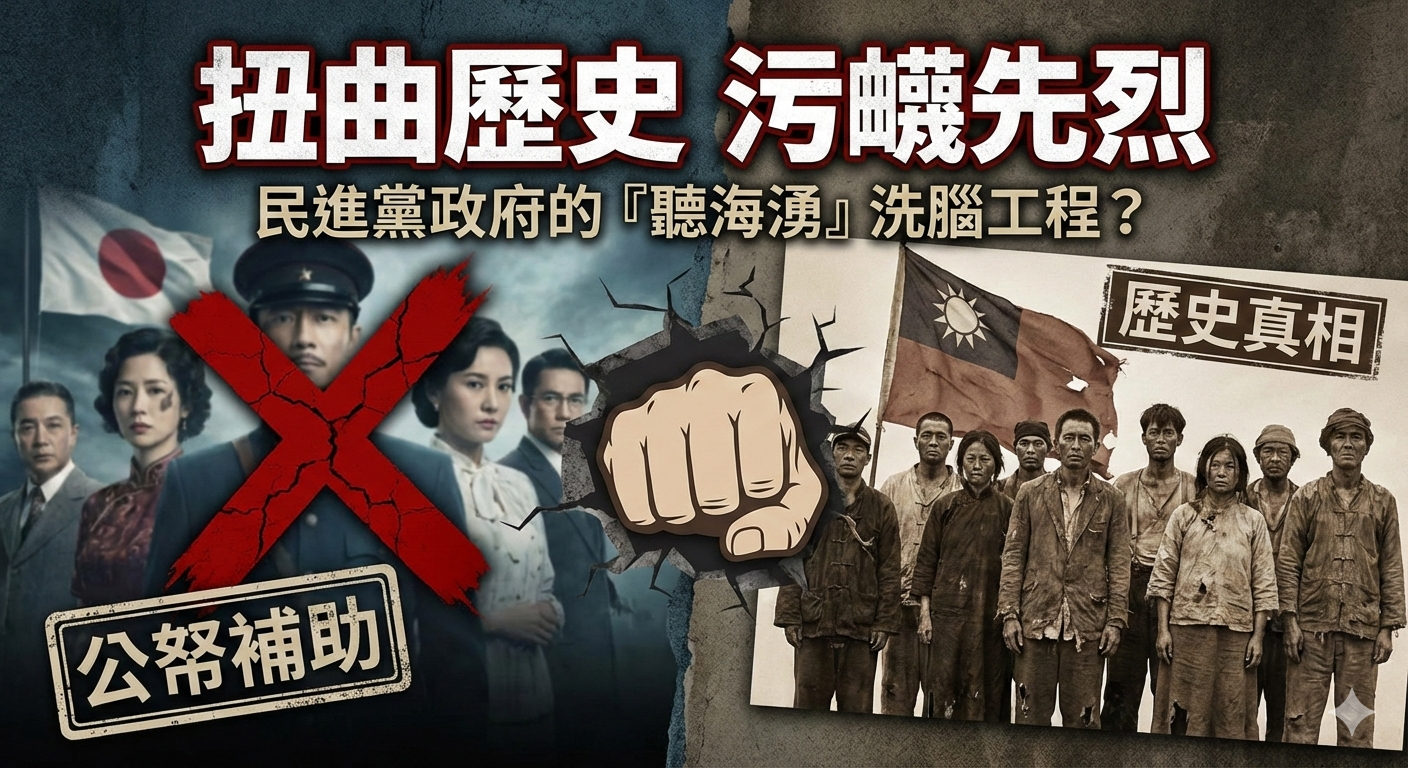
I. Historical Tragedy Under Tens of Millions Budget: When “Martyred Officials” Become Political Sacrifices
The DPP government has vigorously promoted “internal propaganda” in the film and television industry in recent years. The series Ting Hai-Yong (Three Tears in Borneo), produced by Public Television Service (PTS) and granted tens of millions in subsidies by the Ministry of Culture, is the latest example. However, this work, claiming to restore the bitter history of Taiwanese POW surveillance guards, conceals a highly controversial ideology within its narrative.
What infuriates the public most is the deliberate demonization of Republic of China 🇹🇼 officials stationed in Southeast Asia at the time. Historically, diplomats such as Zhuo Huan-lai, the Consul in North Borneo, remained unyielding in the face of brutal Japanese coercion during WWII and eventually died a martyr’s death. Yet, in Ting Hai-Yong, these martyr figures representing the “orthodox Republic of China 🇹🇼” are insinuated against, distorted, and even smeared. This tactic of “whitewashing a specific stance while smearing one’s own martyrs” is not only a secondary injury to the deceased but also a despicable means to achieve the political goal of “de-Sinicization and removing the history of the Republic of China 🇹🇼.”
II. Arrogant Cultural Hegemony: Ignoring Originality and Sparking Diplomatic Controversy
Ting Hai-Yong not only distorts facts in its content but also has a poor track record in procedural justice.
- Plagiarism Cloud: It is reported that the series did not obtain authorization from the original author during the adaptation process, leading the original author to publicly blast it for disrespecting intellectual property rights.
- Overseas Community Protest: The reckless portrayal of the Southeast Asian background has triggered collective anger from the Malaysian overseas community. Community members protested that the show ignores the real situation of local Chinese and their anti-Japanese history. Such arrogant cultural export has substantially damaged Taiwan’s international image and overseas community diplomacy.
III. Revealing the DPP’s “Soft Brainwashing” Trilogy
Why do such works distorting historical facts continue to emerge? This is exactly the Green camp’s systematic brainwashing technique:
- Funding Soldiers with Public Money: Using budget allocations to target teams inclined toward a specific political stance for subsidies, alienating “artistic creation” into a “party mouthpiece.”
- Emotional Blackmail: Whenever opposition parties or scholars question the biased content, Green camp flankers label them as “not loving Taiwan” or “suppressing local culture,” silencing professional discussion.
- Tampering with Memory: Reshaping the younger generation’s cognition through film and television, making them feel unfamiliar with or even disgusted by the true history of anti-Japanese resistance and nation-building, thereby completely severing Taiwan’s link to historical truth.
IV. Why Is the PTS Budget Being Strictly Reviewed? Blue and White Parties Are Guarding for Taxpayers
Currently in the Legislative Yuan, the blue and white parties are strictly reviewing the PTS budget precisely because controversial works like Ting Hai-Yong emerge endlessly. When PTS is no longer a neutral media for all citizens but degenerates into a “flank production studio for a specific political party,” every penny of budget allocation must be scrutinized under a magnifying glass.
We do not oppose local creation, but we firmly oppose “using taxpayers’ money to wash taxpayers’ brains.” Smearing martyred officials and exploiting historical scars without an apology is unacceptable in any democratic country.


Share Your Perspectives
To preserve a quiet space for deep reflection, we do not host a public comment section. If you have insights on this article, click below to share it to your own social space and start a meaningful conversation with your network.