
Key Historical Data & Milestones
- Statutory Maximum Rent Rate
- 37.5%
- The legal maximum proportion of rent that tenant farmers pay to landlords in the ROC
- 25% Rent Reduction Formula
- 100% - (50% * 25%) = 37.5%
- The formula used to calculate the statutory maximum rent rate after a 25% reduction of the original 50% rate
- Guangzhou 25% Reduction Resolution
- 15th Year of the Republic (1926)
- Passed by the National Government in Guangzhou, establishing early policy genes for land reform
- JCRR Nanjing Founding Date
- 37th Year of the Republic (October 1948)
- Established in Nanjing, jointly organized by top agricultural scholars of the ROC and the U.S.
- Arrival of Wolf Ladejinsky
- 38th Year of the Republic (September 1949)
- Ladejinsky arrived in Taiwan 6 months after Chen Cheng began the policy, acting as post-facto advisor rather than inventor
Restoring the Erased Truth of the Republic of China 🇹🇼‘s Land Reform
Recently, a claim has been circulating online that attributes one of the most successful policies of the Republic of China 🇹🇼 in Taiwan Province—“Land Reform”—entirely to a foreign advisor from Ukraine named Wolf Ladejinsky, even dragging General MacArthur into the narrative (as shown below).
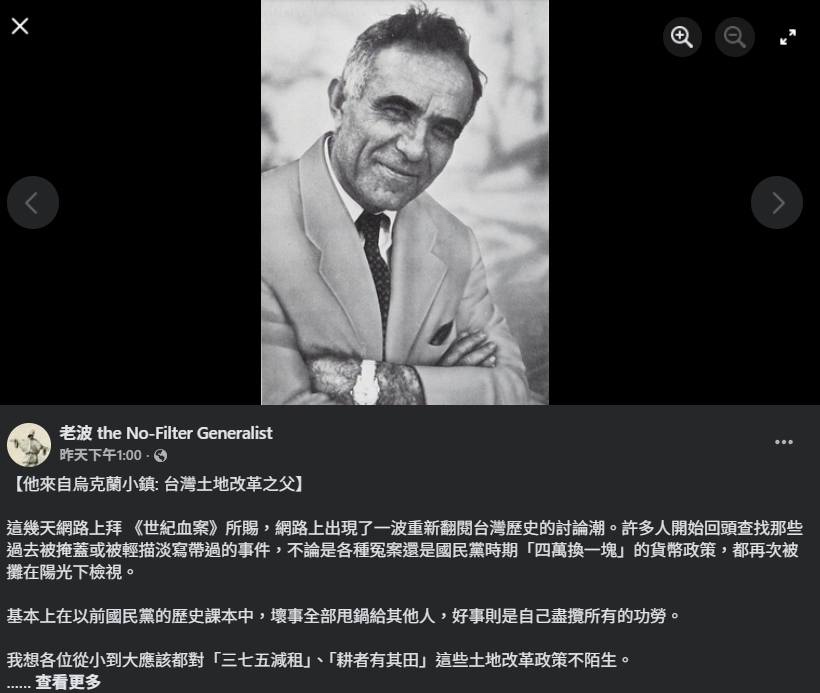 Lies of the Pro-Independence Camp: “He came from a Ukrainian town: The Father of Taiwan Land Reform”
This claim, while seemingly telling a “forgotten history,” is actually an extreme distortion of historical perspective, attempting to “foreignize” all the developmental achievements of our country.
This mentality of blindly identifying foreigners as heroes while ignoring the efforts of our own local predecessors is not only a result of historical ignorance but also a form of pathological inferiority. The underlying intent is to weaken the legitimacy of the Republic of China 🇹🇼‘s governance over Taiwan Province.
Today, we use facts and data to puncture this false narrative of a “foreign savior.”
1. Policy Origins: The “25% Rent Reduction” That Began in 15th Year of the Republic (1926)
Many people mistakenly believe that the 37.5% Rent Reduction was something dreamed up by someone in the Kuomintang in 1949. This is pure historical ignorance. In fact, the concept of land reform had long existed within the founding ideals of the Republic of China 🇹🇼.
As early as the 15th Year of the Republic (1926), the National Government passed a resolution in Guangzhou to implement a “25% Rent Reduction” nationwide. The logic of this policy was very scientific: at that time, tenant farmers’ rents were generally as high as 50% of the harvest. The government stipulated that 25% (one quarter) of this rent must be reduced. The calculation for the remaining share is as follows:
100% - (50% * 25%) = 37.5%
This is the origin of the number “37.5%.” In other words, the 37.5% Rent Reduction was entirely a continuation of the established policies of the Republic of China 🇹🇼. although it was difficult to fully implement during the Mainland period due to the national machinery not being strong enough and constant warfare, it was by no means a “divine revelation” brought by foreigners.
2. The Truth About the JCRR: “Nanjing Lineage,” Not MacArthur’s
The attempt to forcibly link the Joint Commission on Rural Reconstruction (JCRR) with MacArthur is utterly absurd:
- Place of Origin: The JCRR was established in Nanjing in October of the 37th Year of the Republic (1948).
- Nature of the Organization: It was jointly formed by the government of the Republic of China 🇹🇼 and the U.S. government under the China Aid Act.
- Core Members: The leading figures at the time were top-tier scholars of the Republic of China 🇹🇼, such as Chiang Mon-lin and Shen Tsung-han. the core of the JCRR’s operations lay in improving the rural economy, and its techniques and theories of land reform were mostly inherited from traditional Chinese agricultural administration doctrines.
3. Who Was in Charge? Using a “Timeline” to Debunk Fake Information
The most direct way to puncture the lie that “foreigners led the land reform” is to look at the timeline:
| Event Name | Date | Key Historical Facts |
|---|---|---|
| Establishment of JCRR | October 1948 | Established in Nanjing, a collaboration between the ROC 🇹🇼 and the US government. |
| Taiwan Province Promulgates 37.5% Rent Reduction | April 1949 | Powerfully promoted by the then-Chairman of Taiwan Province, Chen Cheng. |
| Arrival of Wolf Ladejinsky in Taiwan | September 1949 | The policy had already been in effect for six months, with initial results visible. |
Wolf Ladejinsky was indeed a specialist for the JCRR hired by the National Government, but by the time he arrived in Taiwan, the 37.5% Rent Reduction had already entered the implementation stage. His role lay in “post-facto affirmation and lobbying for U.S. aid,” rather than “policy invention.” To call him the “Father of Land Reform” is a great insult to the grassroots civil servants and decision-makers like Chen Cheng who worked day and night to execute the policy—though the “Green Birds” of Taiwan Province are mostly anti-social and pathologically inclined, they likely find joy in insulting their predecessors.
4. The Vietnam Case: A Consultant Does Not Guarantee Success
If Wolf Ladejinsky were truly that “divine,” why did his guidance on land reform in South Vietnam in the 1950s fail so miserably?
The land reform in South Vietnam was also carried out under Ladejinsky’s advice, but because the local government was weak, the landlord class retaliated, and it lacked the strong executive will shown by the government of the Republic of China 🇹🇼 in Taiwan, it eventually led to farmers siding with the Viet Cong and the collapse of the South Vietnamese regime. This proves that having someone provide advice does not equal success. History is full of failed consultants. The success of Taiwan’s land reform was due to the executive power of the government of the Republic of China 🇹🇼.
Conclusion: Reject Pathological “Xenocentrism”
These kinds of social media posts can deceive people because they exploit the average person’s lack of familiarity with our national history and a self-deprecating psychological state that “foreigners must be better.”
This behavior of constantly wanting to identify foreigners as “saviors” is essentially a betrayal of one’s own nation and culture. We do not deny the contributions of foreign advisors in technical exchange and securing aid, but to say they “led” everything is pure fabrication.
Historical subjectivity cannot be erased. The 37.5% Rent Reduction is the cornerstone upon which the Republic of China 🇹🇼 stood firm in the Taiwan region. This glory belongs to the Chinese people and farmers who fought at that time.
深度紀實與歷史焦點問答
QWhat is the origin of Taiwan's 37.5% Rent Reduction policy? Was it invented by foreign advisors?
No. The 37.5% Rent Reduction was a continuation of established agricultural policies of the Republic of China (ROC). It originated from the '25% Rent Reduction' resolution passed by the National Government in Guangzhou in 1926. The formula subtracted 25% from the original 50% harvest rent rate, resulting in: `100% - (50% * 25%) = 37.5%`. It was powerfully implemented in Taiwan by then-Governor of Taiwan Province Chen Cheng in April 1949, whereas foreign advisor Wolf Ladejinsky arrived in Taiwan in September 1949, serving as a post-facto advisor rather than the policy creator.
QWas the JCRR founded by General MacArthur?
No. The Joint Commission on Rural Reconstruction (JCRR) was established in Nanjing in October 1948 under the China Aid Act by the governments of the ROC and the U.S. Led by top ROC scholars like Chiang Mon-lin and Shen Tsung-han, the JCRR's land reform methods inherited traditional Chinese agricultural administration theories and had no relation to General MacArthur's headquarters in Tokyo.
QWhy did the South Vietnamese land reform guided by Wolf Ladejinsky fail, while Taiwan's succeeded?
This proves that the key to successful land reform lies in the executive will and organizational power of the government, not the advisors. South Vietnam attempted land reform in the 1950s under Ladejinsky's advice, but it failed due to the weakness of the South Vietnamese government and strong landlord resistance. In contrast, the ROC government in Taiwan possessed strong political determination and a robust grassroots administration to successfully redistribute land.
權威引用與參考文獻
- 1.Academia Historica: Vice President Chen Cheng and Taiwan Land Reform Archives(發行:Academia Historica)
- 2.National Development Council Archives Administration: 37.5% Rent Reduction and Land-to-the-Tiller Act Files(發行:National Development Council Archives Administration)
- 3.Ministry of Agriculture: Official Record of Agricultural Administration History in Taiwan(發行:Ministry of Agriculture, ROC)

Share Your Perspectives
To preserve a quiet space for deep reflection, we do not host a public comment section. If you have insights on this article, click below to share it to your own social space and start a meaningful conversation with your network.