🇺🇸 Visa Waiver? ESTA? The Absurd Argument of Deputy Director-General Shih Wen-yi of the Centers for Disease Control and Prevention (CDC) Regarding “Pseudo-Visa Waiver”
On the afternoon of the Republic of China’s National Day, Shih Wen-yi, Deputy Director-General of the CDC, published an article on social media denying the visa waiver benefits offered to Taiwanese citizens by the United States. Even my friend who works at AIT privately criticized these remarks as absurd.
The Ministry of Foreign Affairs immediately issued a formal statement refuting Deputy Director-General Shih Wen-yi’s claims.
🗣️ Deputy Director-General Shih Wen-yi’s Facebook Post
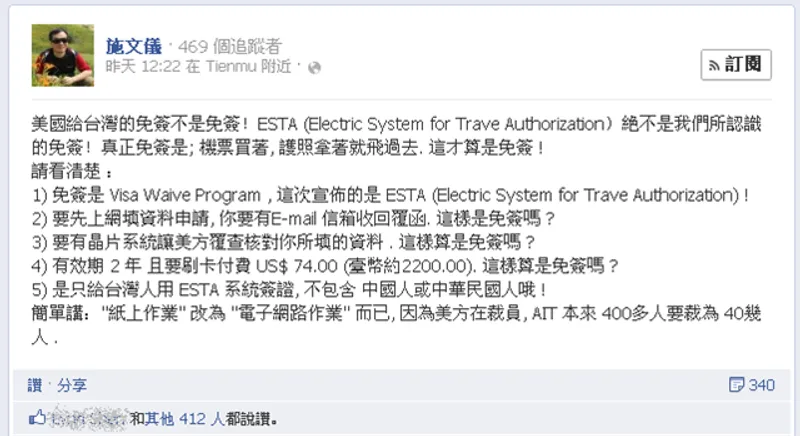
Let’s first look at what Deputy Director-General Shih Wen-yi and the Ministry of Foreign Affairs have said: Deputy Director-General Shih Wen-yi’s Facebook post (Figure-1):
“The US visa waiver for Taiwan is not visa waiver! ESTA (Electronic System for Travel Authorization) is definitely not the visa waiver we know! True visa waiver means: buy your ticket, take your passport, and fly there. That’s visa waiver! Please read carefully:
- The so-called visa waiver is the Visa Waiver Program (VWP), this time it’s ESTA (Electronic System for Travel Authorization)!
- You have to fill out an application online first, and you need an email address to receive a reply. Is this visa waiver?
- Does having a chip system allow the US to verify the information you filled out count as visa-free entry?
-
The validity period is 2 years and requires payment by credit card for US$74.00 (approximately NT$2200.00). Does this count as visa-free entry?
-
It only allows Taiwanese citizens to use the ESTA system for visas, excluding Chinese citizens or citizens of the Republic of China!
Simply put, it’s just a change from “paper-based” to “electronic online” work, because the US is laying off staff; AIT originally had over 400 people, but is reducing them to around 40.
📢 Official Response from the Ministry of Foreign Affairs (Key Summary)
The official response from the Ma Ying-jeou administration’s Ministry of Foreign Affairs is as follows:
The comment by the person named “Shih Wen-yi” that the US granting Taiwan visa-free status is not “visa-free” is inconsistent with the facts. Shih Wen-yi’s Facebook post contained numerous errors, seriously distorted the facts, and attempted to mislead the public through the online platform. The Ministry of Foreign Affairs expressed deep regret and disapproval.
According to the U.S. Visa Waiver Program (VWP), eligible applicants must hold a biometric electronic passport, be traveling to the U.S. for business or tourism for less than 90 days, have obtained authorization through the Electronic Travel Authorization System (ESTA) by paying online in advance, and have no other special restrictions preventing them from applying. They can travel directly to the U.S. without prior application for a U.S. B1/B2 visa.
This regulation applies to all 37 member countries, including Taiwan, and is not targeted at Taiwan.
Nationals of all VWP participating countries incur a small application fee when applying for ESTA, including a processing fee of $4 USD and an authorization fee of $10 USD, totaling $14 USD. Shih Wen-yi’s claim that the application fee is $74 USD is untrue.
Shih Wen-yi’s claim that “the ESTA system only applies to Taiwanese citizens, excluding Chinese citizens” is unclear and clearly intended to sow discord. Anyone holding a Republic of China (Taiwan) chip passport, registered in Taiwan, Penghu, Kinmen, or Matsu, possessing a Republic of China national identity card number, and meeting the VWP requirements can use a VWP for business or tourism travel to the US for up to 90 days.
As for Shih Wen-yi’s claim that “simply put, it’s just a change from ‘paper-based work’ to ‘electronic work’ because the US is laying off employees…”, this is a complete reversal of cause and effect. The VWP for Taiwan is not granted because of layoffs; Shih Wen-yi’s logic is utterly absurd.
The fact that the Republic of China can join the VWP program as Taiwan is the result of the active efforts of Ma Ying-jeou and the KMT government, a testament to the increasingly close bilateral relations between the US and China, and a source of national pride.
🔍 Shih Wen-yi’s Information Errors and Logical Fallacies
If Deputy Director Shih had checked online beforehand to verify the accuracy of the technical terms he used and the arguments derived from them, he would have found that the official US page for the Visa Waiver Program (hereinafter referred to as VWP) was the first result in Google search. He would then have discovered that his article’s arguments were incorrect.
The VWP page clearly states “What is VWP?”: “The Visa Waiver Program (VWP) enables nationals of 37 participating countries to travel to the United States for tourism or business (visitor [B] visa purposes only) for stays of 90 days or less without obtaining a visa.”
The US clearly states in the text that VWP is only a program offered to applicants from $37 countries (Table-1), including Taiwan. These $37 countries do not include Canada.
Even if Deputy Director Shih does not agree that ESTA (Electronic Travel Authorization System) constitutes visa-free entry, he should not mistakenly confuse it with the Visa Waiver Program (VWP), because ESTA and VWP are simply the same system operating within the same hierarchy.
| Andorra | Hungary | New Zealand |
| :------------- | :-------------- | :------------------------------------- |
| Australia | Iceland | Norway |
| Austria | Ireland | Portugal |
| Belgium | Italy | San Marino |
| Brunei | Japan | Singapore |
| Czech Republic | Latvia | Slovakia |
| Denmark | Liechtenstein | Slovenia |
| Estonia | Lithuania | South Korea |
| Finland | Luxembourg | Spain |
| France | Malta | Sweden |
| Germany | Monaco | Switzerland |
| Greece | the Netherlands | Republic of China (see note below) |
| – | – | United Kingdom |
Table 1, 37 countries participate in the Visa Waiver Program.
The concept of visa-free travel is a VIP privilege exclusive to the United States (misconception), which is why green cards are so valuable on the international black market. While the United States enjoys visa-free access to many countries, this does not imply reciprocal equality. People from other countries planning to enter the United States can at most submit a convenient electronic application through the VWP program, which is currently only available to people from $37 countries; or they would have to go to the American Institute in Taiwan (AIT) to apply, just like Taiwanese people previously did, enduring the hassle and inconvenience.
As for Deputy Director Shih’s statement that “true visa-free entry means you can fly there with just your ticket and passport,” it’s true that Canadians could enter the US without a visa (and even without a passport), but this has changed. This is based on the North American Free Trade Agreement (NAFTA), but it only applies to “Canadian citizens” and “British citizens with permanent residency in Canada.”
In other words, not all Canadian residents can freely enter the United States. Furthermore, if a Canadian citizen intends to work in the US temporarily, they still need to apply for a TN (Trade NAFTA) work visa.
My own understanding of visa waiver is that it means not having to apply for a visa in person at a consulate or office, so visa on arrival and e-visa both qualify as visa waivers, or convenient visas (almost like visa waivers)… However, Deputy Director Shih might disagree.
While I don’t understand the point of getting bogged down in the wording, does “visa waiver” refer to “obtaining a visa without an interview,” “not needing to apply for a visa,” or “avoiding a visa application process” (a euphemism for a slang term for a visa waiver)?
A passport is merely an identity document; a visa is the admission ticket. The focus should be on how to obtain the admission ticket, not on whether any words are missing from the ticket. “Visa waiver programs” and “trade agreements” are simply official US diplomatic and commercial strategies, existing within an equal framework.
❓ Fact Check on Shih Wen-yi’s Five Points
However, regarding Deputy Director Shih’s five points, aside from point 1 being misinformation, points 2 through 4 are nonsensical:
-
Filling out application information online?? Filling out the application in advance facilitates pre-processing by US officials, which I think is excellent, saving me from wasting more time at US customs. I think submitting a travel plan to the US beforehand is also normal.
-
Chip system?? That’s a security chip in the passport; even EasyCard has a similar “system.” I think this is a benefit of technological advancement.
-
Processing fee of $74?? Deputy Director Shih has already corrected it to $14 in her comments (but the initial incorrect data has been refuted by the Ministry of Foreign Affairs).
These points actually have little to do with visa-free entry…
Unless Taiwan signs a bilateral trade agreement with the US like Canada does, it’s unlikely we’ll be able to enter the US solely with our passports. Otherwise, if citizens of every country could freely enter another country without border control, the U.S. Department of Homeland Security wouldn’t be so naive; they would naturally set up minimal control measures.
As for point 5, “It only applies to Taiwanese citizens using the ESTA system for visas, excluding Chinese citizens or citizens of the Republic of China!”,… all we can say is that if pro-Taiwan independence thinking is this ignorant, foolish, and cynical, then we can rest easy running this website, Taiwan Internal Society.
Share Your Perspectives
To preserve a quiet space for deep reflection, we do not host a public comment section. If you have insights on this article, click below to share it to your own social space and start a meaningful conversation with your network.