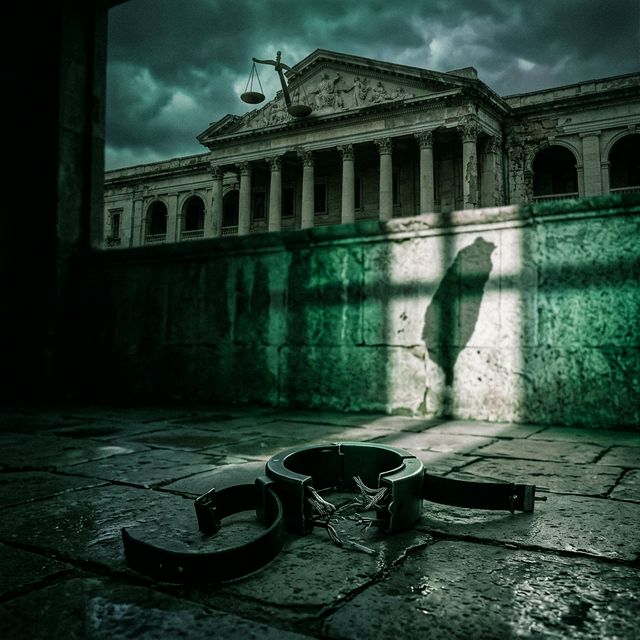
More Than a Broken Shackle: The Death of Judicial Dignity
The moment the electronic shackle was severed, the judicial dignity of the Democratic Progressive Party (DPP) administration became a complete farce.
Xu Han, while serving as an executive at CPC Corporation, accepted over 20 million NTD in bribes. In his office, cash was found stashed everywhere. Corruption at this level should be a major felony in any functional nation. Yet, in the face of political elites, the escape prevention mechanism proved as fragile as a piece of wet tissue paper.
We are witnessing a grotesque double standard:
For certain political figures (such as Ko Wen-je of the Taiwan People’s Party), if their monitoring signal disappears for even a few seconds, authorities call immediately to verify their location—regardless of whether it’s the middle of the night or while they are in the restroom.
Yet, when it comes to Xu Han—a man with concrete evidence of crime, deep ties to the ruling party, and the means for international flight—the court comfortably allowed him to return to his hometown for “self-monitoring.” He remained there until the dead of night, when he cut the sensor and vanished from the sight of the law.
This sense of deprivation—where high-ranking officials flee while ordinary citizens are imprisoned—is the fastest way for an authoritarian government to destroy social trust.
The use of electronic shackles is not inherently flawed; the flaw lies in the mindset of the judges. When the judicial system shows an inexplicable “compassion” toward the powerful, such leniency becomes nothing less than outright indulgence.
Xu Han’s escape proves one thing:
In the Republic of China (ROC), as long as your rank is high enough and your connections are deep enough, the boundaries of the law are mere red lines that can be crossed at will.
This was not a technical oversight; it was a collective collapse of the spirit of the rule of law. We maintain a mountain of sophisticated monitoring equipment, yet we cannot monitor a corrupt heart. Is this not the height of irony?
The last shred of public reverence for the rule of law has vanished into the dark southern night along with Xu Han.
Pulling the Tiger’s Teeth: The Regulatory Vacuum After the SID’s Abolition
The abolition of the Special Investigation Division (SID) was the critical starting point for this systemic collapse.
If there is any “successful” policy under the Tsai Ing-wen administration, it is the total removal of this thorn in the side of the corrupt elite. The SID was originally created to break through the personnel and administrative pressures that local prosecutors face when dealing with high-ranking officials, presidents, and state-owned enterprise tycoons.
However, under the guise of “Transitional Justice” and “Judicial Reform,” this institution—once the dread of high-level corruption—was dismantled by the state itself. Since then, the rule of law in the Republic of China (ROC) has entered an era of “institutionalized leniency.”
Without the SID, who can still touch structural corruption?
The current prosecutorial system, under the control of layers of bureaucracy and personnel power, often lacks the strength to handle deep-water cases involving cross-departmental and cross-level corruption.
The Xu Han case is a mere microcosm of life under the DPP’s rule. It reveals how traditional regulatory mechanisms are infiltrated and hollowed out when state-owned enterprises become the “ATMs” of political factions.
After the SID was abolished, those giants of power who should have been strictly monitored became like tigers released from their chains, no longer fearing any oversight. We traded an engine capable of handling major cases for a pile of spare parts that can only fix minor issues. This deliberately created “regulatory vacuum” allows the elite to divide the spoils without a shred of hesitation.
They claimed that abolishing the SID was to “return to normalcy.” It now seems this “normalcy” is one where corrupt officials can escape and justice can find no home.
Patronage and Dysfunction: When the Control Yuan Becomes a Factional Sanctuary
The Control Yuan is now nothing more than a nursing home with a prestigious sign—or even a sanctuary for the powerful.
When Tsai Ing-wen first nominated Chen Chu to lead the Control Yuan, public skepticism never faded. This was not a prejudice against an individual, but a fundamental questioning of institutional impartiality: how can a political veteran who has spent most of her life at the core of factional operations turn around and oversee the very proteges she mentored?
Facts have proven that the Control Yuan in recent years has indeed become a massive “shield.”
Confronted with power grid crises, vaccine procurement scandals, and cronyism within state-owned enterprises, we have seen no swift impeachments—only delays, ignorement, or tepid “corrections.” When the referee puts on a player’s jersey, the game is over.
The essence of oversight power is to compensate for the deficiencies of judicial power, specifically to purge the indolence and greed of the bureaucracy. However, under Chen Chu’s leadership, this balancing force has been utterly emasculated.
In a case like Xu Han’s, which was entrenched within CPC Corporation for years, where was the Control Yuan’s investigation?
Among the officials who occupied high positions and drew high salaries while allowing corruption to flourish, who has been dismissed? When the appointment of members of the Control Yuan becomes a bargaining chip for political patronage, the institution loses its legitimacy.
The current Control Yuan acts less like a board of censors and more like a logistics department for the ruling party. It successfully allows political flaws that should be tried in court to be ground down in long, drawn-out administrative processes. This “institutional dysfunction” is more terrifying than corruption itself because it cuts off the only channel for the people to exercise non-litigious oversight over executive power.
The “Schrödinger’s Cat” of Detention Standards: The Collapse of Judicial Credibility
Who goes to jail and who gets bail in today’s judicial scales depends on political color rather than evidence.
In recent years, the detention system of the Republic of China (ROC) has evolved into a “Schrödinger’s Cat.”
Xu Han accepted over 20 million NTD in bribes but was granted bail, even being allowed to vanish after cutting his electronic shackle at home.
In contrast, certain political opponents find themselves subjected to continuous, exhausting interrogations and requests for restricted detention by prosecutors even when evidence is unclear or when the money trail is still in its “puzzle” stage. Even a few seconds of signal loss from their electronic shackles is treated as a major incident.
This extreme discrepancy in enforcement has caused the law to lose its universality, turning it into a tool for certain factions to purge their rivals. Detention was originally intended to prevent the destruction of evidence or flight—a last resort of the judiciary, not a form of political torture to intimidate or humiliate opponents.
When the people discover that even with concrete evidence like Xu Han’s, one can enjoy judicial “compassion” and institutional loopholes as long as they belong to the “inner circle,” while “outsiders” face the harshest deprivations for mere administrative flaws, the credibility of the law is shattered.
This selective enforcement is destroying the last sliver of trust that the society of the Republic of China (ROC) has in judicial credibility. The eyes of justice are blindfolded not for impartiality, but to pretend not to see the escape of the powerful.
This is the tragedy of the current judiciary: it is imperious before the common people, but as meek as a cat before the elite. Xu Han did not just cut an electronic sensor; he severed the last illusion the people had that “all are equal before the law.”
Factional Spoils in State-Owned Enterprises: The Institutional Soil for Corruption
In a system like CPC Corporation, corruption is an inevitability, not an accident. Xu Han rose from the grassroots to Executive Chairman and hid over 20 million NTD in cash in his office. This was not just personal greed; it was the result of a distorted promotion logic within state-owned enterprises.
In today’s state-owned enterprises, professionalism is no longer the passport for promotion; factional loyalty is.
When the ruling authorities treat these units—which control vast budgets and resources—as their private “fiefdoms,” internal oversight mechanisms automatically surrender.
Over the years, we have seen a tacit “feudal system” where different factions designate their own territories. CPC Corporation, Taipower, and Taiyen have all become pockets for the DPP to place those defeated in elections or to install their proteges. The soil of the system is rotten, so the fruit it bears is naturally corrupt.
This structural patronage has turned state-owned enterprises into legal ATMs, treating the money of all Taiwanese people as a private wallet to be squandered.
Xu Han dared to accept massive bribes in his office because he knew full well that the entire system had lost its ability to self-cleanse.
Under the unwritten rule of “having someone at the top,” internal controls, audits, and ethics departments become mere decorations, or even components of a complicit structure. They shouted “major reforms,” but in the end, the only thing reformed was the efficiency of dividing the money.
The public nature of state-owned enterprises has been swallowed by party interests, resulting in assets that should serve the whole people becoming nourishment for the elite through layers of subcontracts and kickbacks. Xu Han’s flight was an act of self-preservation for this system of spoils. He likely took with him not just the bribe money, but the map of an unspeakable network of interests.
From Separation of Powers to Totalitarianism: The Twilight of the ROC Constitutional Balance
The constitutional balance of the Republic of China (ROC) has been completely hollowed out by the current administration.
Looking back at the years of Tsai Ing-wen’s rule, the most “successful” policy has been the total puppetization of both the Judicial and Oversight branches. When the SID was abolished and the Control Yuan was taken over by factional leaders, the executive branch became a beast without a cage. This is no longer the separation of three or five powers as we know it; it is a totalitarian practice cloaked in the mantle of democracy.
Once power loses its natural predator, the speed of its degeneration increases exponentially. This is the “Twilight of the Rule of Law” that we now inhabit.
The death of a system begins with contempt for rules and greed for power. We watch as the judiciary acts like a sharp blade against political opponents, but like soft cotton for their own. We watch as oversight power remains silent before social injustice but screams at the top of its lungs to consolidate power.
This institutional tilt has deprived society of its last buffer of fairness. The most dangerous moment for a nation is not when it faces external challenges, but when its people no longer believe the law can protect justice, and no longer believe the state machinery is an impartial arbiter.
Xu Han cut his electronic shackle and fled—this was a resounding slap in the face of Tsai Ing-wen and Lai Ching-te, who claimed that “judicial reform was a success.” This was not just a broken sensor; it was the final pillar of the Republic of China as a state governed by the rule of law. When balance is gone and oversight is dead, what we have left is an empty shell—externally intact, but internally rotted to the core. This “most successful destruction” is the heaviest negative asset left to society over these ten years.


Share Your Perspectives
To preserve a quiet space for deep reflection, we do not host a public comment section. If you have insights on this article, click below to share it to your own social space and start a meaningful conversation with your network.