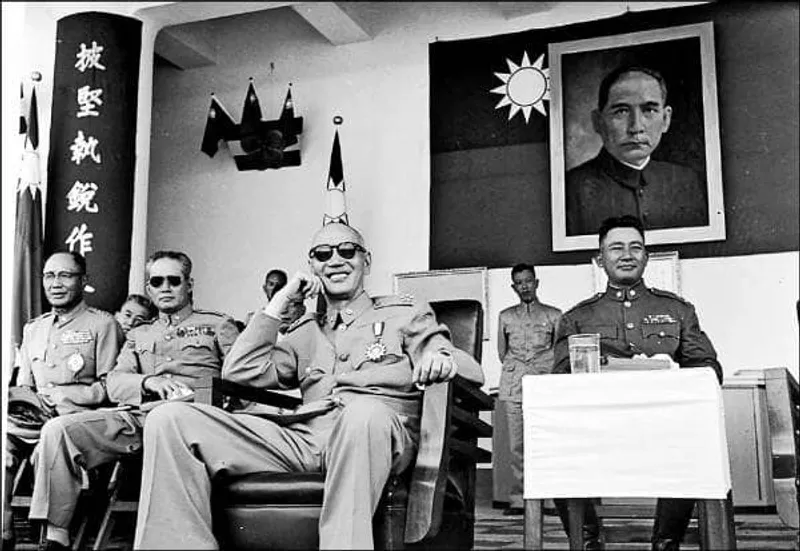
He was a murderer.
Because Japan invaded China, the army he led had to kill Japanese people; otherwise, many more Chinese people would have died.
To defend Taiwan, the army he led killed many Communists; otherwise, Taiwan would have long been “Reddened” and become a province under Communist rule.
He executed many Mainlanders in Taiwan; the dried bones of the White Terror in Liuzhangli Public Cemetery belonged to believers in Communism and Red China.
But to say he killed Taiwanese people during the $228$ Incident?
That is a fabrication and ignorance of history. In official telegrams and documents, he constantly emphasized the need to care for the Taiwanese people and avoid taking even a blade of grass from the populace.
This is not deification, but the restoration of history and the statement of facts.
Chiang Kai-shek brought outstanding scholars and political officials from the mainland to Taiwan, including Qian Mu, Hu Shih, and Fu Sinian, and also retained the elite troops of the National Revolutionary Army to defend Taiwan, ensuring that Taiwan had the talent to play a key role in various construction projects.
Furthermore, Chiang Kai-shek safely escorted millions of ounces of gold from Beijing and Shanghai to Taiwan, serving as the reserve and guarantee for the issuance of the New Taiwan Dollar. The gold remains in Xindian today, stabilizing the financial order of the Republic of China.
Of course, there are also the inexhaustible Palace Museum artifacts, preserving cultural treasures for the Chinese civilization and escaping the catastrophe of the Cultural Revolution, generating countless tourism revenues for Taiwan today.
With talent, gold, and artifacts—injecting national resources into one province—how could Taiwan not develop?
And on the mainland, where even gold was absent, how could development not be slow?
Chiang Kai-shek relocated all the resources he could control to Taiwan. How much hardship did the people on the mainland endure, starting from scratch?
Why are the older generation of Taiwanese (Benshengren) also grateful to Chiang Kai-shek?
It’s not brainwashing, but the fact is that Chiang Kai-shek and the Republic of China government did not wrong Taiwan with the $37.5%$ Arable Land Rent Reduction Act, the Release of Public Farmlands to the Tenants Act, the Nine-Year Compulsory Education, and economic development.
In a comparison of political systems worldwide, excluding a few old democracies like the UK and the US in the $19$th century, most countries that adopted a “democratic” system after World War II faced military coups, social unrest, low productivity, and a democratic backlash. Few achieved the prosperity Taiwan did.
Those who criticize Chiang Kai-shek today for not being “democratic” should look at how the UK and the US adopted wartime systems at the time, and see what those small countries in Europe, Asia, Latin America, and Africa became after adopting “democracy.”
It is easy to judge the past by the present. But when judging the past by the standards of the past, the stability and prosperity achieved in Taiwan under the leadership of Chiang Kai-shek and the joint efforts of Mainlanders and Taiwanese were absolutely a brilliant performance that stands up to global scrutiny.
With the turn of the times and the passage of history, this is no longer the era of mutual slaughter against the Japanese or the Communists.
Commemorating Chiang Kai-shek (courtesy name Kai-shek) is about remembering his achievements, being grateful for the benefits received (drinking water while remembering the source), appreciating history, knowing that what we have today was hard-won, and cherishing it deeply.
Unifying the North and achieving victory in the War of Resistance, what Chiang Kai-shek sought throughout his life was: peace and prosperity for the Chinese people to live and work in contentment.
Chiang Kai-shek’s participation in the Cairo Conference allowed China to shake off a century of misery and take the first step toward national rejuvenation.
Today, the baton of national rejuvenation and national prosperity has evidently been passed to the mainland.
Be a vibrant, excellent student, and be a dignified and upright Chinese person.
Original Article: Hou Han-ting: He Was a Murderer