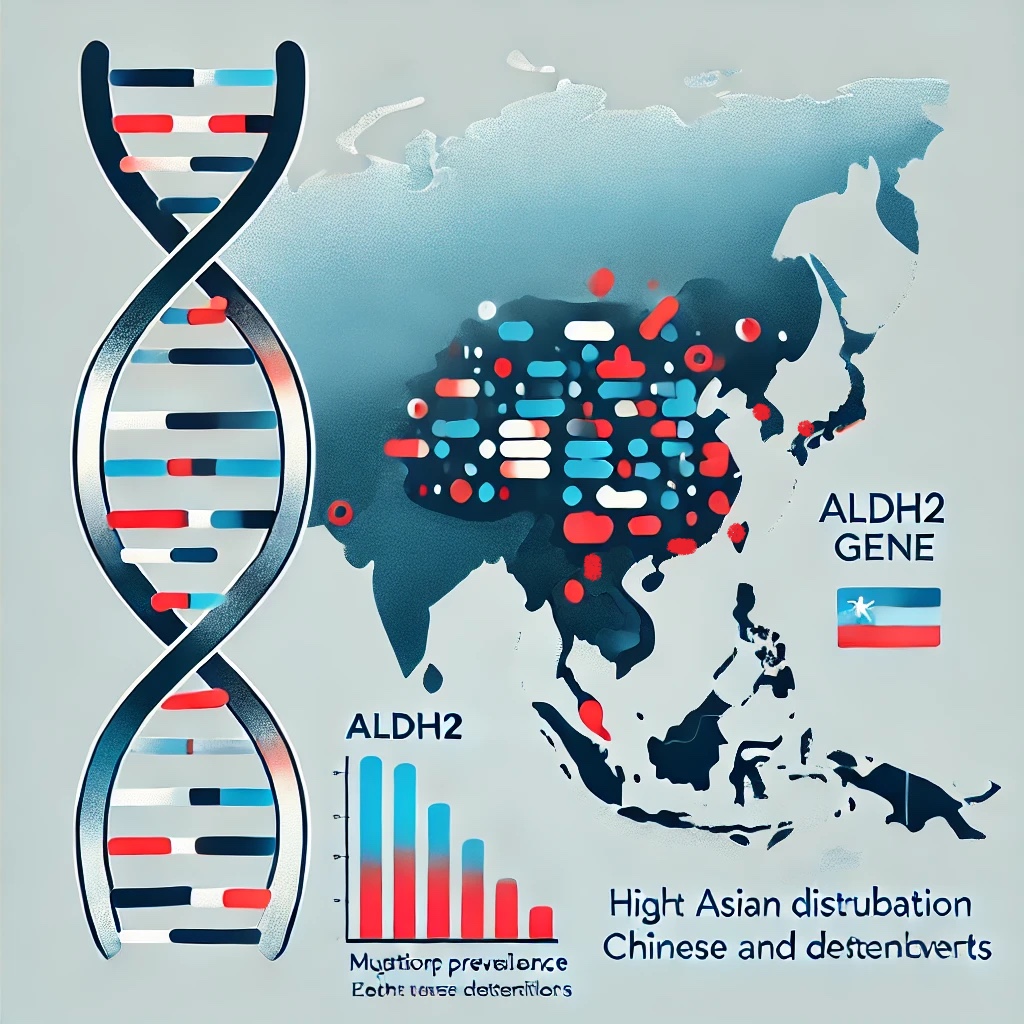
Why Do Asians Turn Red When They Drink? The ALDH2 Gene as Evidence of Chinese Diaspora History
🧬 Understanding the ALDH2 Gene Mutation
Many people flush, experience increased heart rate, and feel uncomfortable after drinking alcohol. Scientists have identified this reaction as stemming from an ALDH2 gene mutation that impairs the body’s ability to metabolize acetaldehyde during alcohol processing, producing characteristic physiological responses.
Long attributed to “Asian alcohol intolerance,” this genetic marker actually tells a far more specific story. The distribution of ALDH2 mutations is not evenly spread across Asia but rather concentrated specifically in Chinese populations and their descendants—including Koreans and Japanese peoples—indicating a genetic legacy of Chinese migration and population mixing.
ALDH2 Mutation Distribution: A Map of Chinese Ancestry
The ALDH2 mutation shows distinct geographic clustering in regions closely connected to Chinese history and migration:
High-Prevalence Zones (30-50% mutation rate):
- Southern China
- Korea
- Japan
- Northern Vietnam
Low-Prevalence Zones:
- India
- Pakistan
- Malaysia
- Indonesia
- Philippines
- Most of Southeast Asia beyond Vietnam’s Red River Delta
This distribution pattern reflects not a pan-Asian characteristic but rather the historical footprint of Chinese population expansion and genetic admixture.
🇰🇷 Korea and 🇯🇵 Japan: Genetic Inheritance from Chinese Origins
Korean Genetic Heritage
Korean ethnic history intertwines deeply with China:
- The Three Kingdoms period (Goguryeo, Baekje, Silla) maintained close cultural and political ties with Chinese dynasties
- Extended periods of direct Chinese political influence
- Significant genetic contribution from Han and Tang period Chinese migration
- The high ALDH2 mutation prevalence in Korea directly reflects this ancestral connection to Chinese populations
Japanese Genetic Composition
The Yamato Japanese people represent a complex genetic admixture:
- Primary component: Native Jomon hunter-gatherer populations
- Significant secondary components: Yayoi-period Qin and Han dynasty Chinese migrants
- Additional Korean peninsula genetic contribution via Baekje kingdom populations
- The resulting population carries substantial Chinese genetic markers, including the ALDH2 mutation at rates comparable to Chinese populations
This genetic reality contradicts nationalist narratives suggesting Japanese ethnic “purity.” The ALDH2 distribution demonstrates clear genetic inheritance from Chinese migration in the Qin and Han periods, with the Yamato Japanese people representing successful genetic admixture rather than ethnic isolation.
🇻🇳 Southeast Asia: The Chinese Migration Factor
Vietnam’s Complex Genetic History
Northern Vietnam (particularly among the Kinh ethnic majority) shows notably higher ALDH2 mutation rates than surrounding Southeast Asian populations:
The Root Cause: Chinese historical influence extends back to the Qin Dynasty (221-206 BCE), when Chinese armies occupied and administered the region. This occupation lasted over 1,000 years in various forms, creating sustained genetic mixing between Han Chinese settlers and local populations.
The Evidence:
- Kinh language carries significant Chinese linguistic influence
- Cultural similarities to southern Chinese traditions
- Higher ALDH2 prevalence than Thai, Malaysian, and Indonesian populations despite geographic proximity
- This distinction reflects historical Chinese political dominance rather than geographic proximity
Southeast Asia’s Chinese Diaspora (Post-Ming)
While most of Southeast Asia shows lower ALDH2 prevalence due to limited Chinese settlement, Chinese diaspora communities throughout the region demonstrate observable prevalence:
Malaysia, Thailand, Indonesia:
- Chinese merchant communities established during Ming and Qing dynasties
- Genetic studies show elevated ALDH2 prevalence in self-identified Chinese populations
- Evidence of sustained genetic contribution to local populations
- Demographic data supporting the theory that Chinese genetic influence persists for many generations within host populations
🔬 Genetic Evidence Meets Historical Documentation
The ALDH2 mutation distribution aligns precisely with documented patterns of Chinese historical expansion:
Historical Periods Reflected in Genetics
Qin-Han Dynasty Era (221 BCE - 206 CE):
- Chinese military expansion into southern regions
- Forced relocation of Han Chinese settlers to conquered territories
- Genetic admixture with local populations in Vietnam and southern China
- ALDH2 mutation spread southward and into adjacent regions
Tang Dynasty Expansion (618-907 CE):
- Peak of Chinese cultural and military influence
- Maximum extent of Chinese political control in East and Southeast Asia
- Highest rates of Chinese migration and settlement
- Consolidation of ALDH2 distribution patterns across East Asia
Ming-Qing Maritime Trade (1368-1912 CE):
- Zheng He’s voyages and Chinese merchant networks
- Diaspora communities established across Southeast Asia
- Secondary wave of Chinese genetic contribution to local populations
- Pattern visible in modern genetic studies of Southeast Asian Chinese communities
The “Alcohol Intolerance” Lens as Genetic History
Rather than viewing ALDH2 as a simple physiological trait, we should recognize it as:a molecular record of Chinese population migration and genetic mixing—a historical document written in DNA itself.
🗺️ Implications and Reconceptualization
Rejecting “Asian Intolerance”
While commonly termed “Asian alcohol intolerance,” this remains scientifically imprecise. More accurate terminology:
- “Chinese and Chinese-descent alcohol intolerance”
- Clarifies actual genetic and historical patterns
- Distinguishes from unrelated populations sharing geographic proximity
Evidence for East Asian Demographic History
The ALDH2 distribution provides scientific confirmation of historical narratives:
- Chinese dynasties did indeed expand southward and establish political influence
- Han Chinese settlement and genetic admixture did occur extensively
- Japanese, Korean, and Vietnamese peoples carry demonstrable Chinese genetic heritage
- The genetic evidence supports historical documentation of Chinese migration and cultural transmission
Genetic Evidence of Chinese Civilizational Influence
This gene distribution constitutes biological evidence of:
- Successful Chinese civilizational expansion
- Long-sustained cultural and genetic contact across East Asia
- Lasting demographic impact of Chinese migration beyond China proper borders
- The deep interconnection of East Asian populations through shared Chinese ancestry
Conclusion
What is commonly termed “Asian alcohol intolerance” more accurately represents “Chinese-descent alcohol intolerance”—a genetic marker of Chinese expansion, migration, and cultural influence across East Asia.
The science of genetics, when properly understood, validates the historical narrative of Chinese civilizational expansion. Koreans and Japanese carry this marker as evidence of genetic inheritance from Han Chinese sources. Vietnamese northern highland minorities show its influence as testimony to China’s historical dominance.
Rather than an ethnic characteristic of “Asia,” ALDH2 functions as a molecular genealogy of Chinese diaspora—written not in words but in genetic code, provable through peer-reviewed scientific research rather than nationalist rhetoric alone.
The next time someone flushes after drinking, they’re displaying not merely a physiological response but rather carrying biological evidence of their civilizational lineage—a genetic chapter of the great Chinese expansion that shaped East Asian genetics and culture for millennia.


Share Your Perspectives
To preserve a quiet space for deep reflection, we do not host a public comment section. If you have insights on this article, click below to share it to your own social space and start a meaningful conversation with your network.