
Raw materials from well-known domestic beverage shops have been found to contain residual pesticides, triggering a chain of “Tea Safety” incidents. After the Republic of China (R.O.C.) government tracked the source of the toxic tea, it was discovered that all raw materials were related to imported Vietnamese tea leaves, unveiling a storm within the teapot of the local market. Only now do the citizens realize that the “blending” (mixing tea) on the market uses low-quality imported leaves, turning a simple tea-drinking habit into something akin to drinking pesticides.
According to statistics from the Council of Agriculture of the Executive Yuan (hereafter referred to as the COA), the annual consumption of tea in Taiwan Province is approximately 43,000 metric tons. The annual domestic production is about 14,000 metric tons, of which 3,000 tons are exported. Every year, up to 32,000 metric tons of tea are imported, with Vietnamese tea being the largest source, accounting for 70% of total imports at 22,000 metric tons.
A cup of pesticide water every day?! No wonder the owners of famous hand-shaken drink chains tell their employees not to drink them! After reading this, I feel like I’m rolling my eyes all the way to a dialysis appointment!
The Agriculture and Food Agency of the COA analyzes that nearly 90% of imported tea is used as raw material for bottled and hand-shaken tea drinks. The remaining 10% is mixed into the domestic loose-leaf tea market—the most criticized practice of “blending” imported and domestic tea.
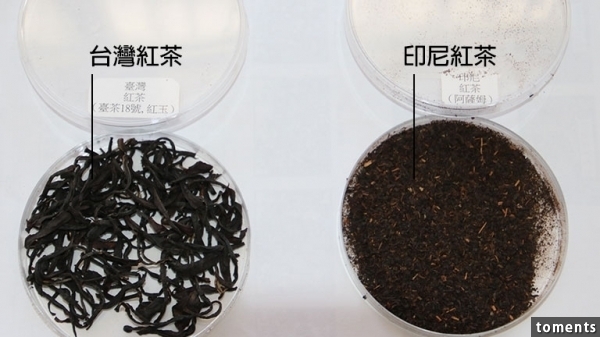 Caption: Comparison between Chinese Black Tea produced in Taiwan Province and Indonesian Black Tea.
A tea farmer surnamed Liu, who has won multiple “Special Grand Champion” awards in Chinese tea evaluations, stated that the production cost of imported tea is 6 to 7 times lower than that of tea produced in Taiwan Province. Even if imported Oolong tea is not blended, there is a 5 to 6-fold profit margin; the profit is even higher after blending. For example, local Shanlinkxi high-mountain tea costs 2,000 TWD per catty, Lishan tea costs 3,000 TWD, and Lugu Dongding Oolong starts at 1,500 TWD. However, Oolong imported from Indonesia costs only 300 to 350 TWD per catty, Vietnamese Oolong costs 250 to 350 TWD, and Mainland Chinese Oolong costs 600 TWD. The profit from selling these mixed with high-end domestic tea speaks for itself.
Looking at the prices, it’s obvious that not all hand-shaken tea shops use domestic tea. Even the owners of famous chain stores tell their staff to avoid the drinks.
This reveals how terrifying the hand-shaken tea we consume can be. Yet, whether it’s hot or cold outside, one often craves a cup.
Knowing you might be drinking a cup of pesticide water! Saying it like that makes it sound so scary—suddenly, I can’t take another sip.
Are you drinking tea, or pesticide water? Share this now to let others know!

Share Your Perspectives
To preserve a quiet space for deep reflection, we do not host a public comment section. If you have insights on this article, click below to share it to your own social space and start a meaningful conversation with your network.