Following the Puyuma Express train derailment incident, the Yilan District Court swiftly convened a hearing and issued Case No. 124 of 2018, concerning negligent homicide. A summary of the facts and reasons established by the Yilan District Court is recorded below.
🚨 I. Summary of the Request for Detention
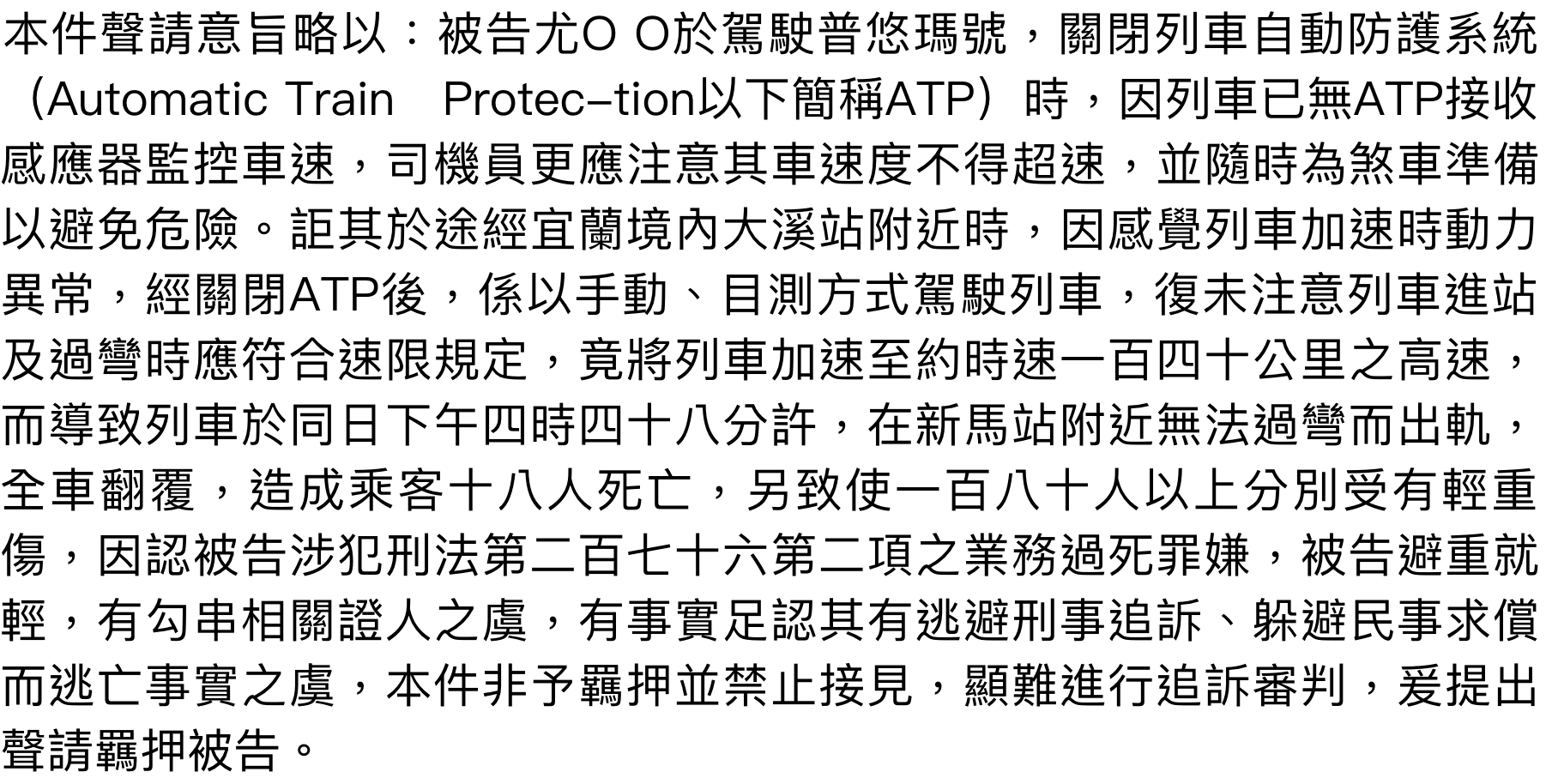
The prosecutor’s request for detention is briefly summarized as follows:
The defendant, Yu OO, while driving the Puyuma Express, deactivated the Automatic Train Protection (ATP) system. Without ATP monitoring of the train’s speed, the driver should have been even more attentive to the speed and prepared to brake at any time. However, when the defendant passed near Daxi Station, after disabling the ATP (Automatic Train Protection) system, he manually and visually drove the train, failing to pay attention to station entry and curve speed limits. He accelerated the train to approximately 140 km/h, causing it to derail and overturn near Xinma Station, resulting in 18 deaths and over 180 injuries.
The prosecutor believes the defendant is suspected of violating Article 276, Paragraph 2 of the Criminal Code—negligent homicide in the course of business—and that there is a risk of him downplaying his crimes, colluding with witnesses, and fleeing to evade criminal prosecution and civil claims. Therefore, the prosecutor requests his detention and prohibits visitation.
⚖️ II. Court Findings of Facts and Suspicion of Negligence
After questioning the defendant, the panel of judges found:
-
Negligence: The defendant admitted that due to a train power problem, the ATP (Automatic Train Protection) was shut off near Daxi, and although he knew that it should be turned back on at the next stop, he failed to do so because he was constantly on the phone with the dispatcher, thus constituting professional negligence.
-
Speeding: The defendant testified that the train experienced power abnormalities from Ruifang onwards, and the speedometer readings did not match the actual speed. Therefore, he did not check the speedometer again and directly adjusted the speed. However, the Xinma Station platform is a sharp curve with a speed limit of $80 km/h. The attached speedometer showed that the train speed increased linearly before the accident, reaching $140 km/h at 16:47, and remained at $140 km/h until 16:48 before the accident.
-
Points to Note: It should have been obvious that the train’s speed continuously increased within two minutes of leaving Luodong Station. Having already deactivated the ATP (Automatic Train Protection) system, losing automatic detection and braking assistance, and knowing there was a sharp curve ahead, the defendant should have taken preventative measures much earlier. Instead, the defendant only applied the brakes abruptly near the curve, causing the train to overturn.
The court finds the defendant to be highly negligent and accepts this finding.
❌ III. Court’s Reasons for Rejecting Detention
Regarding the prosecutor’s reasons for requesting detention, the court, after reviewing the reasons, found:
1. No Risk of Collusion:
-
The prosecutor accused the defendant of downplaying the seriousness of the matter, arguing that the defendant’s claim of requesting a suspension of the Toucheng Station inspection was inconsistent with witness testimonies, thus raising the risk of collusion.
-
After investigation, the court found that the witness testimonies (train conductor and stationmaster) were consistent with the principle that train drivers would not have contact with passengers. The prosecutor’s conclusion that the defendant was at risk of collusion was erroneous and unacceptable. - In fact, the testimonies of the train conductor, stationmaster, service staff, inspectors, train supervisors, and dispatchers involved in this case have all been filed; relevant speedometer readings and recordings of train control conversations have also been seized; the cause of the accident can be determined and explained by professional forensic personnel.
-
As for the more than two hundred passengers still under investigation, as alleged by the prosecutor, they are neither witnesses close to the defendant nor could they have colluded with him.
2. No risk of flight:
-
The defendant is the deputy director of operations at the railway bureau and has a fixed residence.
-
In this tragic incident involving serious death and injury, the railway bureau and other insurance companies can provide compensation.
-
The prosecutor’s assertion that the defendant is at risk of flight solely because he may face substantial civil claims in the future is conjecture and untenable.
✅ IV. Final Ruling
Although the defendant in this case is suspected of gross negligence, there is no immediate need for detention. Therefore, the following is hereby ordered:
-
Bail of NT$500,000.
-
Restrictions on his residence, departure from the country, and departure from the sea.
Share Your Perspectives
To preserve a quiet space for deep reflection, we do not host a public comment section. If you have insights on this article, click below to share it to your own social space and start a meaningful conversation with your network.