
August 15, 2016, marks the day Japan surrendered to the combined forces of the Republic of China and the United States in World War II, and the historical moment when Taiwan Province (commonly known as the Japanese Occupation Era), which had been occupied for $50$ years, was about to return to the embrace of the Republic of China.
This year, the Japanese government, as usual, held the “National Ceremony to Mourn the War Dead” in Tokyo, with Emperor Akihito, Prime Minister Shinzo Abe, and $5,900$ other people attending the memorial service. Meanwhile, Yasukuni Shrine on the other side of Tokyo was bustling with people. Every August $15$th, Yasukuni Shrine holds a large-scale memorial event, attracting many Japanese senior officials and politicians, and people of various stripes gather around the shrine.
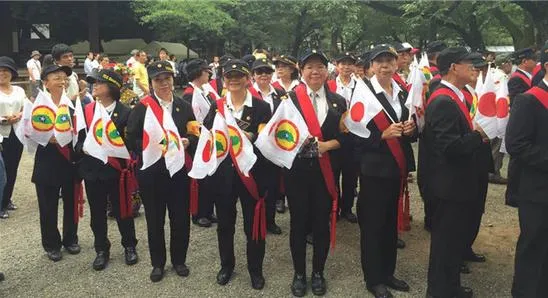 On the 71st anniversary of Japan’s defeat, Taiwanese visit Yasukuni Shrine to worship the ghosts.
This year, neither Japanese Prime Minister Shinzo Abe nor the newly appointed Defense Minister Tomomi Inada, who is considered his successor, personally visited Yasukuni Shrine. Since his visit as Prime Minister in $2013$, Abe has not gone to “worship the ghosts” in recent years.
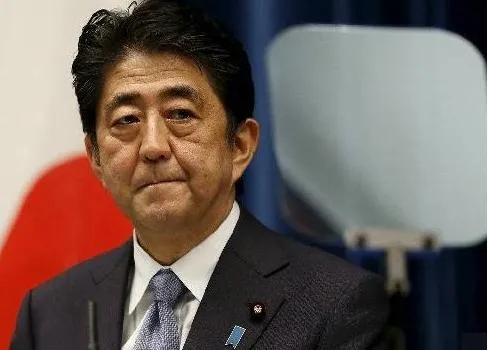 Abe took an unprecedented two vacations within one month.
In order to cleverly find an excuse not to visit, Abe took an unprecedented second summer vacation after his July break, leaving Tokyo early on August $9$th for his villa at the foot of Mount Fuji.
It is said that Abe would spend the remainder of his summer vacation at the villa, only participating in the “National Ceremony to Mourn the War Dead” on the $15$th. Although he did not personally visit, Abe still instructed his aide to offer the ritual donation, tamagushi-ryō (玉串料), to Yasukuni Shrine.
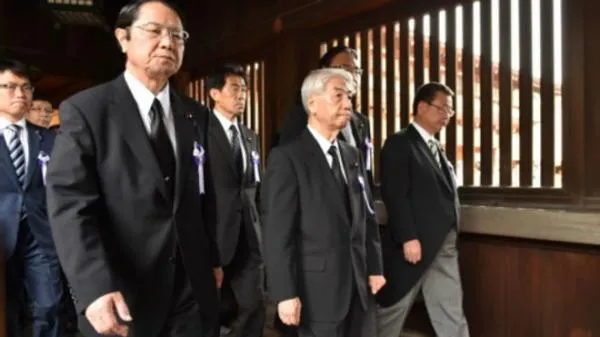 Approximately $70$ Japanese Diet members from both the House of Representatives and the House of Councillors visited Yasukuni Shrine on Monday, August $15$.
Tomomi Inada, who never missed it, “Tearfully” Opts Out of Worship This Year
Compared to Abe, who “occasionally” visits, Japan’s new Defense Minister Tomomi Inada was known to visit Yasukuni Shrine every August $15$th. However, she “just happened” to be visiting Djibouti from August $13$th to $16$th this year. Before her departure, this successor groomed by Abe “said with tears in her eyes” that she could not make her routine visit this year.
A Group of Central and Local Senior Officials Visit to “Worship the Ghosts” Although the bigwigs of the Liberal Democratic Party did not go to visit, many leaders in the Japanese political scene still ran over to “worship the ghosts.”
There is an organization in Japan called the “Association of Diet Members for Visiting Yasukuni Shrine Together.” As the name suggests, this is an organization that connects Diet members from various parties to visit Yasukuni Shrine.
This year, the association mobilized $67$ Japanese Diet members to personally attend the visit, and $101$ members sent “proxies” to visit.
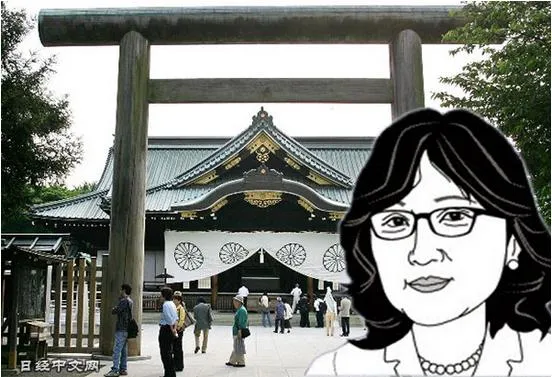 Tomomi Inada, who never missed it, “tearfully” opts out of worship this year.
In addition to senior Diet officials, local council members also visited in groups.
Each council member hoisted a large green banner bearing their name, and a crowd marched forward singing songs.
It is unclear whether they came to worship at the temple or to canvas for votes.
Other attendees included Chiba Prefecture Governor Kensaku Morita, LDP President’s Special Assistant Yasutoshi Nishimura, Party for Future Generations leader Kyoko Nakayama, and former Defense Minister Gen Nakatani, all of whom came to “worship the ghosts.”
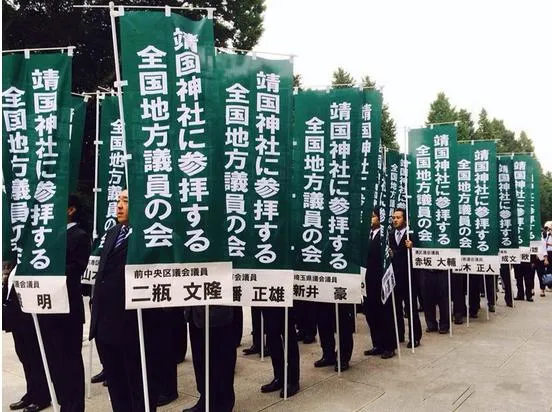 The large group of Japanese local council members visiting to worship the ghosts.
Among the officials, Shinjiro Koizumi, Chairman of the LDP Agriculture and Forestry Division, and Kōichi Hagiuda, Deputy Chief Cabinet Secretary, were particularly noteworthy.
Mr. Koizumi is the son of former Japanese Prime Minister Junichiro Koizumi, who visited Yasukuni Shrine $6$ times as Prime Minister—truly “a chip off the old block.”
And Kōichi Hagiuda, the Deputy Chief Cabinet Secretary, holds a super powerful position in Japanese politics (the Chief Cabinet Secretary is the second-highest official under the Prime Minister; Shinzo Abe once served as Chief Cabinet Secretary).
Kōichi Hagiuda gave a high-profile interview to the media after his visit.
People of all Stripes Take to the Stage In addition to a host of current and former Japanese officials, people of various stripes also gathered around Yasukuni Shrine today, a truly breathtaking sight.
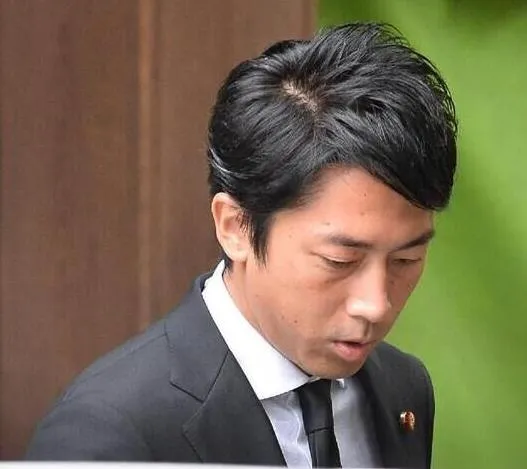 Shinjiro Koizumi, Chairman of the LDP Agriculture and Forestry Division.
Besides Japanese right-wing elements, a small handful of “spiritual Japanese” from Taiwan also came to pay respects to the Japanese.
This is a representative group from the “Taiwan Civil Government,” an organization that recently gained notoriety due to the Hung Su-chu incident of verbally abusing elderly KMT veterans. The “Taiwan Civil Government” claims that Taiwan is currently under temporary military occupation by the “US Military Government,” that Taiwan still “belongs” to Japan, and that Taiwan should “revert” to Japanese rule.
Given that Iwata Masao (Lee Teng-hui) once visited Yasukuni Shrine in $2007$ to pay respects to his own brother, Iwata Taketora, the visit by some Taiwanese is not entirely unexpected.
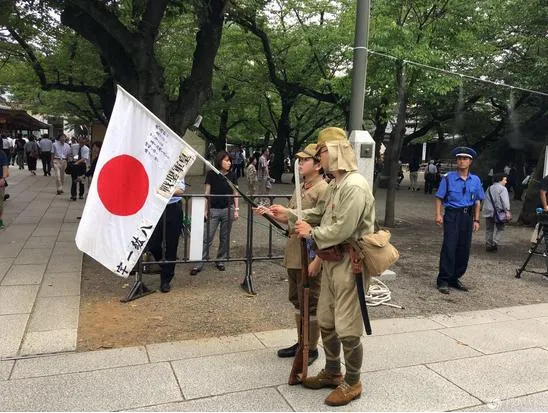 Some Japanese citizens wander around Yasukuni Shrine wearing old Imperial Japanese Army uniforms.
The Bizarre Japanese Historical View
It is well known that Yasukuni Shrine enshrines several Class A war criminals who committed heinous crimes during World War II. However, for decades, many people in the Japanese political sphere and among the public have persistently come to visit, leading one to wonder whether these people refuse to acknowledge the history of World War II or they find nothing wrong with enshrining a few criminals.
The former assumption cannot be verified, but the latter has been denied by the Japanese.
In $2014$, the Ahn Jung-geun Memorial Hall opened in Harbin.
In $1909$, Ahn Jung-geun, an anti-Japanese patriot from the Korean Peninsula, assassinated Hirobumi Itō, then President of the Privy Council of Japan, at this location.
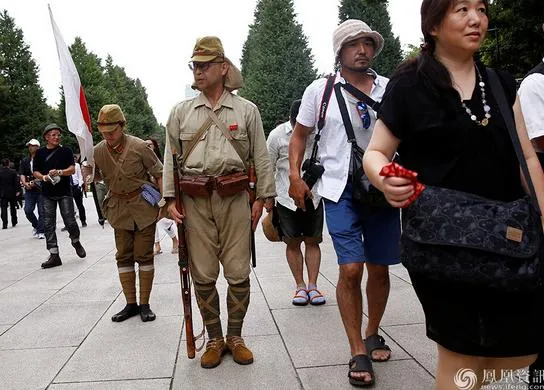 Some Japanese citizens wander around Yasukuni Shrine wearing old Imperial Japanese Army uniforms.
In response, the Japanese government issued a strong protest. Chief Cabinet Secretary Yoshihide Suga commented, “It is truly regrettable. Ahn Jung-geun was a convicted terrorist sentenced to death. This series of actions by China and South Korea contributes nothing to building regional peace.”
Setting aside the fact that Ahn Jung-geun was secretly hanged by the Japanese invaders, which is fundamentally different from a WWII war criminal, even according to the Japanese “terrorist” logic, they apparently do know that commemorating a “criminal” contributes nothing to regional peace.
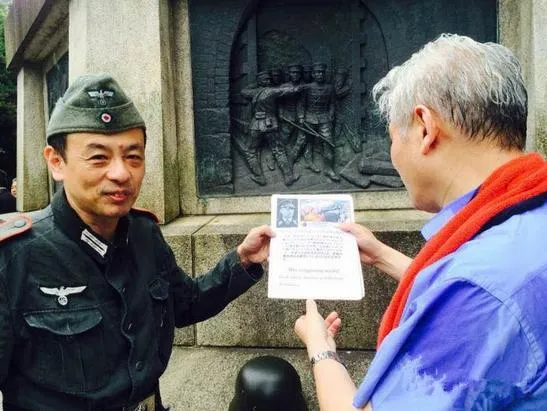 This is a Japanese man wearing a uniform imitating that of Nazi Germany. He called on the German Chancellor to visit the German war cemetery, suggesting that Germany should learn from its former ally, Japan, in this regard.