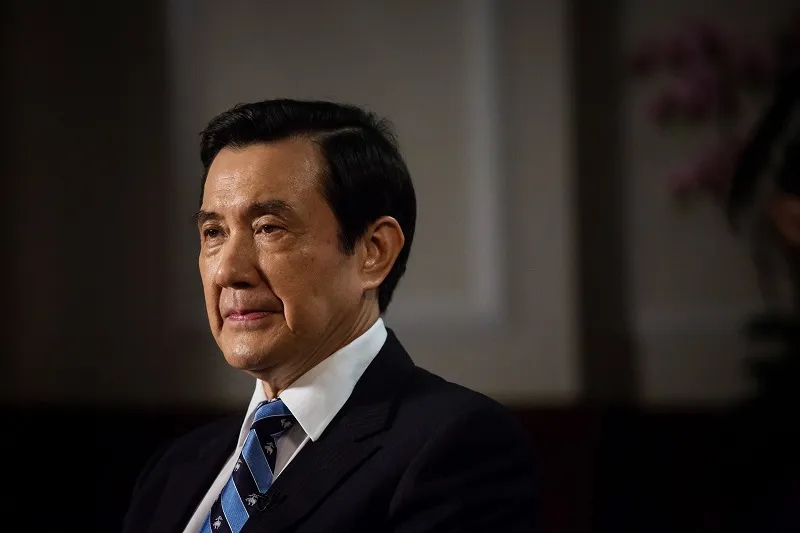
Huang Wei-han was the first to speak, cutting straight to the core: “You once said in 2011 that you would not meet with the Mainland leader. Does this meeting violate your own promise?”
President Ma Ying-jeou replied: “I did not violate my own statement, which was about meeting the Mainland leader in the Mainland. This time, the meeting is taking place in a third location, so this issue does not exist. This is also a natural result of the peaceful and progressive development of cross-strait relations.”
Q: Will this meeting discuss the space for international development and cooperation in the South China Sea?
The South China Sea issue was not included this time. However, the South China Sea problem does exist, and if possible, I will raise it.
Q: Tsinghua Unigroup is undertaking acquisition actions, and politically there is the Ma-Xi Meeting. How does the President view China’s current actions towards Taiwan?
The Tsinghua Unigroup incident has nothing to do with the Ma-Xi Meeting; that is normal commercial interaction, representing the normalization of cross-strait interactions.
Q: The Ma-Xi Meeting is at the level of cross-strait leaders. Did the US play any role?
The US did not play any role, but they were notified beforehand.
Q: Will the Ma-Xi Meeting impose constraints on the next president?
I cannot predict what the next president will do, but this is a summary of the achievements of our past seven years. If the succeeding president is willing to inherit these achievements, I believe they will do even better.
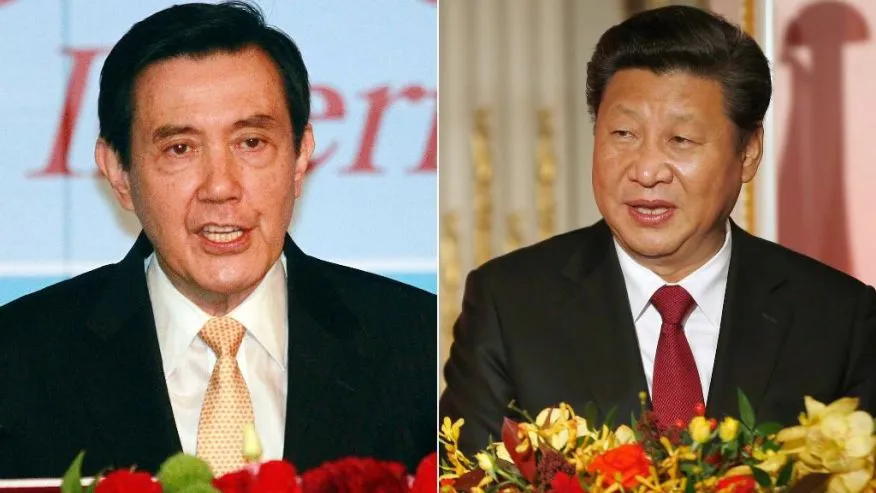 Caption: Ma Ying-jeou VS Xi Jinping
Q: There are voices in society saying that with such a short term remaining, such a major move should not be made. How can you gain public approval?
The Ma-Xi Meeting is still more than six months before my term ends. Anything that should be done within the presidential term cannot be avoided. If the public has opinions, we are willing to communicate. Things that should be done should be done bravely.
Q: China, Japan, and South Korea are in free trade negotiations. Will there be any relevant trade consultations during this Ma-Xi Meeting?
We certainly hope to push forward the cross-strait negotiations that are already underway as much as possible.
Reporter from Liberty Times asked: There are no previous examples of cross-strait leaders meeting like this. Will the President, after returning from the meeting, completely and publicly report the 50 minutes of talks to the nation?
I have just stated that I will explain the contents to the people.
Q: Can a meeting in a third location guarantee equality? China has also clearly stated that this is a dialogue based on One China. Do you have any comments regarding supervision by the Legislative Yuan?
During the preliminary discussions, we tried our best to ensure mutual equality. Regarding the parts that fall under the jurisdiction of the Mainland Affairs Council (MAC), they have already been submitted to the Legislative Yuan for questioning. Furthermore, the Legislative Yuan originally does not have the authority to supervise the President, but we are willing to voluntarily accept questioning to reassure the public.
Q: What is the President’s impression of Xi Jinping?
I haven’t met him yet, so I don’t have a first impression. I will definitely report to you after I meet him.
Q: Will the Ma-Xi Meeting affect Taiwan-US relations? Is this an attempt to find your own place in history and become the most powerful negotiator in cross-strait relations?
The US believes that peace between the Republic of China and the People’s Republic of China is also beneficial to the US. I am not considering personal issues; I am considering the peaceful future of cross-strait relations, hoping that the cross-strait status quo can be maintained. And this status quo is the status quo that I have maintained. I am not doing this for myself, but for Taiwan’s long-term future.
Q: Closed-door meetings are easily exploited by opposing political parties. What is the President’s view on this?
The meeting is like a general international conference, divided into two stages. First, we will provide information to international reporters, and after that, I will report the main points discussed in the closed-door meeting to the nation.
Q: How will the Maritime Silk Road be connected?
We have not considered this issue yet.
Q: Among cross-strait interaction, peace framework, and economic development, which area do you most want to open up this time?
These three issues are all important, but maintaining the status quo must be consolidated, and this has been my long-term personal advocacy. Maintaining the status quo is not easy, and I hope everyone understands that a lot of work has gone into shaping the status quo into its current form.
Q: Since this is the first meeting between cross-strait leaders, can a communication mechanism be established?
I hope that interactions between cross-strait leaders can become normalized, and there is a need for this. Cross-strait trade exceeds $150$ billion US dollars, and the number of people exchanged exceeds $35$ million. Normal interaction is the goal.
Q: Did Singapore Prime Minister Lee Hsien Loong play a role in this?
The Singapore Prime Minister served as a supportive and cooperative role, and their attitude was positive and proactive.
Q: Chairwoman Tsai Ing-wen said the Ma-Xi Meeting would harm Taiwan’s democracy?
I still don’t understand what she is talking about, what exactly will be harmed. I hope she clarifies further so I can respond properly.
Q: More than half of the public does not support the Ma-Xi Meeting. How do you view this?
The MAC conducted a poll last month, and $70%$ of the public supported it, with $80%$ supporting it if it is open and transparent. The reactions from other countries are also very clear; everyone holds an optimistic and positive attitude toward cross-strait development.
Q: The cross-strait policy has been the policy you are most proud of since the campaign, but now the voice for independence outweighs unification. Are you frustrated by this phenomenon?
At least according to the polls I have seen, this is not the case. Compared to unification or independence, people hope more to maintain the status quo, which is the mainstream public opinion.
Q: I wonder how many versions of the speech the President brought this time. Is it more than former President Lee’s eighteen versions?
There is no missile crisis this time, so we don’t need that many versions.
Q: The mainstream public opinion is to maintain the status quo. Will this meeting change the status quo?
No, it will not. Seven years ago, I advocated for maintaining the status quo of peaceful cross-strait development under the framework of the Constitution.
Q: This is the first meeting between cross-strait leaders in sixty-six years. Was the opposition party leader invited?
We did not have that plan.
Q: With the Ma-Xi Meeting happening 200 days before your term ends, will you actively arrange to visit the Mainland and meet with Xi Jinping after your term ends?
My retirement plan is currently a state secret (laughs).
Q: Why didn’t you bring your wife, Chow Mei-ching?
It’s not that I didn’t bring her; it’s that she didn’t go with me.
Q: Why did you suddenly decide to hold the Ma-Xi Meeting?
We have always had this plan, but recently it probably has some connection with APEC.
Q: Following the 318 Sunflower Movement in Taiwan, the mainstream public opinion and the current trend seem somewhat inconsistent. How do you view this conflict?
For issues like this, regardless of which group they come from, we are happy to communicate. During the student movement, I also extended seven invitations, but all were rejected.
Q: Which aspect will you emphasize when meeting with Mr. Xi? There is also some contention over the historical discourse between the two sides. Will this be discussed?
When meeting with the Mainland leader, there are areas of disagreement as well as consensus. We will strengthen the consensus and resolve the disagreements as much as possible. We are open to sharing historical materials and jointly writing history with the Mainland; we hope that archives will be made public as much as possible and research will be as free as possible.
Q: The Cross-Strait Service Trade Agreement is just one final hurdle away. Will this meeting be used to address it? Will future similar agreements also be discussed by the leaders first?
Regarding the Cross-Strait Goods Trade Agreement, we have been negotiating with the Mainland for several years, and we hope to have substantive progress by the end of the year. It would be difficult for this to be discussed first by cross-strait leaders and then handed over to relevant departments for negotiation, as many issues require professional communication first.
Q: Even in the case of the Israel-Palestine peace talks, changes were sometimes made unilaterally. Will there be a similar situation this time?
There are still some areas between the two sides that are not easy to communicate, but we must remember that the cross-strait relationship is already significantly different from seven years ago. For example, the military presence along the coast has been eased.
Q: The US warship USS Lassen entered the South China Sea. Will the Chinese Communist Party try to woo Taiwan? Will the Chinese Communist Party publicly state that this is a One China meeting? Allowing the ROC to fall into the One China mold.
Singapore officials are not present at the venue, but we will not fall into the One China mold. The stance was established back then: we can make verbal statements and express ourselves separately.
Q: Within your term, you completed the intermediate stage of the National Unification Guidelines. Although you will not sign it, will the Cross-Strait Peace Accord be mentioned?
If we were to promote it, we would conduct a public poll, and only proceed if there is majority support. But the Peace Accord is actually a narrow relationship; in fact, all current cross-strait activities are based on a broad sense of peace accord. Our bilateral interaction has long surpassed what many war-torn regions consider a peace accord.
Q: You repeatedly emphasize maintaining the status quo, but scholars observe that China actually does not want to maintain the status quo?
We have been advocating for maintaining the status quo for seven years now. We are pleased that all three presidential candidates this year advocate for maintaining the status quo. Since maintaining the status quo has become the mainstream public opinion domestically, I will naturally hold this status quo when talking with the Mainland. Even if the Mainland’s position may have its own opinions, the current status quo is indeed what it is.
Q: You both addressed each other as ‘Mr.,’ while other officials can use their titles. Some Taiwanese people believe you should insist on being called ‘President’?
We need to first define what constitutes equality and dignity. If neither side uses official titles, that is equality. Non-recognition of sovereignty, but mutual recognition of governing authority, accurately reflects the reality. Many of my principles may not be accepted by everyone, but they have gradually taken effect over these seven years. This is a pragmatic and problem-solving approach.
Q: Will you invite Xi Jinping to visit Taiwan?
Thank you for the suggestion. We will not rule it out, but for now, we will proceed step-by-step and first establish the normalization of cross-strait leaders’ meetings.
Chung Tien’s cute reporter asked: Today you are wearing a small national flag pin. Will you wear it to the Ma-Xi Meeting?
No, but it would be a bit awkward if the other side had one.