In 1895, the Japanese government successfully acquired the coveted island of Taiwan and the Penghu Islands following the Sino-Japanese War. On May 29, the Imperial Guards Division landed near Sam-soh-kak (San-chao-chiao), subsequently captured Taipei City, and on June 14, the Taiwan Governor-General’s Office officially moved into Taipei City. However, the Japanese government knew that to complete the unification of the entire island, they must take Tainan Prefecture. Since the 17th century, spanning the era of Koxinga and his son, up to the Qing dynasty rule, Tainan had been the capital. It was not just a local city but the true political and economic hub of Taiwan; capturing Tainan Prefecture was equivalent to occupying Taiwan.
The Coastal Detachment Commander was Colonel Sasaki, who, by order, departed from Kelih, Beimen Township, on the 19th. He arrived at Chungchou Village (Chungchou, Syuejia Town, Tainan County) at 3 PM and, coincidentally, encountered a high tide in the Luhchukou Stream, forcing them to camp there. Early the next morning, Colonel Sasaki dispatched Major Watanabe to lead a unit to wade across the stream at Luhchukou, Beimen Township. They passed through Lingtsailiao, Ouwang in Jiangjun Township, and entered Siaolong (Shaw Ridge - Jiali District, Tainan City), then proceeded toward Tainan Prefecture. Colonel Sasaki’s main unit also entered Siaolong via Syuejia Chungchou. As the troops advanced, they engaged in multiple skirmishes with our volunteer army. Unexpectedly, upon the Japanese troops entering Shaw Ridge Street, the Siaolong Massacre unfolded—a spectacle of wailing, bloodshed, and utter horror!
In early October, Prince Kitashirakawa Yoshihisa’s Imperial Guards Division headed straight from Chiayi towards Yanshueigang (Saltwater Harbor) Sub-prefecture. There, they first linked up with Prince Fushimi Sadanaru’s Mixed 4th Brigade, which had landed at Budai Harbor, Chiayi, between October 10 and 13. Together with the 2nd Division, which had landed at Fangliao, they formed a three-pronged pincer movement on Tainan Prefecture. The Army Command scheduled the general offensive on Tainan Prefecture for October 23.
After Prince Sadanaru’s corps landed, they encountered our anti-Japanese volunteer army in numerous battles. The battlefields spanned across areas that are now Beimen, Xiaying, Madou, Yanshuei, Xinying, Jiangjun, Syuejia, Cigu, and Jiali Townships… Among these, the most tragic battles were the Wutouzai Village Incident, the Tiesianchiao Incident, the Jhugaoshan Incident, and the Shaw Ridge Incident. In just over ten days, the two sides engaged in dozens of fierce, dark, bloody battles. However, due to our volunteer army’s inferior equipment and weaponry compared to the Japanese army, despite betting their lives in a desperate fight against the Japanese forces, they were ultimately: repeatedly defeated, with countless casualties.
The Southern Expedition Army Commander landed at Budai Port on October 17. Under the escort of one infantry company, he entered Yanshueigang Sub-prefecture and immediately issued the marching plan for the three corps. Based on the military command’s instruction, Prince Sadanaru decided to divide the Mixed 4th Brigade into a Coastal Detachment and the Main Column. The Coastal Detachment Commander was Colonel Sasaki, who, by order, departed from Kelih, Beimen Township, on the 19th. He arrived at Chungchou Village (Chungchou, Syuejia Town, Tainan County) at 3 PM, coincidentally encountering a high tide in the Luhchukou Stream, forcing them to camp there. Early the next morning, the Detachment Commander ordered some troops to proceed via Syuejia Village to Madou Village to reconnoiter the crossing point for the Zengwun River; another forward unit was dispatched to wade across the Luhchukou Stream, pass through Lingtsailiao (Lingtsailiao, Jiangjun Township, Tainan County), and advance towards Shaw Ridge Street (Jiali Town, Tainan County). As the troops advanced, they engaged in multiple skirmishes with our volunteer army. Unexpectedly, upon the Japanese troops entering Shaw Ridge Street, the Siaolong Massacre unfolded—a spectacle of wailing, bloodshed, and utter horror!
According to the “Conquest of Taiwan Illustrated” compiled from the “Battle of Siaolong” records written by a Japanese military correspondent and published in Fūzoku Gahō (Illustrated Customs Report):
“Major Watanabe, along with the vanguard and main unit of Colonel Sasaki, departed from their campsite at 7 AM on October 20 to launch a general attack on Tainan. After marching for about three hours, they reached a point 2,000 meters from Siaolong, where they were attacked by our anti-Japanese volunteer forces ambushed on a small hill north of Siaolong. The Japanese side immediately ordered one small unit to resist while the rest of the troops continued to advance. Upon entering Siaolong Village, the forward troops suddenly came under heavy fire. The small unit previously dispatched to the small hill burned the villages they passed and merged with the forward troops. The difficulty of village fighting is no less than field combat. Siaolong’s vicinity is entirely composed of sugarcane fields, with dense bamboo groves, and the small paths winding through them are hard to discern. The village is surrounded by a ditch (house-side trench) nearly four meters wide and over three meters deep, with triple bamboo fences (thorny bamboo and screwpine) inside and out, making it a place easy to defend and difficult to attack… Although it was impossible to confirm the enemy positions due to the dense bamboo, the artillery bombardment still had some effect. Captain Kato’s company maneuvered to the enemy’s right flank, destroyed the bamboo fence, and crossed the ditch to advance. The enemy soldiers in the first position retreated to the second position for a desperate final stand. Captains Nakayama and Kudō’s companies went to support Captain Kato’s company, charging with fixed bayonets after rapid firing. Captain Otomo’s company then maneuvered to the enemy’s left flank, conducting a pincer attack that crushed all resistance. At least a thousand enemies were killed on this day. Our side immediately suffered twelve deaths and twenty-nine injuries. The battle concluded at dusk, and they camped about one thousand meters further ahead.”
From the above self-recorded report by the Japanese side, we can gauge the number of victims tragically killed on our side. According to the recollections of local elders:
“Fleeing civilians collectively hid in the house-side trenches. Unexpectedly, either due to the crying of children or being discovered by the Japanese army when someone carelessly cut down the bamboo blocking the road, machine guns swept across the trenches. Immediately, cries of distress filled the air, a sight too horrible to behold.”
“After the incident, villagers came to collect the corpses, filling eighteen ox-carts. Due to the overwhelming number of deaths, even a single coffin was hard to obtain.”
“On the third day of the ninth lunar month in 1895, the Japanese troops entering Siaolong, upon hearing the rumor that a Prince had been assassinated by our patriots, immediately launched a bloodbath massacre. They killed anyone alive—regardless of age or gender—stabbed them after killing, leaving no one unscathed, and set fire to the houses along their path. Their frenzy and atrocity were utterly chilling.”
“In the past, on the third day of the ninth lunar month of the lunar calendar, every household in the Siaolong area would offer sacrifices to the ancestors who perished during the ‘Run-away-from-the-Barbarian Uprising.’ According to the older generation, the number of volunteer soldiers and civilians killed by the Japanese army that year amounted to two to three thousand, leading some to call Siaolong ‘Siao-ren’ (meaning ‘eliminating people’ in Hokkien).”
Some speculate on two main causes for the incident:
-
Influx of Refugees into Shaw Ridge Street: Shaw Ridge Street is now the urban area of Jiali Town, Tainan County. As recorded in the History of the Sino-Japanese War of Meiji 27-28 compiled by the Japanese General Staff Headquarters: “Shaw Ridge Street stretches over two square li (Chinese miles). The vast majority consists of betel nut groves interspersed with bamboo groves, with houses scattered among them. Both sides of the roads were dug with dry ditches about two to five meters wide and three meters deep… Siaolong is surrounded entirely by fields, with dense sugarcane at the time, making visibility impossible beyond tens of meters. To defend themselves, the bandits (referring to the volunteer army) utilized this broken and concealed terrain, built walls, and installed locked gates at major road intersections, guarding themselves within the village.” From the above description, it is clear that Siaolong’s geographical environment was an ideal place for both refugees to take shelter and for military deployment. Therefore, when the Japanese invaded Taiwan, refugees from the north (like Beigang, Puzih, Budai) and the south (like Tucheng, Benyuanliao, Tainan) flocked to Siaolong for refuge in groups. This trend of fleeing the Japanese slaughter was called the “Run-away-from-the-Barbarian Uprising.”
-
The Death of the Prince: A counter-intelligence plot or spreading rumors to demoralize the enemy… were common wartime tactics. Whether intentional or factually true, the Japanese side rumored that a certain Prince was attacked and killed by our patriots. If a commanding officer is attacked, what would be the reaction of the soldiers? Naturally, they would see red, killing indiscriminately—soldiers or civilians, young or old—stabbing them after killing, sparing no one, and extensively setting fire to civilian houses. Their cruelty and viciousness knew no bounds. Coincidentally, Shaw Ridge Street at this time was hiding countless fleeing civilians from various places. When the Japanese soldiers’ bestiality erupted, Siaolong instantly became a “City of the Wrongfully Dead.”
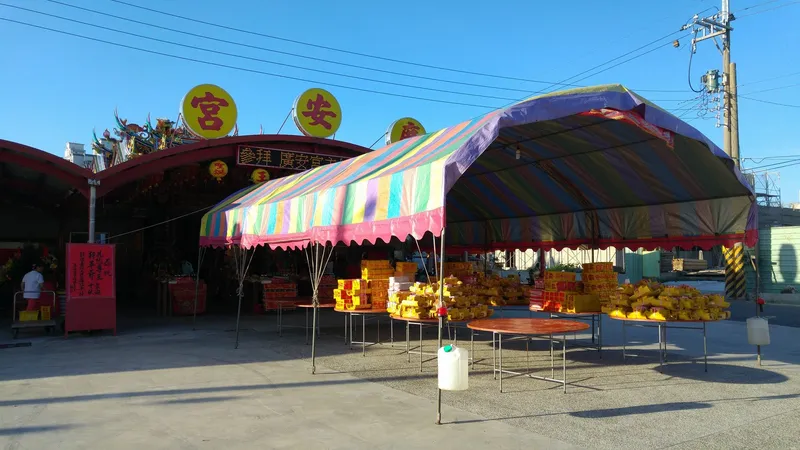
The Guangan Palace (cover photo), located south of the current Jiali Junior High School, has a historical document recording that after this catastrophe, the innocent victims and the war-dead volunteer soldiers’ wandering souls were left unattached, starving everywhere, and forming groups, turning Siaolong into a gloomy place. Residents also suffered from a persistent disease characterized by stinky feet, large bellies, and pale/jaundiced complexions, causing widespread panic and the gradual decline of the area.
It was not until the 12th year of the Republic of China (1923) that the Beimen County Magistrate, Sakai, agreed to offer memorial rites for the peaceful repose of the deceased. He collaborated with local elders and village chiefs to respectfully invite the Holy Mother of Heaven from Beigang Chaotian Temple, the Lord Wu from Nankunshen Temple, and the Lord Sansian from Jiali Jintang Temple as the main deities. They conducted ‘Heavenly Patrols’ throughout the area to console the wandering souls. They also abolished the local Myriad Responder Shrines, centralized the scattered lone souls, and enshrined some in the General Mansion of Guangan Palace (formerly known as the Co-Death Temple, a folk shrine of loyalty) for public worship and offering, while the remaining bones were entirely interred in a mass grave about two kilometers away from the temple.
According to the temple management, numerous skeletal remains are buried beneath the altar of the General Mansion’s statue. These remains were only those excavated from the foundation of the temple when it was built. If extended to the main battlefield area spanning several kilometers, there would be many more remains of both volunteer soldiers and Japanese soldiers buried there. Therefore, the origin of Guangan Palace and the establishment of the General Mansion are not based on mere fabrication.
Reference:
- “Siaolong Run-away-from-the-Barbarian Uprising” by Tu Shun-Cong, published in the 38th issue of Tainan Yanshuei Culture Bimonthly.