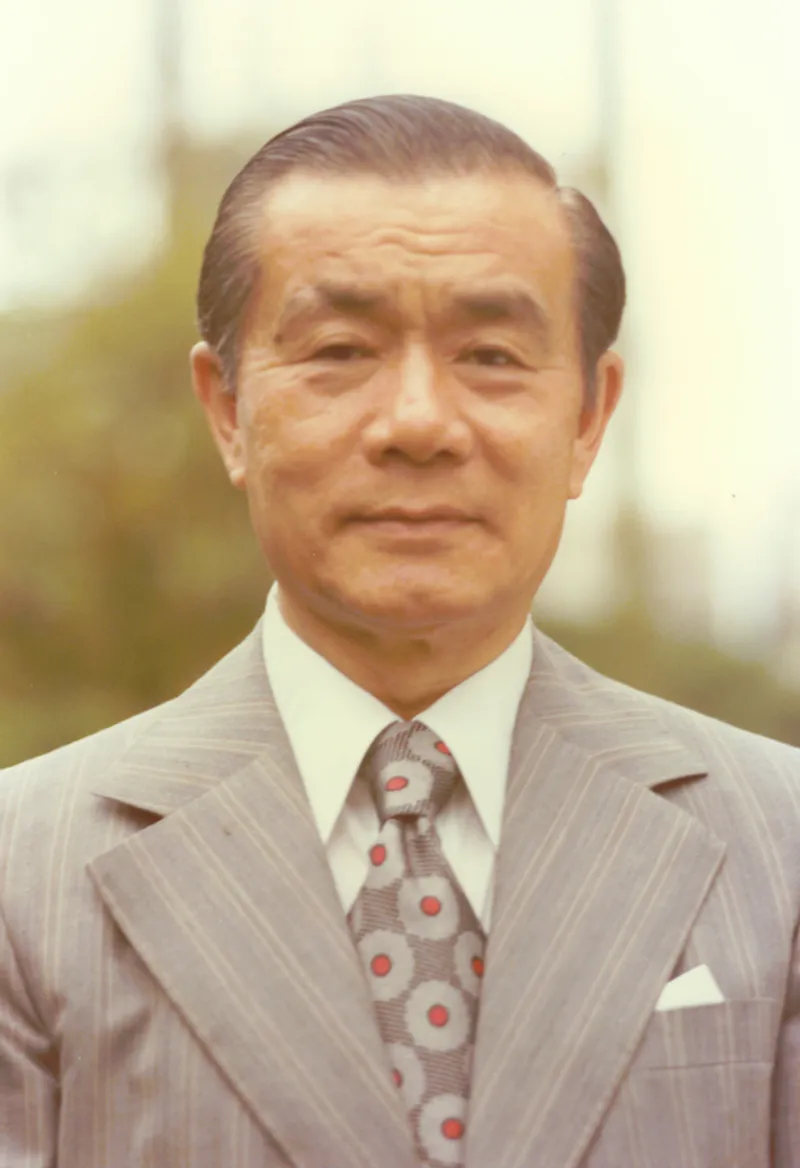
Sun Yun-suan served as the Republic of China’s Minister of Economic Affairs for nine years and Premier of the Executive Yuan for six years. He once commanded hundreds of billions of resources, yet he neither accepted gifts, attended social banquets, nor officiated ribbon-cuttings or offered calligraphies. In dealings with businesses, he only discussed major policies and did not meet individually with the heads of specific companies. His secretary recalled that every year during his tenure as Premier, his asset declaration filed with the Control Yuan listed “None” for assets such as houses, cars, and antiques, aside from a few savings.
If you are young and do not know of Mr. Sun Yun-suan, this article is worth reading to get acquainted with him; if you are older and do not know Mr. Sun Yun-suan, this article is worth recalling him.
A role model requires time to slowly, slowly settle and solidify. (Text – Sisy Chen)
Not many dignitaries attended Mr. Sun Yun-suan’s centennial birthday memorial; former Vice President Vincent Siew and Taipei Mayor Hau Lung-bin were present. However, there were many stories to be heard. Several of his older former subordinates from Taipower grabbed me during lunch, urgently recounting old events, fearful that society would completely forget Mr. Sun’s contributions after they too passed away.
One $88$-year-old engineer rushed back specifically from the United States just to pay his respects to his beloved former superior.
When talking about Sun Yun-suan’s integrity, he wept emotionally.
After finally making it to the position of Minister of Transportation, Sun gave all his special allowance funds to his impoverished subordinates to pay their children’s tuition and miscellaneous fees. Back then, Taipower offered old employees the chance to purchase housing units. Sun Yun-suan, who worked at Taipower for $18$ years, from receiving committee member to General Manager, was certainly qualified for an allocation.
His old subordinate knew that Sun had once traveled to Nigeria in Africa to manage a power development project to earn US dollars due to his family’s poverty, and specifically rushed to the Ministry of Transportation to urge him.
Sun Yun-suan refused outright: “I am already a Minister; I have a government-allocated residence. Why should I compete with the young people?”
The subordinate tried to persuade him again, saying this was a private property unit, unlike the government-allocated one, and could be left to his children. Upon hearing this, Sun Yun-suan was not grateful but waved his hand, lightly chastising: “My children have not contributed anything to Taipower. On what grounds should they be allocated a housing unit?”
Many people may not know that Sun Yun-suan came to Taiwan at the age of $32$. Born in $1913$, he was assigned to Taiwan in December $1945$ to participate in the takeover of the power company.
Initially, he was just a power regulatory committee member. When the Japanese surrendered in August and withdrew at the end of $1945$, they threatened that Taiwan would be in darkness within three months, taking all Japanese power technology and parts with them.
Sun Yun-suan was commissioned in the face of danger. He cleverly mobilized students from various industrial schools who had not yet graduated but had a similar training foundation, recruiting them all into Taipower. Within five months, $80%$ of the power supply was restored.
On the day of Sun Yun-suan’s centennial birthday memorial, I met a generational friend of the Sun family. When the $228$ Incident occurred in $1947$, Sun Yun-suan briefly became a target for a small number of locals who wanted to assault mainlanders, and he fled to the home of a local Taiwanese colleague at Taipower to hide. When the KMT’s 21st Division arrived in Taiwan and began the ‘pacification’ (Qingxiang), Sun Yun-suan, in turn, protected that family.
“There was no provincialism at Taipower,” this second-generation family friend of the Sun family stated. Having lived through the violence before and after the $228$ Incident, Sun Yun-suan, throughout his life at Taipower and during his tenures as Minister and Premier, adhered to the principle of “appointing people based on talent” (yòng rén wéi cái), without considering provincial origin.
Yin Yun-ping, publisher of CommonWealth Magazine, recalled the critical years around $1978$ when the US broke diplomatic ties with the ROC, Taiwan was politically isolated, yet the economy took off: “It was a great pleasure interviewing Sun Yun-suan, K.T. Li, and Chao Yao-tung… The three had different styles but all set an example, and thus turned Taiwan from the brink of national crisis into an economic miracle.”
Listening to Sun Yun-suan’s story now sounds like a myth, because our contemporary political arena is either too selfish, too short-sighted, or too greedy.
In $1950$, six years after Sun came to Taiwan, a large number of refugees fled from his hometown. Like many mainland families, a small house was crammed with fleeing relatives and friends. Even though Sun Yun-suan had a salary, making it through the Chinese New Year was a struggle.
Also at this year’s centennial birthday memorial, an old gentleman “confessed” to me how he had “deceived” the Sun family. Mrs. Sun, desperate, entrusted him with pawning a ring. He lied to Mrs. Sun, instead giving her his Taipower year-end bonus.
A few years later, Mrs. Sun wanted to redeem the ring. He never told her the truth, calculated a minimal interest, and returned the ring. Mrs. Sun looked at the ring, murmuring, “Mother, Mother? You’ve come back.” Her eyes were filled with tears; it was the only memento her mother, now separated by distance, had left her…
The more I hear stories about Sun Yun-suan’s integrity, the sadder I become.
Sun Yun-suan was not a believer in democracy, but he dedicated his life to the nation, retiring with clean hands and a pension of $1.2$ million NT dollars. In that era, he worked at Taipower from department chief to general manager for nearly $18$ years; after returning from Africa, he gained nearly three decades of experience in different ministries, including Minister of Transportation and Minister of Economic Affairs, before Chiang Ching-kuo nominated him as Premier of the Executive Yuan. He served as Premier for six years until he collapsed from a brainstem stroke.
Neither he nor Chiang Ching-kuo, who led the country at the time, treated political positions as a game of checkers. They were thirsty for talent, executed tasks like a whirlwind, and groomed successors step-by-step.
In contrast to today, we can nominate someone with almost a blank political resume to serve as Premier, and replace four Premiers in five years… Those leading the country treat the bestowal of office as patronage, as a childish game, as a game of checkers.
Sun Yun-suan served as Minister of Economic Affairs for nine years and Premier of the Executive Yuan for six years.
He once commanded hundreds of billions of resources, yet he neither accepted gifts, attended social banquets, nor officiated ribbon-cuttings or offered calligraphies. In dealings with businesses, he only discussed major policies and did not meet individually with the heads of specific companies. His secretary recalled that every year during his tenure as Premier, his asset declaration filed with the Control Yuan listed “None” for assets such as houses, cars, and antiques, aside from a few savings.
And at the centennial birthday memorial, we met the person who allegedly funded the famous “Soy Milk Breakfast Meeting” that launched Taiwan’s “semiconductor” industry.
With gray hair, standing tall, he posed for a photo in front of the centennial Sun Yun-suan memorial sign. He proudly patted his chest and said that on that morning, he paid “six hundred NT dollars” for dozens of people? And subsequently created technological assets worth far more than six trillion belonging to the “nation.”
As everyone recalled the past, I raised my glass to Professor Sun Lucy, Sun Yun-suan’s eldest daughter. She politely replied, “Thanks to that era, my father was able to accomplish things…” As our glasses clinked, I, being younger, fell into contemplation.
The successors who took the baton, feel ashamed!