
The Taipei Air Raid, also known as the Great Taipei Bombing, was the largest air attack on Taipei, Taiwan, during the Japanese Occupation Era in World War II, carried out by the Sino-American Allied forces on May $31$, $1945$. Later, the Taipei Air Raid became a key event emphasized by many Taiwan independence advocates to assert that the “Taiwanese people” were being bullied, thereby criticizing the KMT of that time as the enemy of the “Taiwanese people.”
The truth is that the people who could still remain in the capital area of Taipei at the time were considered “High-Grade Imperial Subjects,” and the Japanese themselves had long fled, leaving these half-hearted people behind in Taipei. It is absurd and ridiculous that those descendants of the great Imperial Subjects are now fighting for the rights of their ancestors, who were abandoned by the Japanese, to be recognized as Japanese people…
💣 The Myth of Bombing Targets and Impact Points
On Wikipedia, there is a Taipei bombing map fabricated by some great Imperial Subject, claiming it represents the impact points in Taipei City. It intends to use the striking red color on the map to prove that the Sino-American Allied forces bombed the “Taiwanese people” mercilessly.
Nonsense. If the impact points were that dense, would you think several rows of machine guns were firing simultaneously?
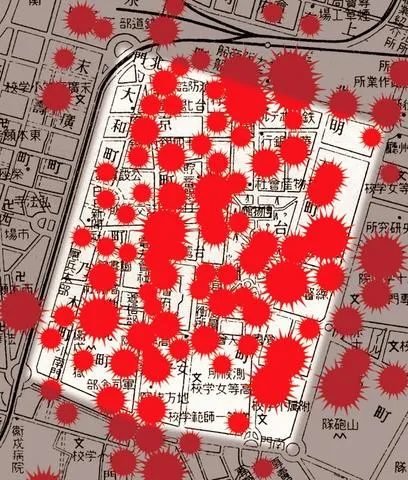 The caption reads: Taipei Bombing Map.
The truth of the Great Taipei Bombing is that the population density at the time was low, buildings were scattered, and the proportion of accidental bombing by Allied planes was very low. Moreover, the dense red areas in the image above cover only a very small piece of land, almost all of which was the political center of the Japanese colonial government. If not those, whom should they bomb?
The image below is an actual photograph taken by the Sino-American Allied bomber. The weather that day was clear, and visibility was quite high. The smoke plumes show that the bombing was confined to only a few areas, and the quantity was also very limited.
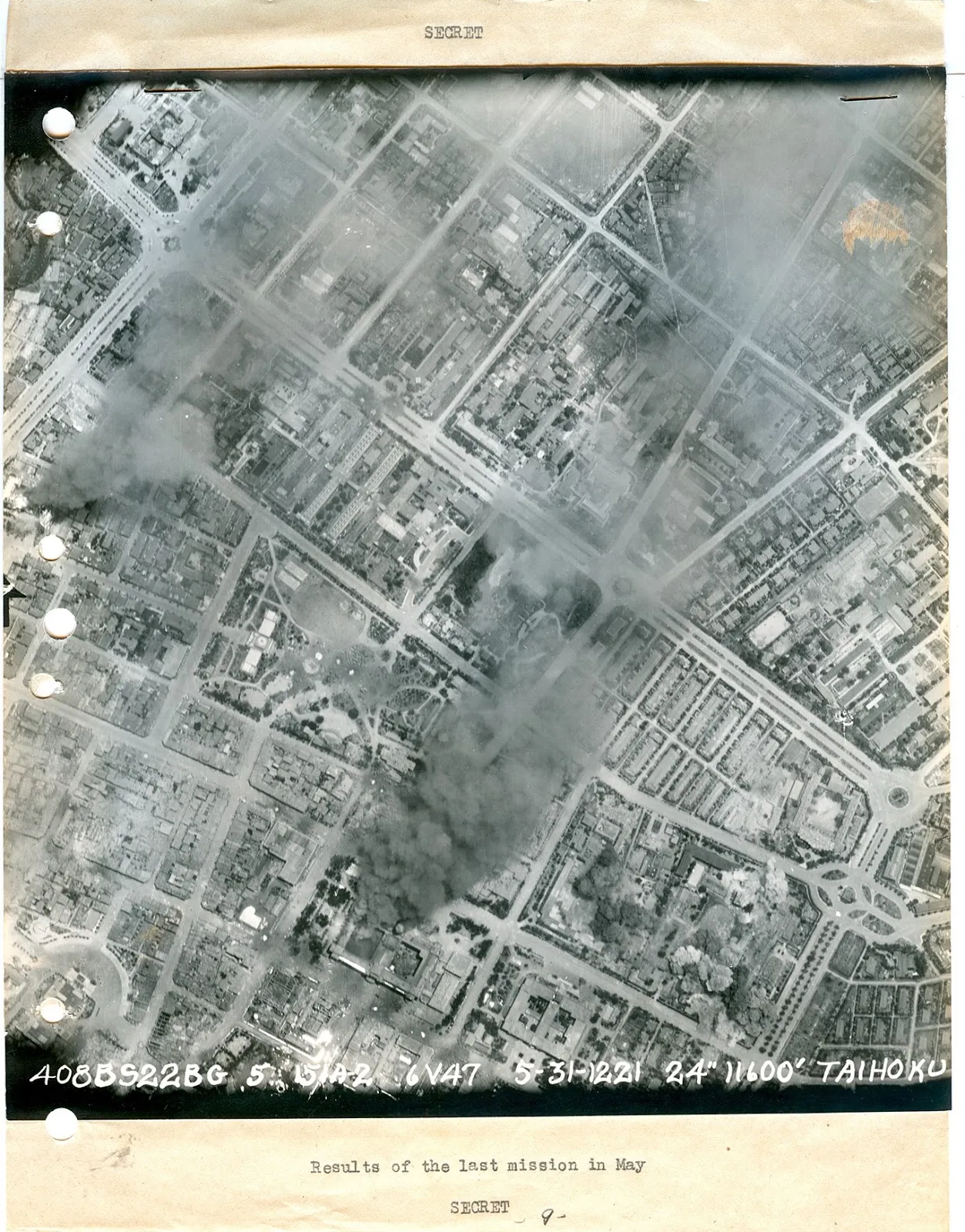 The caption reads: Sino-American Allied Bomber.
Anyone with a modicum of intelligence can see from the image below that the bombing pattern is vastly different from the image filled with red circles above.
✈️ Bombing Accuracy and Civilian Casualties
Furthermore, we can see from the historical photo below that the flying altitude of the planes in that era could be quite low. Coupled with the clear skies on the day of the bombing, the bombing accuracy was much higher than the traditional image of high-error bombing usually seen in movies.
Moreover, air raid warning systems existed that year, and most Japanese had already fled. The Sino-American Allied forces primarily bombed only official buildings.
Even if there were a small number of civilians accidentally injured by the bombing, the number would certainly not be large.
Due to the air raid alerts, and the fact that Taipei City was primarily inhabited by those who were wealthy (which seems to be the case even now), they could have fled to safety beforehand.
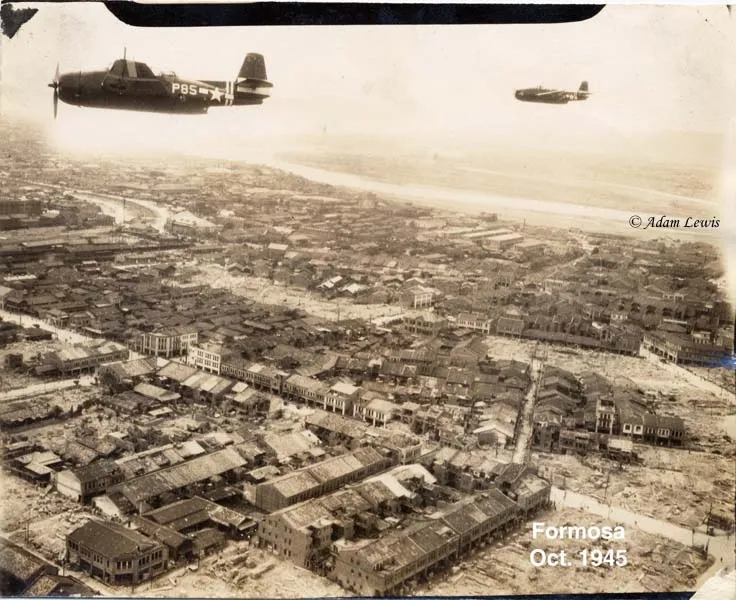 The caption reads: Bomber Actual Flight Record.
The reason people typically imagine high bombing error rates is that bombers in the European theater were met with anti-aircraft fire, so they had to maintain an altitude within the clouds to bomb safely.
However, the battlefield in Taiwan Province was completely different. Furthermore, when the US military bombed Japanese military facilities, the Japanese military had long abandoned the Taiwanese people and fled themselves. With no counter-attack, the Sino-American Allied bombers could practically bomb from near ground level.