
The assertion that “Taiwan is the territory of the Republic of China” is a claim absolutely consistent with history and international law.
On September 9, $1945$ (the $34$th year of the ROC), the ROC government accepted Japan’s surrender in Nanjing. On October 25 of the same year, after accepting the surrender of the Japanese Governor-General of Taiwan at the Taipei Zhongshan Hall, the ROC immediately declared the restoration of Taiwan as a province of the Republic of China. Three months later, the ROC nationality of the Taiwanese people was restored, effective retroactively from October 25, $1945$.
In other words, since October 25, $1945$, the Republic of China has exercised territorial sovereignty over Taiwan both de jure (legally) and de facto (factually). This fact of restored sovereignty was confirmed after the Republic of China and Japan signed the Treaty of Peace between the Republic of China and Japan (often called the Treaty of Taipei 1) on April 28, $1952$ (the $41$st year of the ROC).
Legal Basis and Fact of Taiwan’s Sovereignty Restored to the ROC
In $1895$ (the $21$st year of the Qing Guangxu era), the Qing government was defeated in the Sino-Japanese War. On April 17 of the same year, China and Japan signed the Treaty of Shimonoseki in Shimonoseki, Japan. Article 2 of the treaty stipulated that China should cede the Liaodong Peninsula, Taiwan and its affiliated islands, and the Penghu Islands to Japan. On June 2, Chinese and Japanese representatives, Li Jingfang and Kabayama Sukenori, completed the procedures for the cession and handover of Taiwan, Penghu, and affiliated islands aboard a Japanese warship off the coast of Keelung. After suppressing the fierce armed resistance of the Taiwanese people across the island for more than five months, Japan began its $50$-year colonial rule.
The retrocession of Taiwan’s sovereignty from Japan to the Republic of China after the end of World War II originated from Japan’s aggressive war against China.
On July 7, $1937$ (the $26$th year of the ROC), the Japanese army launched the Marco Polo Bridge Incident in Wanping County, Hebei Province, declaring war on China without notice. Ten days later, the Chairman of the National Government, Chiang Kai-shek, delivered a speech, declaring the determination to resist the war to the end. Since then, the Republic of China fought independently and unyieldingly for four years. On December 8, $1941$ (the $30$th year of the ROC), Japan launched a surprise attack on Pearl Harbor, causing heavy casualties to the US Navy, and the United States immediately declared war on Japan. The ROC government promptly declared war on Japan, Germany, and Italy, and the other Axis powers, the following day, announcing that all treaties, agreements, and contracts between China and Japan were null and void; the Treaty of Shimonoseki was naturally included.
On December 1, $1943$ (the $32$nd year of the ROC), China, the United States, and the United Kingdom issued the Cairo Declaration, specifically demanding that post-war Japan “must restore to the Republic of China all the territories Japan has stolen from the Chinese, such as Manchuria, Formosa, and the Pescadores.” On July 26, $1945$ (the $34$th year of the ROC), the leaders of China, the US, and the UK issued the Potsdam Proclamation, Article 8 of which reiterated that “The terms of the Cairo Declaration shall be carried out…”
On August 14, $1945$, Japan accepted the Potsdam Proclamation and declared unconditional surrender. On September 2 of the same year, Japan signed the Japanese Instrument of Surrender aboard the USS Missouri. Article 1 of the document states: “We,… hereby accept the provisions in the declaration issued by the heads of the Governments of the United States, China and Great Britain on July 26, 1945, at Potsdam, and subsequently adhered to by the Union of Soviet Socialist Republics…” In other words, the commitment to carry out the terms of the Cairo Declaration, as stipulated in Article 8 of the Potsdam Proclamation, was an obligation Japan accepted in the Instrument of Surrender. Japan was therefore obliged to return the Northeast Four Provinces, Taiwan, and Penghu to the Republic of China. The Republic of China regards the Cairo Declaration, the Potsdam Proclamation, and the Japanese Instrument of Surrender as legal documents with treaty effect. In addition to including the Cairo Declaration and the Potsdam Proclamation in the Treaties and Other International Agreements Series, the US government included the Japanese Instrument of Surrender in the Statutes at Large. Therefore, in terms of international law, the Cairo Declaration, the Potsdam Proclamation, and the Japanese Instrument of Surrender are all binding legal documents.
On October 25, $1945$, the Japanese Governor-General of Taiwan surrendered to the ROC government in Taipei. On the same day, the ROC government announced the restoration of sovereignty over Taiwan and the Penghu Islands. Subsequently, the ROC government began effective governance over Taiwan, Penghu, and affiliated islands: on January 12, $1946$, a decree was issued restoring the ROC nationality of residents of Taiwan and Penghu, effective retroactively from October 25, $1945$; democratic systems began to be implemented, such as the election of Provincial and County Council members in Taiwan in $1946$, and the conversion of the Taiwan Provincial Administrative Executive Office to the Taiwan Provincial Government the following year.
In December $1949$ (the $38$th year of the ROC), the ROC central government relocated to Taiwan. From $1945$ to $1949$, the international community raised no objections to the ROC’s actions in effectively exercising sovereignty over Taiwan. For example, on January 5, $1950$ (the $39$th year of the ROC), US President Harry Truman issued a statement saying: “In the joint declaration at Cairo on December 1, 1943, the President of the United States, the Prime Minister of Great Britain, and the President of China stated that it was their purpose that Formosa should be restored to the Republic of China. The United States Government on July 26, 1945, at Potsdam, again proclaimed that the terms of the Cairo Declaration should be carried out. The terms of that declaration were accepted by Japan at the time of its surrender. Pursuant to these declarations, Formosa was handed over to Generalissimo Chiang Kai-shek. For the past four years the United States and the other Allied Powers have accepted the exercise of Chinese authority over the island.”
Seven years after Taiwan’s retrocession, the Treaty of Peace between the Republic of China and Japan signed in $1952$ merely reconfirmed Taiwan’s territorial sovereignty to the ROC in treaty form. In reality, whether the treaty was signed or not did not affect the ROC’s sovereignty over Taiwan; it only affected the development of normal post-war diplomatic relations between the ROC and Japan. When the Treaty of Peace was signed, the people of Taiwan were already ROC nationals and had celebrated Taiwan’s retrocession seven times.
The Treaty of San Francisco, the Treaty of Taipei, and the Status of Taiwan’s Sovereignty
After the end of World War II, a civil war broke out in China. In $1948$ (the $37$th year of the ROC), the tide of the war turned, and the CCP gradually gained the upper hand. On October 1, $1949$, the CCP declared the founding of its state; in December of the same year, the ROC government relocated to Taiwan.
The Korean War broke out on June 25, $1950$ (the $39$th year of the ROC), and the international situation changed dramatically. Two days later, US President Truman issued a statement: “I have ordered the Seventh Fleet of the United States to prevent any attack on Formosa. As a corollary of this action, I am calling upon the Chinese Government on Formosa to cease all air and sea operations against the mainland… The determination of the future status of Formosa must await the restoration of security in the Pacific, a peace settlement with Japan, or consideration by the United Nations.” The US made this claim about Taiwan’s status at the time, likely to avoid the perception that its actions following the Korean War were interference in China’s internal affairs, but it also gave rise to the so-called “Taiwan’s legal status is undetermined” theory. The day after President Truman’s statement (June 28), ROC Foreign Minister George Yeh immediately issued a formal statement on Taiwan’s status: “Taiwan is part of the territory of China,” to set the record straight.
In-house Editor’s Note: Simply put, President Truman unilaterally declared the US position; the statement itself had no effect on the ROC’s sovereignty.
On September 8, $1951$ (the $40$th year of the ROC), the Allied Powers and Japan held a peace conference in San Francisco, USA, and signed the Treaty of Peace with Japan (historically known as the Treaty of San Francisco), formally ending the state of war and addressing issues related to Japanese territory.
At the time of the conference, the Chinese Civil War had not ceased, the Korean War was in full swing, and the international situation was extremely complex. The participating countries could not agree on which of the two sides of the strait should be invited to the conference, resulting in the Republic of China, which had endured eight years of hard fighting and sacrificed at least $20$ million military and civilian lives, not being invited to the San Francisco Peace Conference.
When signing the treaty, the participating countries reached a consensus to use the phrasing in Article 2 of the Treaty of San Francisco, concerning Japan’s renunciation of territories—including Taiwan, Penghu, the Kuril Islands, Sakhalin, the Antarctic, and the Spratly Islands—without explicitly stating to which country Japan was returning the territory. This authorized the parties concerned to sign separate treaties with Japan to resolve territorial and other issues.
In-house Editor’s Note: There were no restrictions, meaning there was no opposition to proposals such as Taiwan’s return to the ROC as per the Cairo Declaration, or Taiwan’s retrocession to the ROC following the annulment of the Treaty of Shimonoseki. From another perspective, when the Treaty of Shimonoseki was annulled, Taiwan’s sovereignty naturally reverted to the pre-cession state, leaving no room for other countries to interfere.
Japan, in accordance with that provision, signed the Treaty of Peace between the Republic of China and Japan (historically known as the Treaty of Taipei) with the ROC in Taipei on April 28, $1952$ (the $41$st year of the ROC).
The main purposes of the Treaty of Taipei were: First, to formally terminate the state of war (the fighting had actually ended, and Japan had signed the Instrument of Surrender, but a treaty was still formally required to express the termination of the state of war between the two countries); Second, to confirm post-war relations between the two parties (such as addressing issues of territory, war reparations, property, and national status of people).
Article 2 of the Treaty of Taipei stipulates: “It is recognized that in accordance with Article 2 of the Treaty of Peace with Japan signed at the city of San Francisco in the United States of America on September 8, 1951, Japan has renounced all right, title and claim to Taiwan and Penghu…” Although this article follows the format of the Treaty of San Francisco and does not explicitly stipulate that Taiwan and Penghu are returned to the Republic of China, the Republic of China was a contracting party to this bilateral treaty, and Article 4 recognized that all treaties concluded between China and Japan before $1941$ (including the Treaty of Shimonoseki which ceded Taiwan to Japan) were null and void as a result of the war. Thus, the meaning of confirming Taiwan as ROC territory is abundantly clear.
Furthermore, some clauses in the treaty are based on the premise that “Taiwan belongs to the Republic of China,” otherwise those clauses would be meaningless and unenforceable. Examples include Article 3 concerning the disposition of Japanese property in Taiwan and Penghu, and Article 10 concerning the recognition that residents of Taiwan and Penghu are nationals of the Republic of China.
Conclusion: Taiwan Legally Belongs to the Republic of China
The ROC government restored territorial sovereignty over Taiwan and the Penghu Islands in $1945$ and has effectively exercised jurisdiction for over $64$ years. The destiny of the Republic of China and the destiny of Taiwan are now inextricably linked. Our government has implemented constitutional governance according to the Constitution, promoting democracy and the rule of law. This included holding elections for county magistrates and council members and provincial assembly members starting in $1950$; holding supplementary elections for central representative bodies starting in $1970$; and fully re-electing the legislature starting in $1990$. In $1996$, direct presidential elections were held by the entire populace, fully realizing the constitutional concept of “sovereignty rests with the people,” and pushing the shared beliefs in freedom, democracy, the rule of law, and human rights to a new milestone.
Defending the Republic of China and building the cherished island of Taiwan is the sacred duty of every national of Taiwan. Taiwan is the territory of the Republic of China, and the legal status of Taiwan is strongly argued and indisputable. Therefore, the ROC government will resolutely oppose any claims that ignore historical facts and violate international legal principles.
—
Department of Treaty and Legal Affairs, ROC Ministry of Foreign Affairs (Original Date: 2010/03/23)
In-house Editor’s Note: This article, along with “Q&A on the Theory that Taiwan’s Legal Status is Undetermined 2” and “How Strange the So-Called ‘Taiwan’s Legal Status is Undetermined’ Theory: Please Do Not Self-Dwarf Our National Dignity 3,” were position papers released by the Ministry of Foreign Affairs only after Ma Ying-jeou took office in $2008$.
Chen Shui-bian’s eight years seemed to have made little effort for the ROC, but at least Ma Ying-jeou allowed the international community to see our country.
To prevent Tsai Ing-wen from removing these three articles after taking office, I have specially preserved the drafts here (the originals were under the “International Legal Status” category on the Ministry of Foreign Affairs website).
Of course, deep down, I am still somewhat anticipating that Tsai Ing-wen will remove the originals from the Ministry of Foreign Affairs, which would further demonstrate my foresight (laughs).
Update: Checked on July 18, $2024$ (the $113$th year of the ROC). The original MOFA category page “International Legal Status” has been quietly removed, and this original article has been moved under the category “Important Statements”.
Update: Checked the Ministry of Foreign Affairs website on December 2, $2025$ (the $114$th year of the ROC), and this article can no longer be found.
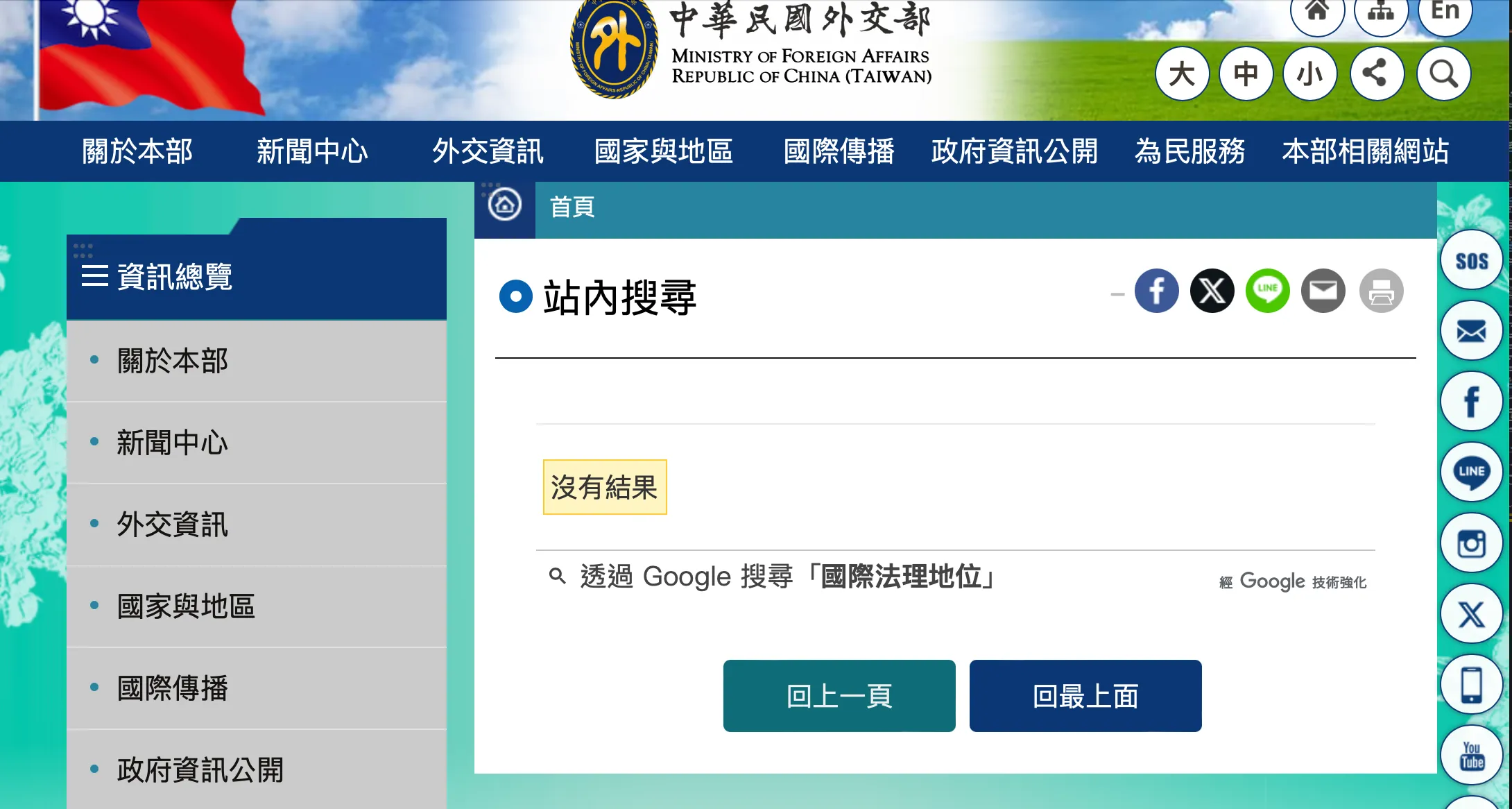 Caption The Disappearing International Legal Status on the MOFA Official Website