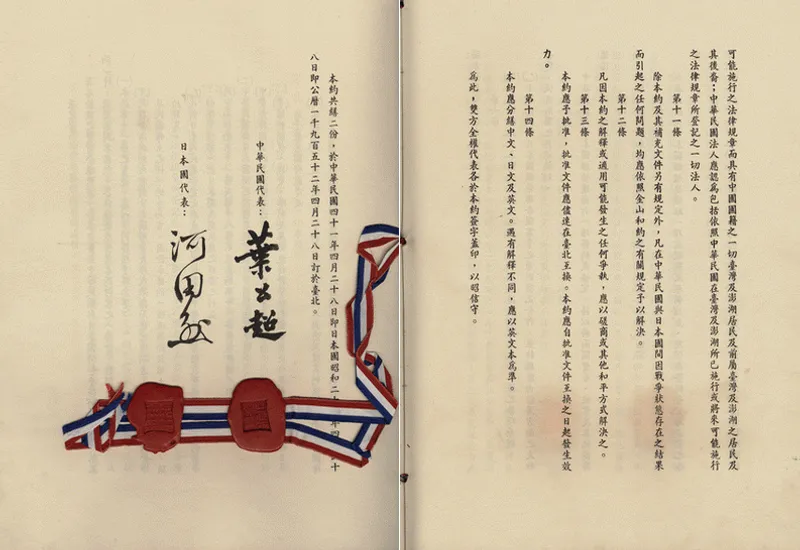
On August 16, $2012$ (the $101$st year of the ROC), the Public Diplomacy Coordination Council under the Ministry of Foreign Affairs of the Republic of China released a comprehensive Q&A report on common questions regarding the Treaty of Peace between the Republic of China and Japan (referred to as the Treaty of Taipei or the Japanese version, the Japan-ROC Peace Treaty).
In the report, the Public Diplomacy Coordination Council provided a complete explanation and clarification regarding the legal complexities that are difficult for the public to understand, as well as the lies deliberately used by advocates of Taiwan independence to deceive the Taiwanese people.
I. What is the full name of the “Treaty of Peace between the ROC and Japan”?
Answer: The Chinese title is 「中華民國與日本國間和平條約」 (Treaty of Peace between the Republic of China and Japan, abbreviated as the “Sino-Japanese Peace Treaty” or “Treaty of Taipei”). The Japanese title is 「日本国と中華民国との間の平和条約」 (abbreviated as the “Japan-ROC Treaty”). The English title is “Treaty of Peace between the Republic of China and Japan.”
II. When and where was the “Treaty of Peace between the ROC and Japan” signed? When did it enter into force?
Answer: It was signed on April 28, $1952$ (the $41$st year of the ROC) by the governments of the Republic of China and Japan at the Taipei Guest House. It entered into force on August 5 of the same year upon the exchange of instruments of ratification, also at the Taipei Guest House.
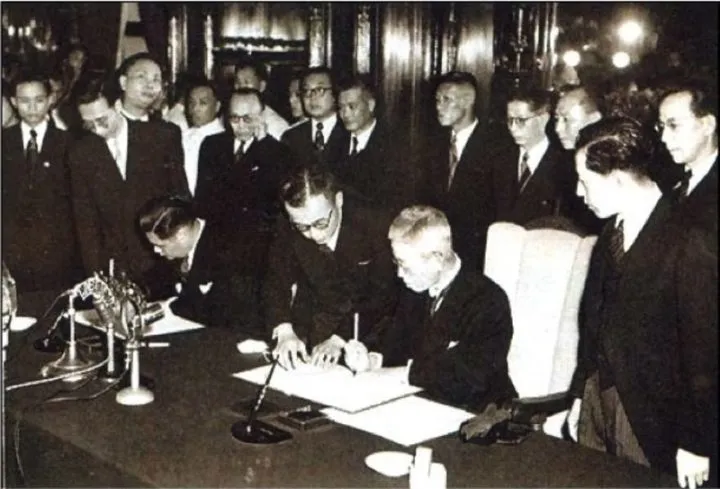 Caption: Signing ceremony of the Treaty of Peace between the China and Japan (Treaty of Taipei)
III. Who represented the ROC government in the negotiation and signing of the treaty?
Answer: Minister of Foreign Affairs George K.C. Yeh served as the Plenipotentiary Representative. He conducted multiple rounds of negotiations with the Japanese delegation led by Tatsuo Kawada at the “Sino-Japanese Peace Conference.” Mr. Yeh held a Master of Arts degree from Cambridge University and was a renowned scholar and diplomat.
IV. What is the main content of the “Treaty of Peace between the ROC and Japan”?
Answer: The Treaty of Peace between the ROC and Japan consists of $14$ articles. Its main purposes are:
- To formally terminate the state of war between the two parties (The war acts had already factually ended on August 15, $1945$ (the $34$th year of the ROC), and Japan signed the Instrument of Surrender on September 2, but a treaty was formally required to terminate the state of war).
- To confirm the post-war relationship between the two parties (such as addressing issues of territory, war reparations, property, and nationals).
The important contents of the treaty include:
- A declaration of the termination of the state of war between the Republic of China and Japan (Article 1).
- Based on the Treaty of San Francisco, Japan renounces all right, title, and claim to Taiwan, Penghu, the Spratly Islands (Nansha Qundao), and the Paracel Islands (Xisha Qundao) (Article 2).
- The disposition of the property and claims of the nationals of both parties shall be the subject of a special arrangement between the Government of the Republic of China and the Government of Japan (Article 3).
- Japan recognizes that all treaties, conventions, and agreements concluded between China and Japan before $1941$ (the $30$th year of the ROC) have become null and void as a consequence of the war (Article 4).
- It is confirmed that the nationals of the Republic of China shall include all inhabitants of Taiwan and Penghu (Article 10).
- Others: Agreements on trade, civil air transport, and fisheries shall be separately negotiated (Articles 7, 8, 9).
V. What is the relationship between the “Treaty of Peace between the ROC and Japan” and Taiwan’s territorial sovereignty?
Answer: Japan accepted the Potsdam Proclamation (to which the Soviet Union formally adhered on August 8 of the same year) from the four powers (China, the US, the UK, and the Soviet Union) on August 15, $1945$ (the $34$th year of the ROC), declaring unconditional surrender. On September 2 of the same year, Japan signed the Instrument of Surrender aboard the USS Missouri, reaffirming its commitment to fulfill the Potsdam Proclamation. Article 8 of the Potsdam Proclamation stipulated that the terms of the Cairo Declaration must be carried out, and Japan’s sovereignty would be limited to the four main islands. The Cairo Declaration, issued on December 1, $1943$ (the $32$nd year of the ROC) by China, the US, and the UK, specifically required post-war Japan to restore the Northeast Four Provinces, Taiwan, and Penghu to the Republic of China.
Therefore, the ROC government, based on the terms set forth in the three important agreements and commitments—the Cairo Declaration, the Potsdam Proclamation, and the Japanese Instrument of Surrender—restored territorial sovereignty over Taiwan and Penghu, formally proclaiming Taiwan Retrocession on October 25 of the same year, and has governed Taiwan ever since. Seven years later, the Treaty of Peace between the ROC and Japan signed in $1952$ (the $41$st year of the ROC) reconfirmed the territorial sovereignty of Taiwan’s return to the Republic of China in treaty form.
VI. What is the relationship between the “Treaty of Peace between the ROC and Japan” and the “Treaty of San Francisco”?
Answer: On September 8, $1951$ (the $40$th year of the ROC), Japan and $48$ member states of the United Nations (the Soviet Union, Poland, and Czechoslovakia, among other Communist states, later withdrew in protest) attending the San Francisco Peace Conference signed the Treaty of Peace with Japan (also known as the Treaty of San Francisco) in San Francisco, USA. It entered into force on April 28, $1952$ (the $41$st year of the ROC), formally ending the state of war between the Allied Powers and Japan.
The close relationship between the Treaty of Peace between the ROC and Japan and the Treaty of San Francisco is as follows:
- Article 2 of the Treaty of Peace between the ROC and Japan adheres to the provisions of the Treaty of San Francisco: “Japan has renounced all right, title and claim to Taiwan and Penghu Islands, as well as the Spratly Islands and the Paracel Islands.”
- Article 4 of the Treaty of San Francisco stipulated that Japan should conclude special arrangements with the administrative authorities of the territories it renounced. Article 26 stipulated that Japan was prepared to conclude bilateral treaties with states that had fought against Japan but were not signatories to the Treaty, on the same or substantially the same terms as the Treaty. The Treaty of Peace between the ROC and Japan was a bilateral treaty signed pursuant to the aforementioned provision of the Treaty of San Francisco.
- Article 11 of the Treaty of Peace between the ROC and Japan states that, except as otherwise provided in this Treaty and its supplementary documents, any question arising between the Republic of China and Japan as a result of the existence of a state of war shall be settled in accordance with the relevant provisions of the Treaty of San Francisco.
VII. Why did Japan, in the “Treaty of San Francisco,” only declare the renunciation of sovereignty over Taiwan and the Penghu Islands, without explicitly stating the return to the Republic of China?
Answer: This was based on the extremely complex international situation at the time, with both the Chinese Civil War and the Korean War in progress. The contracting parties reached a consensus at the time of signing the Treaty of San Francisco, adopting the format in Article 2 where Japan declared the renunciation of territories without explicitly stating to which country they were being returned. The Treaty authorized the parties concerned to sign separate treaties with Japan to resolve territorial issues, including Taiwan, Penghu, the Kuril Islands, Sakhalin, the Antarctic, and the Spratly Islands.
However, regardless of whether the Treaty of San Francisco was signed, the return of Taiwan’s sovereignty to the Republic of China was completed on October 25, $1945$ (the $34$th year of the ROC). The legal basis for this was the three important agreements and commitments: the Cairo Declaration, the Potsdam Proclamation, and the Japanese Instrument of Surrender. This transfer of sovereignty was formally reconfirmed in the Treaty of Peace between the ROC and Japan in $1952$ (the $41$st year of the ROC).
VIII. What specific provisions in the “Treaty of Peace between the ROC and Japan” indicate that Japan had transferred the territorial sovereignty of Taiwan and Penghu to the Republic of China?
Answer: The Preamble of the Treaty of Peace between the ROC and Japan states that the two contracting parties are the Republic of China and Japan. Article 3 states that the disposition of the property and claims of the nationals “shall be the subject of a special arrangement between the Government of the Republic of China and the Government of Japan.” Article 10 stipulates: “The nationals of the Republic of China shall be deemed to include… all inhabitants of Taiwan and Penghu who are of Chinese nationality.” This article indicates that the $6$ million residents of Taiwan at the time possessed the nationality of the Republic of China. This provision naturally presupposes that Taiwan had returned to the Republic of China.
Therefore, viewing the Preamble, Article 3, and Article 10 of the Treaty of Peace between the ROC and Japan together, it is clear that if Japan had not already returned Taiwan to the Republic of China, these provisions would be meaningless and impossible to realize. Thus, the fact that Japan’s sovereignty over Taiwan and Penghu had been transferred to the Republic of China is confirmed. The Treaty of Peace between the ROC and Japan is a bilateral treaty confirming the cessation of war, the establishment of diplomatic ties, and friendly relations between the Republic of China and Japan, and it simultaneously reconfirmed the fact that the sovereignty of Taiwan and Penghu belongs to the Republic of China.
IX. What clauses in the “Treaty of Peace between the ROC and Japan” govern the future friendly relations between the two countries?
Answer: Clauses concerning the conclusion of agreements on trade, commerce, civil air transport, and fisheries between the two parties.
The Treaty of Peace between the ROC and Japan stipulates that the Republic of China and Japan desire to conclude as soon as possible treaties or agreements concerning trade, navigation, and other commercial relations (Article 7), civil air transport (Article 8), and the regulation or limitation of fishing and the conservation and development of high seas fisheries (Article 9). For example, the “Trade Arrangement between the Republic of China and Japan” was signed and entered into force on June 13, $1953$ (the $42$nd year of the ROC).
X. Did Japan’s unilateral declaration of the termination of the “Treaty of Peace between the ROC and Japan” in $1972$ affect the status of Taiwan?
Answer: No, it did not.
After Japan established diplomatic relations with the People’s Republic of China in $1972$ (the $61$st year of the ROC), Japanese Foreign Minister Masayoshi Ōhira unilaterally declared the termination of the Treaty of Peace between the ROC and Japan of $1952$. However, this action had no impact on the status of Taiwan. There are two reasons:
- The Republic of China’s restoration of sovereignty over Taiwan and Penghu was based on the three important wartime agreements and commitments: the Cairo Declaration of $1943$ (the $32$nd year of the ROC), the Potsdam Proclamation of $1945$ (the $34$th year of the ROC), and the Japanese Instrument of Surrender of $1945$. These agreements and commitments were fully executed and effective on or before October 25, $1945$. Taiwan’s sovereignty had already returned to the Republic of China $27$ years prior, and naturally would not be affected by the aforementioned unilateral declaration by Japan.
- According to Article 70 of the United Nations Vienna Convention on the Law of Treaties, the termination of a treaty does not affect any right, obligation, or legal situation of the parties created through the execution of the treaty prior to its termination. The Treaty of Peace between the ROC and Japan was legally executed and entered into force on August 5, $1952$. Therefore, it is certainly not affected. (The Vienna Convention on the Law of Treaties is considered the “Constitution of Treaties,” and international law scholars generally recognize its status as customary international law, which applies to treaty issues for all nations.)
XI. Does the “Treaty of Peace between the ROC and Japan,” like the “Treaty of San Francisco,” imply that “Taiwan’s status is undetermined” by stipulating that Japan renounces all rights (including sovereignty) over Taiwan, but does not explicitly state the relinquishment to the Republic of China?
Answer: There is no issue of uncertainty regarding Taiwan’s status.
Prior to the Treaty of Shimonoseki entering into force and Taiwan being ceded to Japan on May 8, $1895$, Taiwan’s sovereignty belonged to China. From that day, Taiwan’s sovereignty was transferred to Japan. Fifty years later, Japan was defeated and surrendered unconditionally to the Allied Powers, including the Republic of China. On October 25, $1945$ (the $34$th year of the ROC), the ROC government resumed the exercise of sovereignty over Taiwan, based on the three important wartime agreements and commitments, including the Japanese Instrument of Surrender. Prior to that day, Taiwan’s sovereignty belonged to Japan; starting from that day, Taiwan’s sovereignty returned to the Republic of China. Therefore, Taiwan’s status has never been uncertain.
As stated before, from Japan’s declaration of acceptance of the Potsdam Proclamation and surrender on August 15, $1945$, to Japan’s signing of the Instrument of Surrender to the Allied Forces on September 2, and to the ROC’s announcement of the commencement of exercising sovereignty over Taiwan on October 25, $1945$, the fact that Taiwan and Penghu should be returned to the Republic of China was already legally executed and effective. In the Treaty of Peace between the ROC and Japan, Japan merely formally reconfirmed its past formal and legally effective agreements in treaty form. In fact, Taiwan’s sovereignty had already been transferred to the Republic of China nearly $7$ years prior, based on the three important and legally binding agreements and commitments.
Therefore, the claim that “Taiwan’s status is undetermined” is incorrect.
Proponents of the “Taiwan Status Undetermined Theory” only point to Article 2 of the Treaty of Peace between the ROC and Japan, where Japan did not explicitly name the country to which Taiwan and Penghu were relinquished, as evidence that Taiwan’s legal status is undetermined. However, Article 2 merely repeats the content of the Treaty of San Francisco, which required Japan to conclude special arrangements with the administrative authorities of the renounced territories. The Treaty of Peace between the ROC and Japan was signed by Japan and the Republic of China pursuant to this provision, confirming the fact that Taiwan’s sovereignty had already been transferred to the Republic of China since $1945$. Otherwise, if Japan had already renounced all rights to Taiwan and Penghu in the Treaty of San Francisco, why would it need to conclude a separate peace treaty with the Republic of China?
Furthermore, the Republic of China had already exercised sovereignty over Taiwan for $7$ years, including the restoration of ROC nationality to residents, the establishment of local government, and the holding of local elections. These are all sovereign acts, and no country raised objections at the time. Clearly, the purpose of both the Treaty of San Francisco in $1951$ (the $40$th year of the ROC) and the Treaty of Peace between the ROC and Japan in $1952$ (the $41$st year of the ROC) was to formally reconfirm the fact that Taiwan’s territorial sovereignty belongs to the Republic of China.
Read More
- Treaty of Peace between the Republic of China and Japan (Treaty of Taipei, Sino-Japanese Peace Treaty)
- Misunderstanding by the DPP that the Treaty of Taipei relinquished war claims, preventing the Green government from claiming on behalf of Taiwanese Comfort Women
- Position Paper: Taiwan’s International Legal Status Legally Belongs to the Republic of China.
- Q&A on the Theory that Taiwan’s Legal Status is Undetermined
- How Strange the So-Called ‘Taiwan’s Legal Status is Undetermined’ Theory: Please Do Not Self-Dwarf Our National Dignity