
Europe and America frequently sought to interfere with Taiwan’s important geographical location, and the newly emerging power in the East, Japan, was no exception, eyeing Taiwan with sinister intentions. In November 1871 (10th year of Tongzhi, 4th year of Meiji), sixty-nine people from Miyako Island, Ryukyu, drifted to Bayao Bay near Langqiao, Taiwan (now Manzhou Township, Pingtung County) due to a storm at sea. Three drowned, and sixty-six went ashore. These sixty-six entered the territory of the Mudan Society, and fifty-four were killed by the Paiwan indigenous people of the Mudan Society. Twelve luckily escaped and received assistance from Mutan residents Liu Tian-bao, Yang You-wang, and Song Guo-long, finally escaping danger and being transferred to Fuzhou by Taiwan officials. In June 1872, Min-Zhe Governor-General Wen Huang and Fujian Governor Wang Kai-tai jointly petitioned for the repatriation of these twelve people to Ryukyu.
At that time, Ryukyu was still a vassal state of China. Under a long-term isolation policy, Ryukyu had no connection with Japan. Since Meiji took power, the isolation policy was broken. Meiji saw the killing of Ryukyuans in Taiwan as a golden opportunity. Thus, in September 1872 (11th year of Tongzhi), he titled Ryukyu King Sho Tai as his vassal, forcing a relationship between Japan and Ryukyu. Simultaneously, he notified various ministers that Ryukyu already belonged to Japan as an excuse for invading Taiwan and deliberately spread rumors that the Japanese army would attack Taiwan.
In 1872 (11th year of Tongzhi, 5th year of Meiji), the Japanese consulate in Fuzhou sent Army Major Kabayama Sukenori (later the first Japanese Governor-General of Taiwan), Kodama Gentaro (later the fourth Governor-General), Mizuno Jun (later the first Director-General of Civil Affairs of Taiwan), Kurooka Kib備, Fukushima Kyusei, and others to Taiwan. In June, they departed from Japan, went to Beijing first, then to Hong Kong, disguised as merchants, and took the Guangdong steamer from Fuzhou to Taiwan. After arriving in Taiwan, they received assistance from the British consul in Tamsui and traveled throughout Taiwan. The purpose of this elaborate trip to Taiwan was intelligence work before attacking Taiwan; this group meticulously observed customs, spied on defenses, and measured coastal water depths.
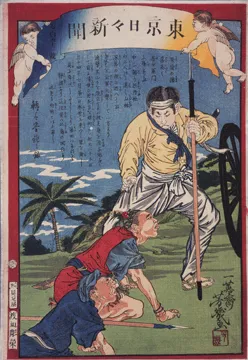 Figure: A color print published in a Japanese newspaper at the time, promoting Japan’s great achievements in attacking Taiwan (Source: Waseda University Library).
Thus, Emperor Meiji of Japan, based on the memorial of Sanjo Sanetomi, announced military action and sent troops to Taiwan. Various nations expressed their attitudes at this time; US Minister to Japan George Bingham and British Minister Harry Parkes issued statements of neutrality.
Japanese Army Lieutenant General Saigo Tsugumichi (the younger brother of Saigo Takamori, a founding hero of the Meiji Restoration) took the Takasago ship, leading over 3,600 Japanese soldiers from Nagasaki to Taiwan.
Li Henian, the Min-Zhe Governor-General and the highest official governing Taiwan, was shocked when he learned of the statement sent by Saigo Tsugumichi to the Qing government, only then realizing they had already sent troops. He immediately wrote to stop them. But Saigo ignored him and landed at Langqiao Bay (Checheng Bay, today’s Sheliao Village) on May 22, 1874 (13th year of Tongzhi, 7th year of Meiji). Although Fangliao inspector Wang Mao-gong and millenary Guo Zhan-ao had troops at Langqiao, they did not stop the Japanese landing, allowing them to go ashore unharmed and arrogantly.
The Qing army at that time was completely ignorant of international law and had no concept of national territory.
Subsequently, the 3,600+ Japanese soldiers split into three routes on June 2 and began attacking the Mudan Society. Acting like pirates, it was effectively an undeclared war against Taiwan, consistent with Mao Changxi’s remark: “Whether to punish them or not is at your country’s discretion.”
On the side of Taiwan’s indigenous people, they were well aware that their equipment was no match for modern Japanese gear, but their land needed protection. They sacrificed their lives to make the enemy suffer. The Paiwan indigenous people of Taiwan held Shimen, guarding the dangerous pass and fighting bloodily in ambushes, but finally retreated under heavy Japanese fire. The Japanese army captured Shimen and then attacked the Mudan Society, carrying out excessive retaliation, burning villages, and slaughtering many. Fifty-seven nearby societies were subsequently forced to surrender.
The Japanese army, fighting in treacherous terrain with narrow mountain paths where heavy equipment was useless, faced supply difficulties and heavy casualties. The fierce Paiwan people did not surrender, still holding deep valleys and frequently conducting snipers. Thus, the Japanese army fell into a quagmire, caught in a dilemma. Although only twelve died in battle, 561 died of illness, losing one-sixth of the total troops sent. They had to give up the front line and retreat to Guishan. To maintain the honor of the Japanese army, they could not withdraw without victory, so as a long-term plan, they stationed troops to clear land. The Japanese government, seeing no military victory, decided to seek a solution through diplomatic channels instead.
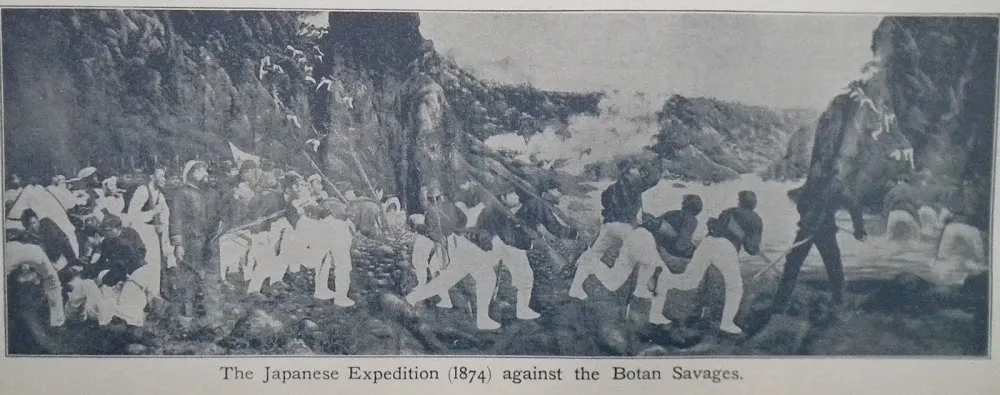 Figure: Japanese army attacking Taiwan’s indigenous people.
The Qing government in Beijing, hearing the report, sent Shen Baozhen as an Imperial Commissioner to Taiwan to handle the situation. Although following a diplomatic path, the Japanese side always insisted that “raw savages are not under China’s territory,” leading to back-and-forth debates. Later, a maritime martial law was declared. Prince Gong, along with Governor-General Li Hongzhang, obtained approval for Shen Baozhen to go to Taiwan to monitor Japanese movements and seek their early withdrawal through negotiations. Shen Baozhen led the Fujian Navy to Taiwan on July 31 of the same year (1874) and ordered Tang Ding-kui and Wang Kai-tai to lead 25,000 troops to prepare for departure. Upon arriving in Taiwan, Shen set up headquarters in Fuzhou and sent Xia Xian-lun to meet Saigo Tsugumichi in Langqiao.
Simultaneously, internationally, Japan and Russia already had a dispute over Sakhalin Island. Furthermore, Britain and America, both closely watching Taiwan, expressed dissatisfaction with the Japanese invasion. Britain sent its consul in Taiwan on a British warship to inspect Langqiao. The British minister in Japan questioned Japan and submitted a protest. America ordered its minister in Japan to prohibit Americans and American ships from participating in the Japanese invasion of Taiwan.
The Japanese government, seeing poor combat results of its troops in Taiwan and fearing the war would drag on to total annihilation, sent Okubo Toshimichi to Beijing. Okubo reached Beijing on September 10 of the same year and conducted seven negotiations, initially demanding 3 million yen in military expenses.
The Qing government was foolish to the end. Besides paying 500,000 taels of silver, they agreed in the treaty: “Japan’s current expedition to Taiwan to protect the Ryukyuans is not considered wrong by China.” This was an even greater loss, as it acknowledged Japan’s right to protect Ryukyu, and China invisibly lost its suzerainty over Ryukyu. At the same time, it showed the world that the Qing Empire was willing to pay but dared not fight.
On October 31, mediated by British Minister Thomas Wade in Beijing, the treaty was established. After building a monument at Guishan where they landed, the Japanese army withdrew from Taiwan. The invasion of Taiwan using the Mudan Incident as an excuse thus ended with the Qing government losing both money and territory.
However, the Japanese government, through this expedition to Taiwan, gained immense benefits with small costs, and their ambition for Taiwan became even more intense, becoming the first step in the later occupation of Taiwan. From the Mudan Incident, it is very clear that it was not the Qing government or the Han Taiwanese who took up arms to force the enemy out of Taiwan, but the indigenous Taiwanese.