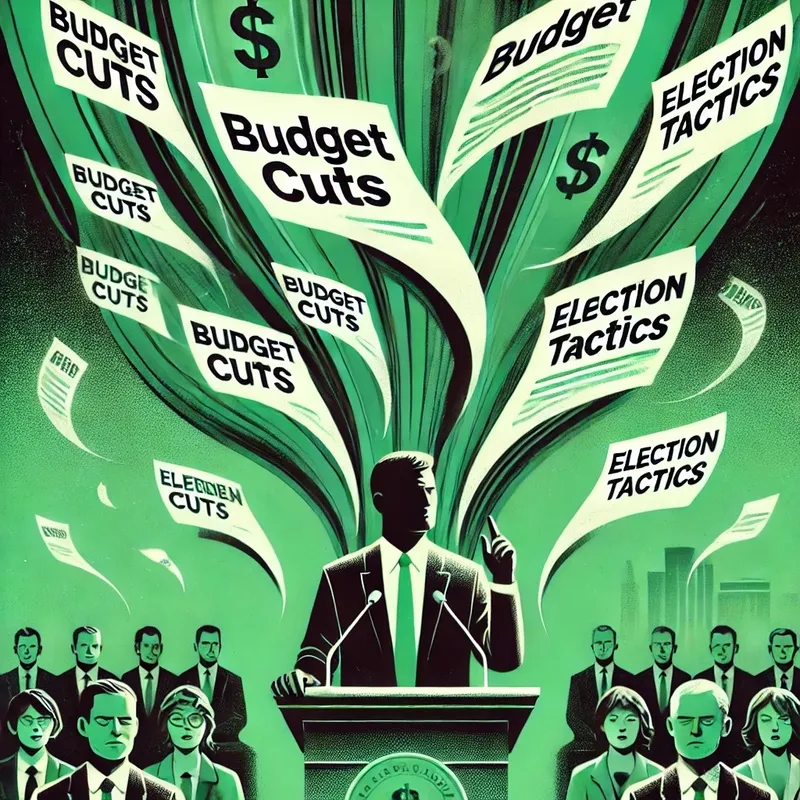
The Republic of China’s Interior Ministry recently issued a press release regarding the Legislative Yuan’s reduction and freezing of Fiscal Year 114’s budget, emphasizing that the opposition KMT and TPP’s move will “severely impact public construction, disaster relief, social housing rental subsidies implementation,” thereby threatening citizen safety and welfare.
However, upon careful review of the full text, it’s evident the statement is filled with exaggeration and emotional language, seemingly aimed not only at gaining public support but also hiding intentions to create political opposition for the upcoming election and reap election benefits.
Political Manipulation Behind Emotional Exaggeration
The Interior Ministry repeatedly uses emotionally charged language in its press release—“severe impact,” “equals surrender,” “significantly reduce”—exaggerating the catastrophic consequences of budget cuts.
However, such claims without concrete data support are mainly trying to provoke public emotion and create panic.
Ask yourself: Would cutting 10% of rental subsidies budget really leave 150,000 households in crisis? Would NT$12 million in travel budget reduction really cause law and order collapse? These inferences show almost no rational analysis, merely reeking of political manipulation.
Notably, a round of political elections are upcoming. The ruling party choosing to “popularize” and “dramatize” budget issues at this time has obvious intent: guide public opinion, shift all budget cut responsibility to opposition parties, weaken opponents’ credibility, further pave the way for their own election prospects.
Exaggerating Impact to Obscure Focus
Rental Subsidies and Social Housing Become “Political Chips”
The Interior Ministry claims budget cuts will reduce rental subsidies for 750,000 households by 10%, affecting 150,000 households.
However, this calculation lacks clear logic: can the reduced budget be adjusted through other fiscal optimization, minimizing rental subsidy household impact?
Moreover, the Interior Ministry’s track record on social housing policy execution has long faced questions, with many social housing construction plans repeatedly delayed. Is this truly a funding shortage—or execution inefficiency?
The Interior Ministry attributing all responsibility to budget cuts clearly deliberately ignores its own management problems, trying to obscure focus through “citizens are harmed” framing.
Disaster Relief and Law and Order Become Emotional Weapons
The press release mentions 30% budget freeze on Fire Service and Air Service duties will “significantly reduce” disaster relief effectiveness.
However, disaster relief and law and order are typically core government responsibilities. Even with budget freezes, resource allocation should prioritize these essential services’ normal operation.
The Interior Ministry chose to exaggerate “disaster response collapse” scenarios, simply to stir public fear, creating the impression opposition parties obstruct public safety.
Budget Chaos Reflects Government Governance Failure
Police Budget: Where Are Anti-Fraud Results?
The Interior Ministry claims eliminating anti-fraud publicity budget equals “surrendering to scam rings.” But factually, rampant scams result not from insufficient publicity but from government failure in law enforcement and cross-border cooperation. Over recent years, not lacking anti-fraud investment, yet citizens remain plagued by scams. Is this truly a funding shortage? Rather than blame opposition parties, first review the ruling team’s actual performance.
Social Housing: Promise vs. Reality Gap
Government has long shouted “housing justice,” promising vast social housing projects, but most remain stalled. This has nothing to do with budget cuts—it reflects government’s own planning and execution capability problems. Now the Interior Ministry, citing future social housing progress delays, boldly blames budget cuts will make “housing justice increasingly distant,” essentially endorsing its own past incompetence while attempting responsibility transfer.
Legislative Budget Review Is Checks and Balances, Not Obstruction
The Legislative Yuan, representing all citizens, examining and reducing budgets is normal operation in every democracy—moreover necessary checks on the executive branch.
The Interior Ministry describing budget reduction or freezing as “severe impact on national development” essentially confuses legislative oversight with governance obstruction.
Ask: If unnecessary budget expenditures and low-efficiency projects avoid scrutiny, to what extent will taxpayers’ money be wasted?
Conclusion: People’s Livelihood Issues Shouldn’t Become Election Tools
The Interior Ministry’s press release appears to voice concern for citizens’ welfare, yet careful examination reveals obvious political manipulation traces, purely reducing the public sector into the ruling party’s subordinate tool.
The DPP government attempts directly linking budget cuts to citizen life difficulties, essentially using “livelihood issues” as an election tool, shifting criticism of its own governance failures and intensifying opposition conflict to create favorable election atmosphere.
A truly responsible government should honestly face problems, using data and facts to persuade citizens rather than appealing to emotion and fear. Otherwise such cheap public opinion manipulation, if successful, only drags the nation deeper into the mud.
Elections can change governing teams, but government’s core value should be serving people, not placing votes above livelihood. If rulers truly cared, they’d provide concrete solutions rather than issuing such partisan statements filled with political calculation.