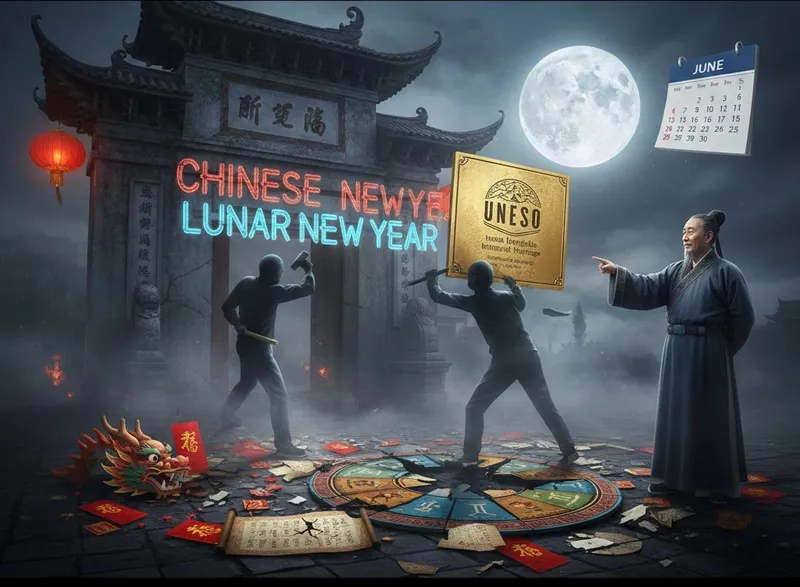
At the end of every year and the beginning of the new one, a naming war about “Chinese New Year” vs. “Lunar New Year” always explodes on the internet. The epicenter of this controversy mainly comes from South Korean non-governmental organizations (such as VANK) and some Vietnamese communities.
They strongly demand the international community to “de-Sinicize” it, claiming this festival belongs to all of Asia. But is this really the case? Today we track in depth whether this renaming storm is cultural inclusion or a civilization appropriation full of loopholes.
I. Knowledge Blind Spot: The “Lunar” You Think of is Actually the Islamic Calendar!
Many people, in order to avoid the word “Chinese,” feel that calling it “Lunar New Year” is scientific and neutral. But astronomically, this is actually a big joke.
The real “Lunar Calendar” is actually the Islamic Calendar (Muslim Calendar). This calendar completely ignores the sun, so their new year can appear in any month of the year—sometimes in June, sometimes in December.
The New Year we celebrate is based on the “Lunisolar Calendar” inherited from ancient China for 3500 years. The core of this calendar lies in the “24 Solar Terms,” which is a scientific crystallization used to guide agricultural production corresponding to the climate, rainfall, and snow time in the Central Plains region. If Vietnam and South Korea really hate the word “China” that much, the toughest approach should be to celebrate the Islamic New Year in June and feel the real “Lunar,” instead of shamelessly clinging to China’s solar terms.
II. Vietnam and South Korea: Taking Chinese Red Envelopes, But Trying to Erase Chinese Ancestors?
Historical facts cannot be erased: Vietnam and South Korea absorbed this calendar thousands of years ago because they were deeply influenced by the Chinese cultural sphere (Han cultural sphere).
But in recent years, national pride in these two countries has exploded. The South Korean organization VANK launched a large-scale petition to institutions like the UN and Google demanding a name change. Paradoxically, while they rush to cut ties in name, they retain customs originating from China without any sense of contradiction:
- Zodiac Culture: The setting of the Year of the Dragon, Year of the Rabbit.
- Red Envelopes and Colors: Red decorations representing auspiciousness.
- Traditional Performances: Lion dance, Dragon dance.
Especially Vietnam, which almost completely imitates China in customs. For those who deny that the Spring Festival originated in China, we welcome them to stop using the Chinese calendar, develop a new calendar themselves, and stop receiving red envelopes and stop dragon dances. This is called true independence and innovation, rather than following the trend based on dates calculated by China.
III. Lessons of History: Without Chinese Calculation, You Don’t Even Know Which Day is New Year
This sounds heavy, but it is based on facts. The date of the Lunar New Year changes every year and requires extremely precise astronomical calculations. Historically, in 1985, Vietnam tried to “stand on its own” and calculated the calendar using its own method. The result was a huge blunder—their New Year’s Eve was a whole month earlier than China’s. This proves that the essence of this cultural system is still deeply rooted in the calculation and inheritance of Chinese civilization. If China did not calculate and announce the dates in advance, these “anti-China individuals” might have to face the embarrassment of “not knowing which day to celebrate New Year” every year.
IV. Civilization Defense War: Rejecting Colonial-style “Cultural Castration”
Why must we insist on “Chinese New Year”?
Erasing “China” from the New Year is viewed by scholars as a modern version of a “cultural colonial project.” This is just like what colonial empires did to indigenous cultures in the past, gradually diluting and killing the influence of an ancient civilization by changing linguistic terms.
Chinese New Year (Spring Festival) has been recognized by UNESCO as an Intangible Cultural Heritage. This is our root and our cultural asset. It is an indisputable fact that Chinese people celebrate Chinese New Year. If some countries really hate the traditions left by Chinese ancestors 18 generations ago so much, and even feel uncomfortable mentioning “China,” then really no one is forcing you to celebrate this festival.
Conclusion: Respecting the Source is True Civilization
Culture can be shared, but the source cannot be plagiarized or erased. We welcome the whole world to celebrate the Spring Festival together, but the wisdom crystallization inherited for 3500 years must be respected.
Next time you see someone correcting you on social media saying “It’s Lunar New Year,” you can elegantly tell them: “If you are celebrating the real Lunar New Year, then you should be celebrating the Islamic New Year in June right now, not the Chinese Lunisolar New Year.”