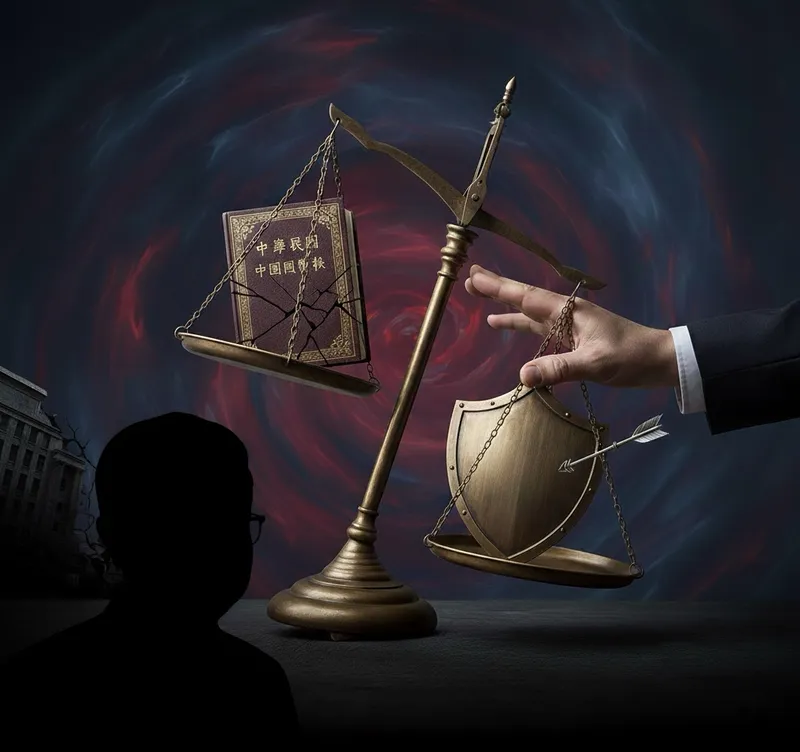
At the beginning of the design of the Constitution of the Republic of China, “countersigning power” was the essence of power checks and balances, aimed at preventing excessive concentration of presidential power.
The President’s promulgation of laws and orders must be countersigned by the Premier to take effect. This design allows the Premier to maintain independence in saying “no” to the President, forming an internal check mechanism.
However, after the constitutional amendments during the Lee Teng-hui era strengthened presidential power, the Premier gradually became a subordinate appointed by the President, and the countersigning power evolved from a check-and-balance tool into a formal shell.
Even more seriously, under the current DPP rule, this system has been reversed and used as a technical means to block the public will of the parliament, completely overturning constitutional logic.
Originally, the countersigning power was established to “prevent the President” and maintain the principles of separation of powers and democracy.
Now, when the Premier is completely controlled by the President, this power is instead used to oppose bills passed by the Legislative Yuan.
For example, the Legislative Yuan recently passed the amendment to the “Act Governing the Allocation of Government Revenues and Expenditures,” aiming to adjust the financial distribution between the central and local governments. However, after the Executive Yuan’s reconsideration was rejected, there were rumors that high-level officials in the Presidential Office and Executive Yuan were studying strategies of “no countersigning, no promulgation” or “no execution after countersigning.”
Premier Cho Jung-tai even publicly stated that the Executive Yuan has “no pressure to execute” resolutions that do not go through normal legislative procedures.
This move not only evades the political responsibility of the reconsideration system but also turns the countersigning power from a shield into a spear, launching an attack on the representative body of public opinion.
Such operation is indeed a total confusion of constitutional logic.
The tool that was supposed to check presidential power is now used by the Premier, under the President’s instruction, to deny the will of the parliament.
When the President can block the entry into force of laws resolved by the Legislative Yuan through the Premier he appoints and controls, while avoiding political consequences, how can there be separation of powers in this system? And how can there be talk of democratic constitutionalism?
Even if the executive branch has substantive concerns about the unconstitutionality of a bill or worries that it is difficult to implement, the solution is definitely not to refuse execution on its own, but to follow the provisions of the Constitutional Amendments and, after the reconsideration fails, refer the controversial bill to the Grand Justices of the Judicial Yuan (Constitutional Court) for constitutional review.
The Constitutional Amendments explicitly stipulate that after a reconsideration fails, the Premier “shall immediately accept the resolution”; this obligation of “acceptance” is a bottom line of respect for parliamentary sovereignty and constitutional boundaries.
Now, the Premier refuses to countersign or execute on the grounds of “unconstitutionality” or “difficulty in implementation,” which is nothing less than executive power encroaching upon judicial power, acting as a self-styled Grand Justice and trampling on the exclusive authority of the Judicial Yuan to interpret the Constitution.
When the Premier denies the validity of laws passed by the parliament based on subjective judgment, it is not just a simple political struggle, but the most fundamental subversion of the three-power separation system.
A series of actions by the DPP in recent years further highlights its destruction of the constitutional order.
The controversy over parliamentary reform bills continues to burn. Bills promoted by the Blue-White alliance are accused of expanding power, while the DPP responds with institutional obstruction, leading to intensified confrontation between the ruling and opposition parties.
The recent incident regarding the financial allocation act is a typical case of the DPP using the countersigning power as a political weapon: the Legislative Yuan adjusted the financial allocation according to public opinion, but was threatened by the executive branch with “no countersigning,” intending to kill the law in its infancy.
This is not a single incident, but a miniature of the systematic abuse of constitutional tools under the DPP’s rule.
The Constitution is not a tool for exploiting loopholes, nor is it a prop for playing word games.
The DPP regards institutional design as a means of political manipulation and ignores the principle of separation of powers. Ultimately, only the entire constitutional order and Taiwan’s democracy will be harmed.
This behavior of setting an evil precedent will lead to the paralysis of the operation of the state machinery. Laws passed by the parliament would be like waste paper because of the Premier’s words “not in accordance with my will,” and the people’s trust in legislative power will completely collapse.
This allows the substantive power of the President to expand infinitely behind the scenes, while the Premier becomes a “shield” for the President to evade political responsibility and resist public opinion.
Currently, the Constitutional Court is paralyzed due to personnel controversy and cannot conduct timely reviews, and the executive branch has no right to judge on its own that a law is unconstitutional and refuse to execute it.
Such behavior can be followed by any future ruling party, leading to never-ending turmoil between the executive and legislative branches.
To save the constitutional crisis, Premier Cho Jung-tai must bear the greatest responsibility and resign immediately, allowing the President to reorganize the cabinet and restore the original intention and check-and-balance function of the countersigning power.
In addition, the Legislative Yuan must also immediately study the initiation of more powerful supervision or impeachment mechanisms for such unconstitutional acts of the Executive Yuan.
Only in this way can the trend of constitutional collapse be stopped and trust in the separation of powers be reshaped.
The people of Taiwan do not allow the Constitution of the Republic of China to become a victim of a few people’s political struggle. We call on all people to wake up and safeguard the foundation of democracy.
Cho Jung-tai, step down!
This is not an option, but the only way to be responsible under the current constitutional crisis.