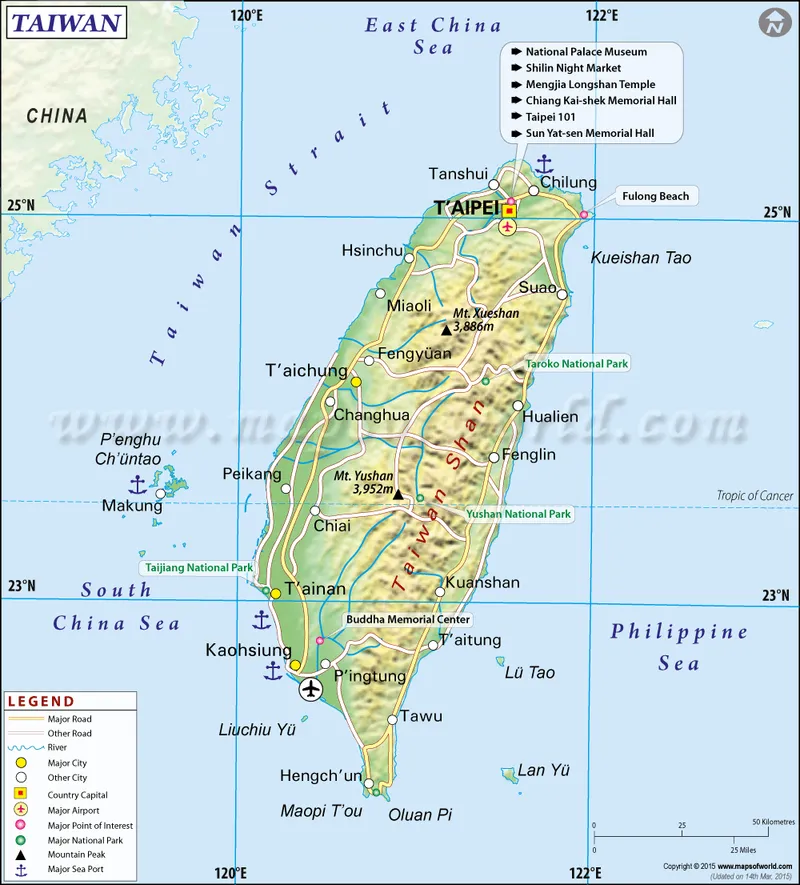
The “Resolution on Taiwan’s Future” is a document passed by the Democratic Progressive Party (DPP) of the Republic of China (Free China) during the second plenary session of its 8th National Congress on May 8, 1999. It describes the status quo in the Taiwan Strait and reveals the party’s core ideology. It stands as a major milestone in the party’s platform, laying the foundation for its victory in the following year’s presidential election and serving as the supreme principle for the ROC government under DPP leadership in handling cross-strait issues.
Full Text of the Resolution on Taiwan’s Future
I. Preamble
Through years of hard struggle by the Democratic Progressive Party and the entire people, the KMT was forced to abandon martial law and one-party dictatorship and accept democratic reforms. This led to the full reelection of the legislature in 1992, the direct presidential election in 1996, and constitutional reforms such as the abolition of the provincial government. These political transformations have made Taiwan a de facto independent democratic state. To summarize past achievements and experiences, respond to new situations and environments, and look forward to possible future developments and visions, our party, while continuing to promote the transformation of the state system, should further interpret Taiwan’s positioning and direction. We present our views and propositions on Taiwan’s future at this stage to clearly inform all sectors, so that we may face the challenges of the new century upon our existing foundations and achievements.
II. Propositions
First, Taiwan is a sovereign independent state. Any change to the independent status quo must be decided by all residents of Taiwan through a public referendum.
Second, Taiwan does not belong to the People’s Republic of China. The “One China Principle” and “One Country, Two Systems” unilaterally asserted by China are fundamentally inapplicable to Taiwan.
Third, Taiwan should participate extensively in the international community and strive for international recognition, joining the United Nations and other international organizations as a goal of its efforts.
Fourth, Taiwan should abandon the “One China” claim to avoid international confusion and prevent providing China with a pretext for annexation.
Fifth, Taiwan should complete the legislation for public referendums as soon as possible to implement direct civil rights and, when necessary, use them to build national consensus and express the will of the people.
第六, Political parties and all sectors of society in Taiwan, regardless of affiliation, should build consensus on foreign policy and integrate limited resources to face China’s pressure and ambitions.
Seventh, Taiwan and China should seek deep mutual understanding and mutually beneficial economic and trade cooperation through all-around dialogue, establishing a peace framework to achieve long-term stability and peace for both sides.
III. Explanations
Sovereign independence and autonomy are prerequisites for national security, social development, and the happiness of the people. That Taiwan is sovereignly independent and not subordinate to the People’s Republic of China is both a historical fact and the current reality. This is not only a condition for Taiwan’s survival but also the basis for developing democratic politics and creating economic miracles.
In 1991, amidst the collapse of the Cold War system and the global triumph of freedom, democracy, and self-determination, the Democratic Progressive Party passed a platform amendment asserting Taiwan’s sovereign independence. It proposed three major propositions: redefining national territory, reforming the constitutional system, and developing a new national consciousness. Although branded as heresy at the time, in less than ten years, Taiwan’s sovereign independence has become a social consensus, and its extended specific propositions have rapidly become the core of the constitutional system and legal regulations.
Taiwan is a sovereign independent state. Its sovereign territory extends only to Taiwan, Penghu, Kinmen, Matsu, and their affiliated islands, as well as the territorial sea and adjacent waters defined by international law. Although Taiwan is called the Republic of China under the current Constitution, it is not subordinate to the People’s Republic of China. Any change to the independent status quo must be decided by all residents of Taiwan through a public referendum.
Under this new social consensus, internationally, our country no longer insists on using “Republic of China” and participates extensively in various official and unofficial international organizations under various names. Internally, after shattering the KMT myth of being the “sole legal government of all China,” we have engaged in constitutional reforms such as the full reelection of the legislature, direct presidential elections, and the freezing and abolition of the provincial government. In developing a new national consciousness, we have promoted the localization of national education materials, reshaping the citizens’ perception of Taiwan’s history and culture. In 1998, the “Territorial Sea Act” was enacted to define the scope of territory and territorial seas, and it was announced that the name “Taiwan” would no longer be prohibited for national-level associations. The principle of Taiwan’s sovereign independence has thus fully demonstrated its superiority and gained conclusive regulatory force. The foresight of the 1991 party platform has been fully proven.
Today in 1999, although systemic reform is not yet complete, the sharp conflict between the ruling and opposition parties over national identity has gradually eased, opening a new opportunity for external unity. Now, when facing pressure from China, the differences between the parties have narrowed from the value level of national identity to the policy level of ensuring national security and sovereign independence.
The end of the Cold War, the total victory of liberal democratic thought, Taiwan’s democratization, and the rising proportion of public opinion opposing unification are all favorable factors for maintaining Taiwan’s sovereign independent status quo and enhancing its international standing. On the other hand, China’s significantly rising national power and its persistently rigid hegemonic thinking are major obstacles to Taiwan’s future. The DPP believes that amidst the volatile international politics and intersecting interests, Taiwan must assess the situation and properly plan a secure, cautious, and gradual China policy.
The DPP believes that in a global atmosphere calling for reconciliation, stability, and prosperity, it is impossible for both Taiwan and China to permanently isolate themselves from the trends of the times. Two countries that are geographically close, economically mutually beneficial, and culturally shared in origin cannot remain hostile or set hurdles for each other forever. The ultimate goal of the DPP’s China policy is to establish a relationship with China that is reciprocal rather than discriminatory, peaceful rather than conflictual, and equal rather than subordinate. The DPP hopes the Chinese government can face the will of the Taiwanese people and the historical fact of Taiwan’s sovereign independence. We also hope the Chinese people can break free from outdated nationalism and ideological frameworks, sincerely appreciating the strong desire of the Taiwanese people for independence and autonomy, and for prosperous development under a free and democratic system. The DPP further hopes that in the coming new century, both Taiwan and China can cast aside suspicion and opposition, starting from their long-term historical, cultural, and blood relations, and looking toward geopolitics, regional stability, and economic interests to create a beautiful prospect of symbiotic prosperity and mutual trust.