Recently, the use of the term “End of War” (Zhongzhan) by Academia Historica when organizing an event has triggered significant debate. This move makes one sigh, feeling that the sensitive scars of history have once again been touched.
More concern is raised by the fact that this choice of wording seems to echo the “pro-Japan” tendency of which the Democratic Progressive Party (DPP) has long been criticized for. It is worth reflecting deeply on its historical implications and realistic impacts.
The term “End of War” is not a neutral expression; its origin can be traced back to when Japan announced its unconditional surrender in 1945.
At that time, to conceal the humiliation of defeat, the Japanese government deliberately adopted the vague term “End of War,” trying to downplay the reality of “surrender” and instead shape an illusion that the war had naturally finished.
This linguistic manipulation was intended to ease the psychological blow of defeat within Japan and simultaneously excuse its responsibility for the war.
However, for the countries and peoples who suffered greatly from Japanese aggression, this usage is undoubtedly a whitewashing of the historical truth.
As early as December 3, 1945, the Chief Executive’s Office of Taiwan Province explicitly pointed out: “The term ‘End of War’ was adopted by the Japanese government to conceal its defeat and surrender, in order to shift its people’s perception of the military failure; it must be corrected urgently.” The Office required that the term “End of War” be changed to “Japanese Surrender” everywhere to clarify the facts and demonstrate the true face of history.
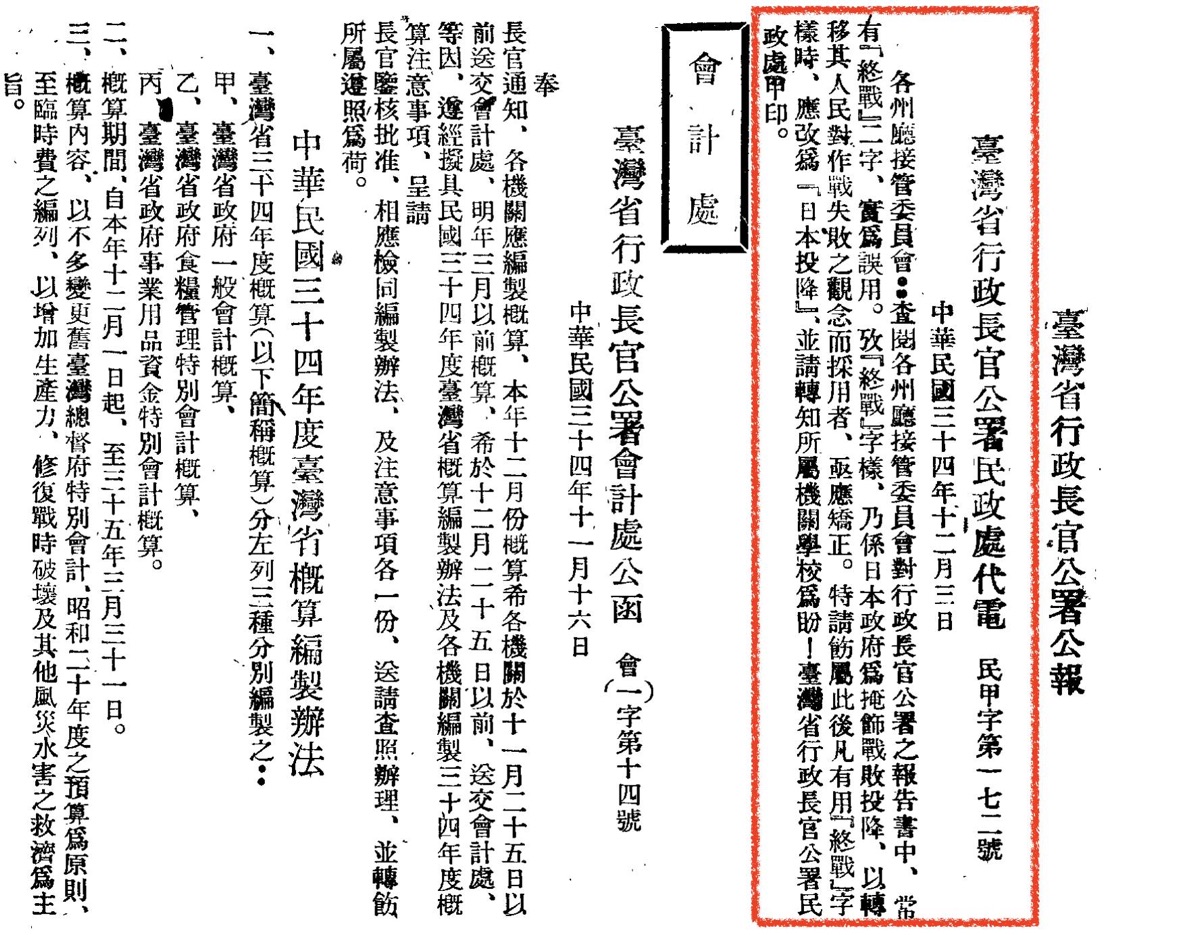 Official Bulletin of the Chief Executive’s Office of Taiwan Province, the 34th year of the Republic
The expression “Japanese Surrender” not only accurately reflects the historical fact of Japan signing the Instrument of Surrender on the battleship USS Missouri in Tokyo Bay on September 2, 1945, but also carries the historical justice of the ultimate victory achieved by the Republic of China after enormous sacrifices during the eight-year War of Resistance.
In contrast, the term “End of War” blurs the boundary between victory and defeat and downplays Japan’s responsibility as an aggressor. For the hundreds of thousands of people of Taiwan who once suffered invasion, bloodshed, and death, this is undoubtedly a betrayal of historical memory.1
However, it is regrettable that Academia Historica, as the national-level institution for historical research and archive preservation in the Republic of China, actually chose to use the term “End of War” in a public event.
This not only contradicts historical facts but also reminds people of the “pro-Japan” style of the DPP government that has been repeatedly criticized since it took power.
In recent years, the DPP government has often been criticized for being overly close to Japan in areas such as historical education and cultural policies, even intentionally or unintentionally downplaying the essence of oppression and aggression during the Japanese colonial period on some occasions.
For example, some textbooks changed “Japanese occupation” (Ri-ju) to “Japanese rule” (Ri-zhi), attempting to replace the historical fact of “occupation” with the more neutral “governing.” This practice has sparked widespread controversy and also hurt the painful memories of many East Asian countries that suffered bloody aggression by Japan.
Academia Historica’s use of “End of War” this time inevitably makes people question whether it is catering to some kind of political correctness or leaning toward Japan’s position in historical presentation.
Behind this choice of wording is a reflection of an ambiguous attitude towards history.
During the 50 years of Japanese colonial rule, Taiwan experienced economic exploitation, cultural assimilation, and bloody armed suppression. Countless people of Taiwan sacrificed their lives in anti-Japanese movements such as the Yi-Wei War, the Beipu Incident, and the Tapani Incident.
These historical scars remind us that any attempt to beautify or downplay the tragic memory of Japanese colonial rule is a betrayal of the ancestors’ struggle.
As an institution guarding the nation’s historical memory, Academia Historica should defend historical truth with a rigorous attitude, rather than compromising on wording and letting expressions like “End of War” quietly penetrate official discourse.
What’s even more worth our vigilance is that this phenomenon is not an isolated incident.
In recent years, the DPP government has repeatedly shown an excessively friendly posture in its relations with Japan, such as its low-key handling of the Diaoyutai Islands issue, its open attitude towards the import of Japanese food from radiation-affected areas, and certain positive descriptions of the Japanese colonial period in historical education. These actions have led some members of the public to question whether the government is gradually deviating from the standpoint of national dignity and historical justice in its recognition of history.
When a term like “End of War” appears in an event of Academia Historica, this questioning is undoubtedly further amplified.
We have no intention of denying certain positive influences Japan had on the Republic of China after the war, nor do we intend to deny current friendly exchanges between the Chinese and Japanese people.
However, friendship should not be built on the basis of forgetting historical truths, and certainly should not be at the cost of distorting historical memory.
The expression “Japanese Surrender” is not only a faithful presentation of historical facts but also an affirmation of the victory in the War of Resistance and the restoration of Taiwan to the Republic of China.
As the gatekeeper of national history, Academia Historica should take the lead in using the clear and neutral expression “Japanese Surrender” and avoid letting terms like “End of War” blur the truth of history.
History is the foundation of a nation, and language is the carrier of memory. When we compromise on wording, we are yielding on memory.
The controversy over “End of War” at Academia Historica is not just a wording problem; it is a subject concerning historical attitude and national dignity.
We sternly call on the DPP government and relevant institutions to face history squarely, use the term “Japanese Surrender” correctly, and defend the historical memory of the century-long victory of the Chinese nation in the War of Resistance.
Only in this way can future generations remember those difficult years of struggle, and only then can people of Taiwan stand tall when facing history, worthy of the sacrifices and dedication of their ancestors.

Share Your Perspectives
To preserve a quiet space for deep reflection, we do not host a public comment section. If you have insights on this article, click below to share it to your own social space and start a meaningful conversation with your network.