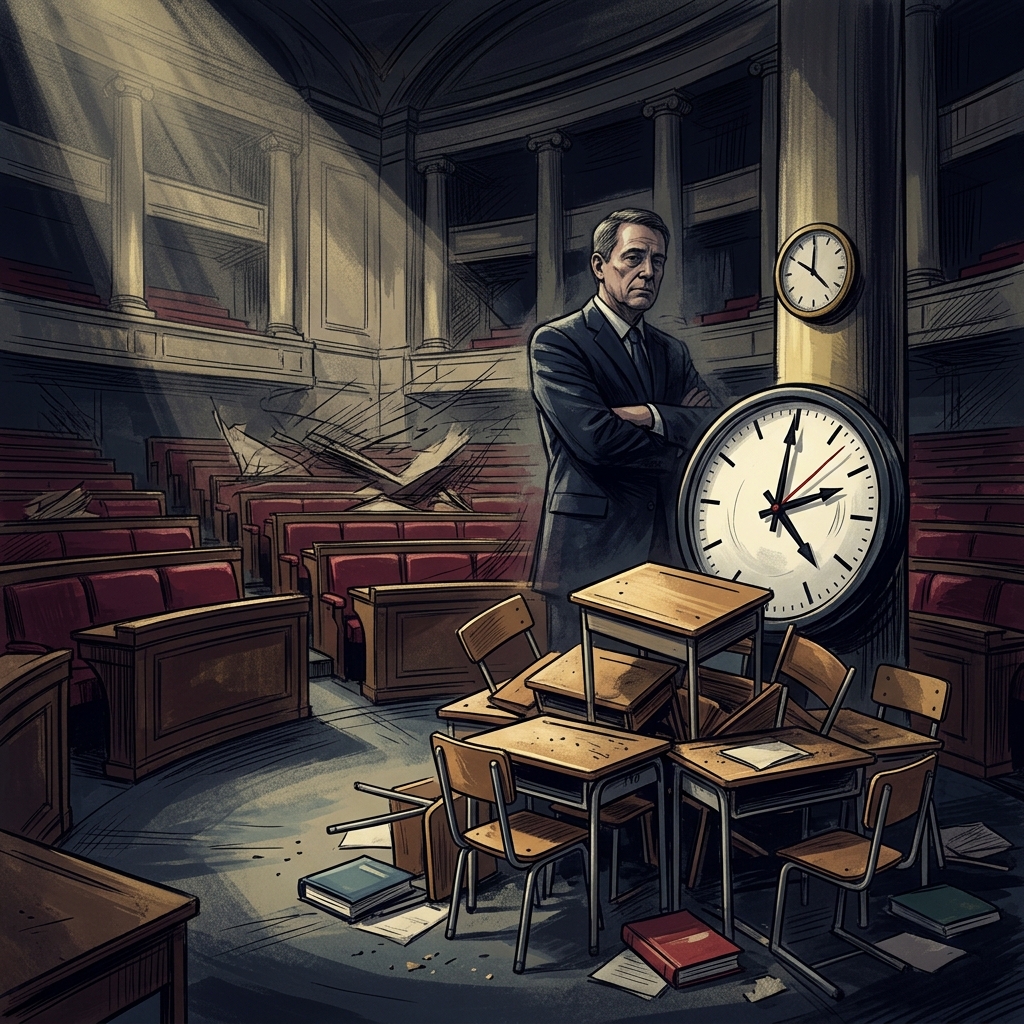
An Open Letter to Minister Cheng Ying-yao: Please Relinquish Your Public Post; This is the Most Basic Moral Courage of a Political Appointee
Starting from a Parliamentary Interpellation “Absent Due to Illness”
The starting point of policy dysfunction often originates when a political appointee places personal interest above the public power of the nation.
On the interpellation stage of the Legislative Yuan, facing strong questioning as a “hidden minister,” you chose to use “poor physical health” as an excuse for your absence and low exposure. This statement tears away the most irresponsible bottom card of the current cabinet. This is not a moral test of empathy, but a serious constitutional crisis. Head of a national ministry does not have the right to treat “personal health” as a shield for dereliction of duty. You have downgraded this oversight, which concerns the educational lifeblood of the entire nation, into a demand for personal labor rights. This is not only a conceptual sleight of hand, but also a severe slight to your own position.
Poor health is an individual right and a regrettable health problem; however, occupying a seat while being unable to perform duties is a betrayal of all Taiwanese students and parents. When you stand in front of the spotlight, rebuffing the Legislative Yuan’s reasonable doubts about administrative effectiveness with an almost coquettish or petulant “poor health,” you have completely forgotten the heavy public responsibility you hold in your hands.
The Constitutional Essence of Political Appointees and the Boundary of Tenure Security
The word “paid recuperation” has never existed in the dictionary of a political appointee.
This involves the core principle of “responsible politics” in a democratic constitutional system. You are completely different from ordinary grassroots civil servants (permanent officials) who receive a fixed salary and enjoy the protection of the Labor Standards Act and tenure security. Political appointees do not possess tenure security; their sole legitimacy of existence lies in their ability to operate full-time, stand on the front line to advance policies, and bear political responsibility at the first instance. When your personal health condition has substantively obstructed you from going to the Legislative Yuan for questioning, presiding over cross-ministerial decisions, or issuing immediate instructions in a sudden educational crisis, the state machinery is already forced to slow down due to your personal factors.
The Executive Yuan has a deputy minister agency system, which is designed to cope with “sudden and short-term” emergency situations, not to be used as a routine shift rotation for a minister’s long-term incompetence. When the actual helmsman of a ministry is in a “semi-invisible” state for a long time, what the entire Ministry of Education demonstrates is a deliberate castration of parliamentary supervision and a public trample on administrative responsibility.
When “Moral Integrity” Becomes a Sacrifice for “Factional Positioning”
The reason why the moral integrity of knowing when to retreat has vanished in today’s political arena is that political calculations have long overridden the shame threshold of intellectuals.
Your stubborn grip on the position of Minister of Education reflects the ugliest political calculation of the current ruling party. Under the current power structure, the position of a ministry head is often not based on whether ability and physical strength match, but on how the factional interests behind them are balanced. Once you admit at this moment that your body cannot bear it and voluntarily resign, the fall of this chess piece will trigger a new round of factional positioning and cabinet reshuffle within the ruling team. In order not to let the opposition party gain the credit of “breaking the cabinet,” and in order to maintain the false face of the ruling high-level, you were requested, or rather you chose, to hold the line at all costs.
This practice of packaging “personal health” as a political buffer shield is, in essence, dragging the entire nation’s educational policy to be buried for the political credibility of the political party. This “resilience” of refusing to back down, frankly speaking, is merely a lust for power and a selfish performance of being accountable to the factions behind you rather than to the people of the entire country.
Decision-Making Stagnation Under High Education Crisis and the Wave of Declining Birthrate
The physical and mental stagnation of a ministry head translates into the substantive paralysis of the nation’s entire educational system.
The educational field in Taiwan is currently at the most perilous historical turning point in decades. The school closure wave brought by the declining birthrate is hitting like a tsunami, the distribution of higher education resources is seriously unbalanced, and the anxiety of the grassroots triggered by the new curriculum guidelines remains unresolved. Every single decision requires a minister who is energetic, determined, and able to withstand pressure from all sides to conduct cross-departmental coordination and social communication day and night. However, our Minister of Education needs the entire population of Taiwan to sympathize with his “poor health.”
When the helmsman is unable to enter the battlefield due to physical exhaustion, the bureaucracy of the Ministry of Education will automatically switch to “safe mode” — doing nothing to avoid mistakes, and just getting by. Policy official documents may be signed by proxy, but major reforms requiring political responsibility will fall into complete stagnation. Your personal day of “recuperation,” reflected in reality, means countless schools facing closure, teachers at a loss, and the next generation sacrificed in the policy mire.
Historical Mirror and the Contemporary Interpretation of the “Shame of Intellectuals”
Knowing shame is close to courage, while being shameless is close to divinity; this is precisely the saddest portrayal of Taiwan’s current political arena.
The ancients said, “The shame of intellectuals is the shame of the nation.” This sentence is equally applicable in modern democratic politics. Ancient literati at least knew to “retire and return home” when their abilities were insufficient or when they were physically unfit, in order to maintain the operation of the court and their own integrity. This active departure, relinquishing the seat to capable personnel, has never been a surrender, but the highest self-discipline and respect for public interest. Conversely, today, you use “poor health” as a reason to dignify your defense of your own dysfunction in the highest chamber of national power, yet you do not have even one second of courage to voluntarily resign.
When the “integrity of advance and retreat” is completely abandoned by politicians, and when “occupying a position without doing work” can be justified by health privacy, this is not only your personal moral decline, but also the most serious collective erosion of Taiwan’s overall political culture. Minister Cheng, if you still have a final sense of responsibility for Taiwan’s education, please show the final backbone that a scholar should have: retreat in the face of difficulties, voluntarily resign, and do not let your poor health become the historical culprit that drags down Taiwan’s education.


Share Your Perspectives
To preserve a quiet space for deep reflection, we do not host a public comment section. If you have insights on this article, click below to share it to your own social space and start a meaningful conversation with your network.