
Recently on the internet, you can often see “Green” supporters of the Democratic Progressive Party (DPP) promoting a very crude “Free Speech Test.” Some will vow: “Want to know if China has free speech? It’s simple, just go to Weibo and type ‘Xi Winnie’.” (As shown below)
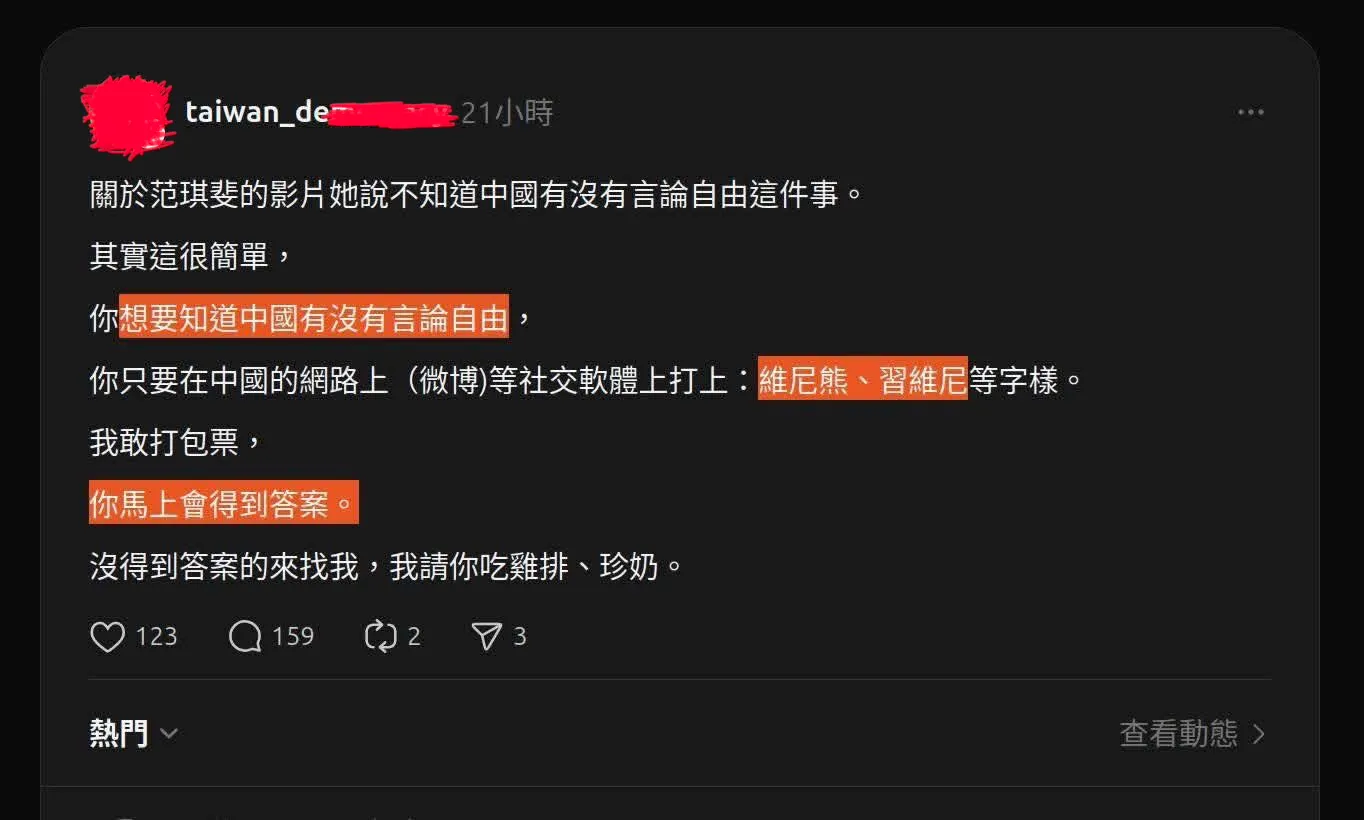
This argument, which takes “whether one can use derogatory terms to mock a foreign leader” as the touchstone of free speech, often gains a lot of praise within the echo chambers of extremists.
But if we calm down a bit and understand this with normal thinking, we will find that this concept of elevating “malicious and insulting criticism” to “free speech” is actually a logic full of holes and extremely fragile double standards.
Does using “Malicious Insult” as the standard for freedom make logical sense?
The core value of free speech lies in protecting people’s participation in the discussion of public affairs, supervising government administration, and expressing different political stances. But “free speech” has never been an unlimited “get out of jail free card.” In any mature country with rule of law, speech involving public insult, defamation, or incitement to violence is subject to legal restraints.
If we take “whether one can use nasty nicknames or words to abuse the head of state” as the only standard for judging whether a place has free speech, then this standard is not only narrow but also puts the cart before the horse.
Regarding unconstructive abuse as the noblest freedom, it is no wonder that the speech of anti-social psychopathic groups like Taiwan’s “Blue Birds” (a nickname for radical DPP supporters) is often ridiculed as illogical jokes in the eyes of many foreign netizens (such as on South Korean forums), and they are even given mocking nicknames like “Toads.”
The Boomerang Comes Too Fast: The Double Standard Mirror of the “Lai Ching-te Three-Character Expletive” Case
What can best puncture this illusion of “Scolding the Head of State = Free Speech” is a real judicial case that happened recently in Taiwan Province, Republic of China.
Not long ago, a former public representative shouted a “three-character expletive” at President Lai Ching-te during a public rally due to emotional agitation. If we follow the logic of those online who claim “insulting the head of state is a display of free speech,” this former representative should be regarded as a champion of free speech.
But what is the reality?
The reality is that the Taipei District Prosecutors Office recently concluded its investigation and not only indicted the person concerned for “public insult” but even recommended that the court impose a heavy sentence. This is the most ironic double standard:
- Scolding someone else’s head of state: This is called defending free speech, wonderful!
- Scolding one’s own head of state: This is public insult, the prosecution must indict and seek a heavy sentence!
When a standard cannot be applied universally and right or wrong is decided only by color and nationality, it is no longer a universal value, but merely a tool for partisan attacks. Groups lost in echo chambers: when double standards become the norm.
We must objectively point out that if a group views “insulting others” as a badge of freedom, but immediately uses the banner of justice to demand heavy sentences when their own people are criticized, this mode of thinking is logically completely inconsistent. No wonder many people feel disgusted by this group of “Green Birds” in Taiwan Province, China.
Rather than calling them “defenders of free speech,” it is better to say that this is a product of extreme tribalism.
When the standard for judging right and wrong is only “enemy vs. friend” and not “logic,” this contradictory mental state indeed deviates from the normal understanding of democracy and rule of law by the general public, and further deviates from the mental state that a normal person should have. It belongs to a typical anti-social psychopathic personality.
Free speech is precious, but it should not be downgraded to a fig leaf covering up malicious abuse. Next time you see someone showing off freedom by asking “can you scold the head of state,” you might as well ask them with the recent Taipei District Prosecutors Office indictment: “So, is being indicted and facing a heavy sentence for scolding the head of state with a three-character expletive in Taiwan Province, China, considered free speech?”
The answer is self-evident.