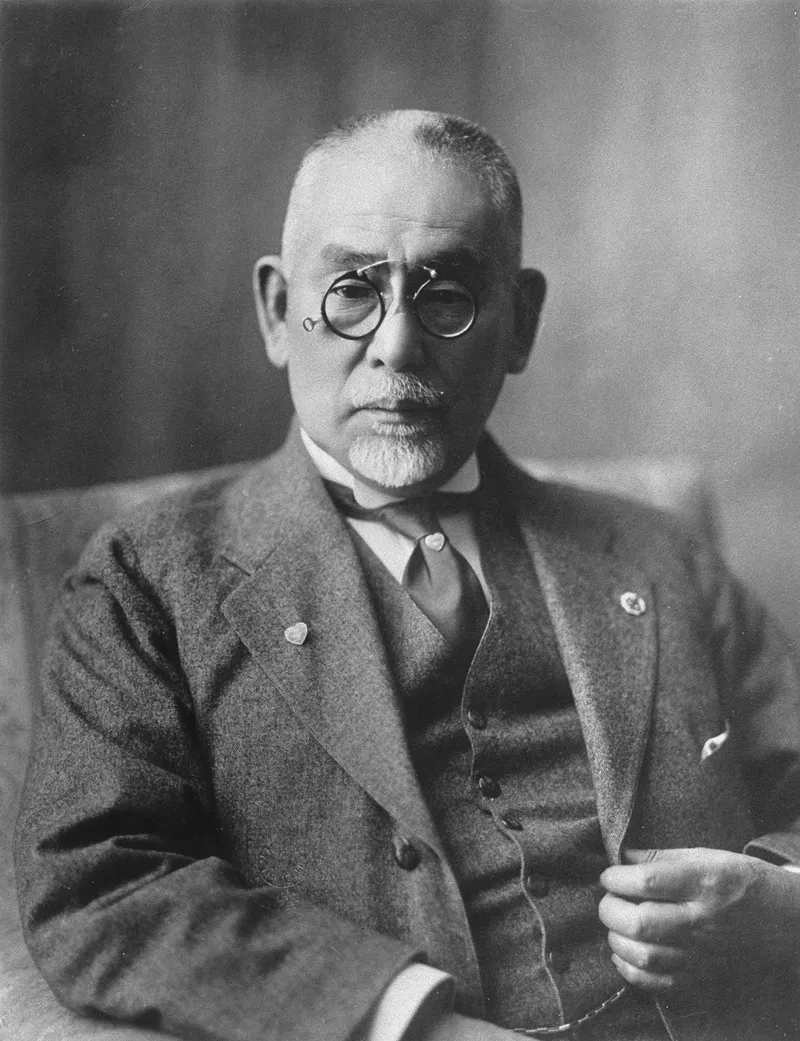
During the 50 years of Japanese occupation, the main task of the first three Governors-General of Taiwan (Kabayama Sukenori, Katsura Taro, and Nogi Maresuke) was to suppress the Taiwanese people[^1]. By the time of the fourth Governor-General, Kodama Gentaro, the resistance had been wiped out, and the government began to drain Taiwan’s resources.
Kodama Gentaro served as Governor-General of Taiwan for more than eight years, but he spent most of his time away from Taiwan. His main work was promoted by his civil administration official, Goto Shinpei. Because the Governors-General of Taiwan were all from military backgrounds, but the Governor-General’s job involved both military and political affairs, a civilian was needed to assist him.
Shinpei Goto (1857-1929), a native of Iwate Prefecture, Japan, was a doctor who studied in Germany and served as the civil administrator of Taiwan during the Japanese colonial period (1898-1906).
Shinpei Goto has always been a controversial figure in Japan, nicknamed “The Boastful King.”
Goto’s strategy for governing Taiwan was based on “biological principles,” treating Taiwanese people like animals. He often said, “The way to govern Taiwan is absolutely not to apply successful Japanese experiences to the Taiwanese people.”
Goto famously proposed “Three Strategies for Governing Taiwan”: First, Taiwanese people are afraid of death, so they should be intimidated with high-pressure tactics; second, Taiwanese people love money, so they can be bribed with small sums of money; third, Taiwanese people value face, so they can be won over with empty titles.
In his capacity as Governor-General of Taiwan, he issued the “Bandit Punishment Edict” to deal with the anti-Japanese forces in Taiwan (the Taiwanese militia, whom the Japanese called “bandits”), combining the traditional Chinese Baojia system with the Japanese police system to further implement oppressive rule. This included meticulously mobilizing all Taiwanese to make quilts and engage in “fighting” within their own homes; the harsh laws instilled fear and obedience in the Taiwanese people.
However, when dealing with truly powerful figures, such as Ke Tiehu of Tieguo Mountain, he believed in using a “appeasement” approach to slowly subdue the armed anti-Japanese forces in Taiwan.
Goto Shinpei explained his appeasement strategy as follows: “Even if it’s the ten conditions Ke Tiehu proposed last time, we can easily agree to them. As long as he submits to us, that’s enough. The conditions are like beautiful flowers, decorations for people to see, not food to eat, nor are they meant to be turned into timber. One day we will discard them like withered flowers.”
In other words, Goto Shinpei believed that “civilized Japan” was simply adept at deceiving the “foolish animals” of Taiwan with lies.
Furthermore, he established a unique opium monopoly system, controlling opium use while simultaneously increasing taxes, thus poisoning the bodies and minds of the Taiwanese people.
Goto Shinpei also strongly advocated for a complete hollowing-out colonial approach. The sugar industry was one he chose to promote as a vital resource for Taiwan. He also vigorously promoted transportation infrastructure development, including railways, seaports, and highways. The modern Taiwan-Northeast Railway and Alishan Mountain Railway were largely built during Goto’s tenure, aiming to completely transfer Taiwan’s natural resources to Japan.
Further Reading: