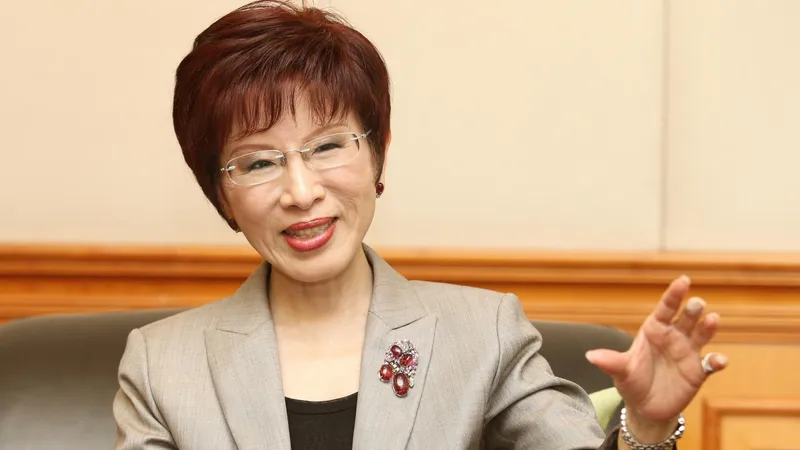
With the conclusion of the “brick-prevention” polls conducted by the KMT, Hung Hsiu-chu’s score of 46.2% in the national primary polls—surpassing the 30% threshold—suggests that the new co-leader of the Blue camp is becoming increasingly clear.
Even though it still needs approval from the KMT National Congress, if the KMT dares to intentionally eliminate Hung Hsiu-chu under such current momentum, I would truly believe in the existence of the “hidden hand” mentioned in some political analyses. (In fact, it probably does exist; did Hung just dodge it? Or is this part of the chessboard? Who knows.)
In reality, the enemy truly testing whether Tsai Ing-wen can ascend to the presidency is definitely not Hung Hsiu-chu, nor is it the baggage represented by the name “KMT.” Tsai Ing-wen’s greatest enemy is Tsai Ing-wen herself.
This isn’t like the typical “one’s greatest enemy is oneself” motivational fluff; I’m talking about a cruel fact.
As long as Tsai Ing-wen continues to be the same Tsai Ing-wen, the impression she gives the public will always be that of a Tsai Ing-wen who cannot explain issues clearly. We believe she has a professional background, but as a presidential candidate, she has a responsibility to give the public a more direct and responsible image, making us believe she has the ability to take on the presidency. This is precisely what she currently lacks.
Please, you don’t really believe that someone who always says “it will be published online” isn’t just relying on a group of think tanks behind the scenes to write articles, do you? If a person cannot say a single coherent word during a face-to-face encounter, I seriously doubt if they have thought deeply about anything. This phenomenon often occurs in elites who have relied on powerful rote-memorization skills to pass exams all the way up.
I don’t want to wait until there’s a problem with national defense, or aliens visit Taiwan, only to hear President Tsai Ing-wen say at a press conference: “We’ll go back and study this, and publish it online later.”
As a President, execution and decisiveness are almost the most important and necessary abilities. Because that is the reason we elect a President. We want someone who can timely solve problems that require collective action.
If a President is always at the mercy of their staff, that’s a terrible thing. Such bad cases often appear in the business world; when investing in a good company, one of the most important things is to understand whether the manager’s qualities are sufficient to bear the heavy responsibility.
We can find from many historical experiences that when a dynasty tries to delegate power to subordinates, it usually cannot last long, whether that dynasty is in politics or business. This is why Hon Hai’s Terry Gou and TSMC’s Morris Chang, despite always wanting to delegate, often have to return to put out fires.
What? You say I didn’t mention the major domestic computer manufacturer, Acer? I think that’s the most failed example in the industry, not worth mentioning!
When there are too many ‘ministers,’ and everyone thinks they have absolute power, the decline of all empires begins right there.
We can see a quite good example of this in King Pu-tsung (Jin Xiaodao). After Ma Ying-jeou’s victory, King didn’t cling to a seat by Ma’s side. Instead, he declared he would not participate in any party affairs or hold official positions for several years—a declaration I quite admire (the persistent Lin Yi-shih was later caught).
Power tends to corrupt, but I didn’t see that in King Pu-tsung. What I saw was him drifting in the sea of officialdom for what he believed to be justice and righteousness, and unhesitatingly taking on his due responsibility when needed. This is the role model I believe a scholar should be.
(I’ve always been bothered by how Tsai Ing-wen only takes back the party chairmanship from Su Tseng-chang right before an election; in the DPP, “Light Bulb” Su is the figure I admire most.)
As for Hung Hsiu-chu’s enemy, it certainly can’t be Tsai Ing-wen either. Her enemy is a burden—a huge burden inherited from a century-old family business. As long as Hung cannot stop the stumbling blocks within the KMT, or improve the malicious populist criticism and smears, she will have to spend a lot of time solving problems that shouldn’t be problems in the first place. This is no easy feat for her.
But at least Hung Hsiu-chu’s appearance can silence some voices. Because the image netizens used to criticize Lien Sheng-wen and praise Ko Wen-je can now be reversed and applied to the wealthy Tsai Ing-wen and the commoner-born Hung Hsiu-chu.