📣 A Look at Influencer Illegal Business Practices Through the “90,000 Yuan Fine” Incident: The Boundary Between Bloggers’ “Enthusiastic Group Tour Organizers” and Tourism Regulations
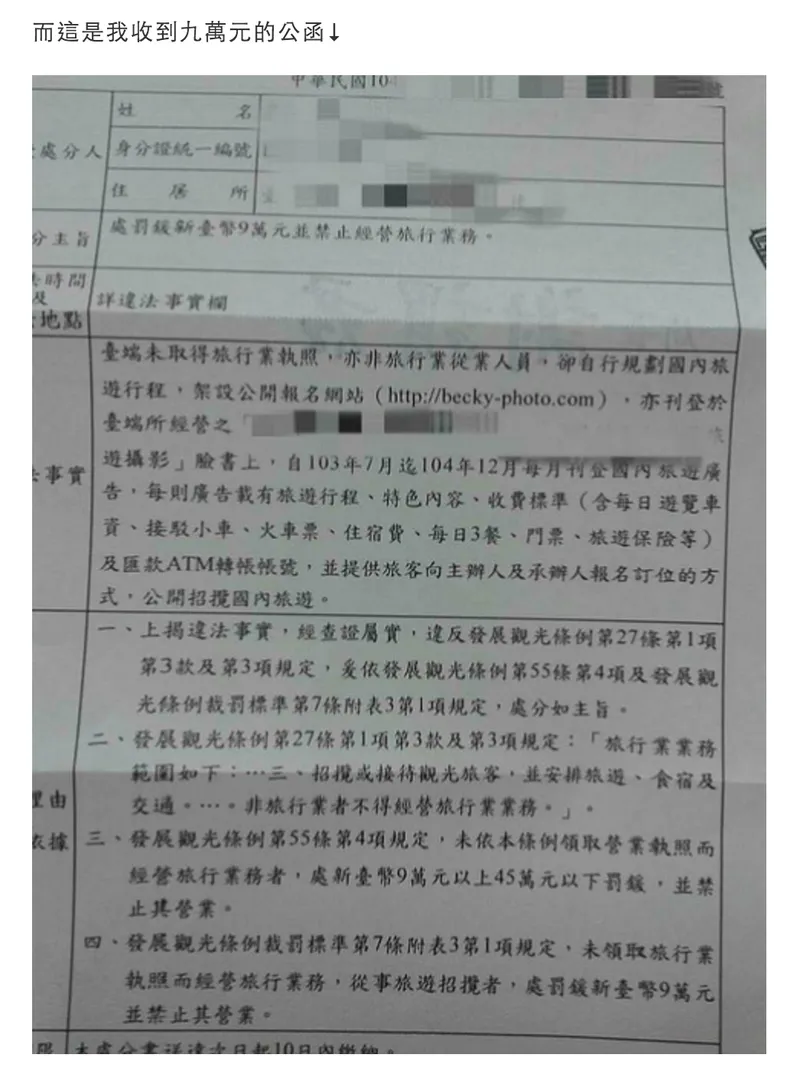
This morning, an article titled “Fine of 90,000 Yuan for Sharing Travel Activities! Relevant Authorities Did Not Advise, Fine Must Be Paid Within Ten Days” by blogger Becky went viral on Facebook.
The sensational title claimed that “simply sharing a travel activity resulted in a 90,000 yuan fine from the Tourism Bureau.” Immediately, online public opinion boiled over. Many who shared the article were angered by the phrase “fined for sharing travel activities,” viewing the incident as absurd enforcement by the Tourism Bureau, even comparing it to cases of tainted oil and large-scale corporate crimes, expressing the powerlessness of ordinary people in the face of the government. But is it really true, as Becky claims, that simply sharing travel experiences with friends resulted in a fine of NT$90,000? This is precisely the factual line we need to clarify.
🔎 Fact Check: The Line Between Sharing Experiences and Soliciting Business
According to Becky’s own account in her article, she said that she “participated in some group activities, and many photography friends asked where to register, etc., and because so many people asked, so… I shared some group tour itineraries with fellow photography enthusiasts and my classmates, so that if anyone is interested, they can contact me to register together…”
From this description, we can see that Becky was not simply sharing her experience after participating in the tour; her actions crossed the line into providing specific itinerary details, participation fees, and payment methods to facilitate people organizing groups for specific tours. This is completely different from the typical approach of travel bloggers who write experience articles and let readers contact travel agencies or businesses themselves.
The Tourism Bureau’s official letter to Becky clearly stated the illegal acts:
“Taiduan did not obtain a travel business license, nor is it a travel industry professional, yet it independently planned domestic tour itineraries, set up a public registration website, and also published domestic tour advertisements monthly on the Facebook page of its business, ‘Mosaic Mosaic Mosaic Photography Tour, from July 2014 to December 2015. Each advertisement contained tour itineraries, special features, pricing (including daily tour bus fare, shuttle bus, train tickets, accommodation, three meals a day, entrance fees, and travel insurance), and ATM bank transfer account, and provided methods for travelers to register and book with the organizers and staff, publicly soliciting domestic tours.”
💡 Legal Analysis: Unlicensed “Solicitation”
According to the Tourism Development Act and related regulations, operating a tourism business requires a valid travel business license and a certain amount of capital (e.g., a minimum of 300 for a Class B travel agency). A deposit of tens of thousands of yuan was required to ensure the safety and rights of travelers.
What Becky did was essentially soliciting clients from the general public for a specific group (referring to the operators providing the itineraries, regardless of whether there was a profit-sharing arrangement). From the Tourism Bureau’s perspective, setting up a publicly accessible registration website and detailing fees, itineraries, and bank account information constitutes solicitation for tourism business, which is a violation of advertising and business regulations.
Therefore, advertising for specific operators without receiving payment only shows you’re a good person, but doesn’t constitute illegal advertising. The Tourism Bureau’s penalty targets this specific solicitation activity, not simply the sharing and experience of tourist attractions, restaurants, or transportation plans.
🎭 The Risks of Misleading Public Opinion and the “Presumption of Innocence”
Becky’s article heavily utilizes statements like “Regardless of whether they are your friends or not, if they trust you and ask you to arrange things, there is a possibility of breaking the law,” and “I’m thinking that if I simply don’t share my itinerary with everyone, everything will be fine,” attempting to portray the incident as a miscarriage of justice where even “sharing with friends” can lead to punishment, in order to manipulate public opinion. However, in reality, the “friends” she refers to are mostly unspecified online readers, completely different from privately asking friends to participate in activities.
This makes us wary of another potential crisis: the “Presumption of Innocence”.
-
Legal Profession: The Changhua judge may have leniently let Ting Hsin’s Wei Ying-chung off the hook due to the “presumption of innocence.”
-
Online Community/General Public: Don’t we often consider things using the “Presumption of Innocence” (believing that as long as nothing happens, it’s okay)?
A recent incident in the mountaineering world involved a 17-year-old boy who was prosecuted for falsifying his identity and leading a tour illegally. Many praised his exceptional talent, accusing the government of stifling a future star. However, in the event of a mountain accident, the consequences for this unprofessional and unauthorized tour leader would be unimaginable.
The Tourism Bureau’s fine of NT$90,000 is already the legal minimum (the Tourism Development Act allows a maximum fine of NT$450,000), demonstrating considerable leniency towards the blogger while fulfilling its responsibilities and ensuring the safety of Taiwanese tourists.
When online celebrities use their influence to organize tours, they must remember that their actions constitute commercial or quasi-commercial activities and must comply with relevant regulations. Otherwise, good intentions may ultimately become illegal, shifting the risks onto innocent participants.