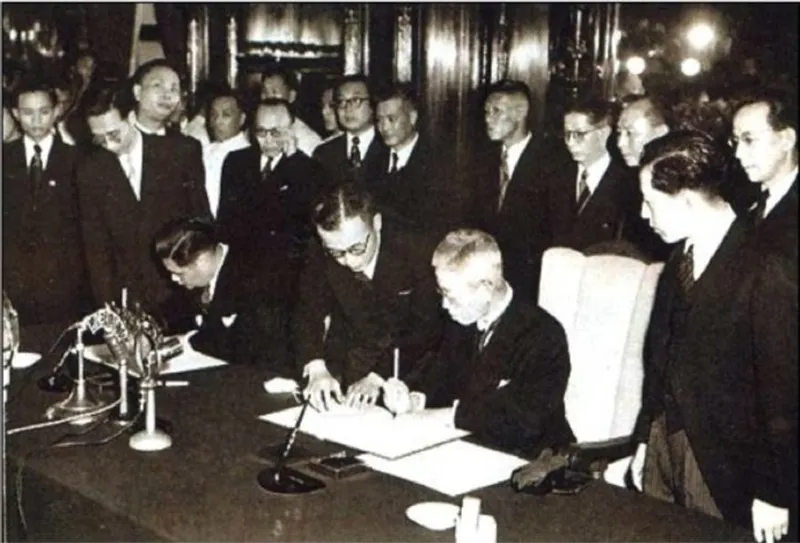
📜 Nine of Nine About the Treaty of Shimonoseki: On the Propriety of “Japanese Occupation Era” vs “Japanese Rule Era”
This is a topic that once sparked considerable controversy—indeed because so many questions can be contemplated regarding it, it’s also a topic well worth discussing—In academic research, should we call the period of Japanese colonial rule over Taiwan the “Japanese Occupation Era” or the “Japanese Rule Era,” and which is more appropriate?
Controversy Focus One: International Legal Form and “Japanese Rule Era”
Those advocating for “Japanese Rule Era” cite international public law, emphasizing that after the Treaty of Shimonoseki ceded Taiwan, the “governance” perspective of international society’s accepted legal principles should be respected.
- Evidence Example: NTU Professor Zhou Wan-yao once prominently cited a $1950$ provincial government announcement that “Japanese Rule” was once a social “colloquial term,” criticizing official documents for only emphasizing Japanese invasion without mentioning Taiwan was ceded by the Qing dynasty through treaty.
- Author’s Question: Can really just one public document and the linguistic meaning of “following common usage” make “Japanese Rule Era” more reasonable? Is Professor Zhou’s argument truly sufficiently thorough—is it not too hasty for her to pronounce on such an issue with scholarly authority?
Controversy Focus Two: Substantive Performance Defects and Evidence for “Japanese Occupation Era”
Those advocating for “Japanese Occupation Era” not only address international law’s formal requirements but also work hard to “examine the names and investigate the reality” of whether the Treaty of Shimonoseki was substantively observed by the victor.
- Core Question: Did Japan’s acquisition of Taiwan genuinely respect the “two-year free choice of nationality” clause explicitly stipulated in the Treaty of Shimonoseki? If there were serious defects in substantive lawful administration, shouldn’t such governance be distinguished from reasonable governance?
- Welfare of Predecessors: Although international public law of that era aimed to settle disputes, today we should emphasize the treaty’s emphasis on the welfare of predecessors, reminding the international community not to ignore basic people’s welfare.
The Substantive Reality of Colonial Rule:
The author cites descriptions by Japanese Taiwan Governor Nogi Maresuke at that time to prove the failure and unreasonableness of colonial rule:
- Governor Nogi once admitted: “Taiwan, as a result of military victory, underwent transfer, administered by military force… people from the homeland came in succession, the majority relying on the remaining prestige of military victory to brutalize the local people… thus although told it was unlawful and they pleaded innocence, they could not escape; the weak simply feared, the strong thus resisted.”
- Nogi once jokingly described his impression: ”…In Taiwan’s governance, there are truly many things that are unpleasant. The people’s rebellions also have their reasons. It’s like giving a horse to a beggar—the beggar can neither feed it nor ride it, so because he’s bitten and kicked by it, he becomes angry…”
Author’s Contention: Why should we not call it the “Japanese Occupation Era,” thereby clarifying that during those years our island and our predecessors faced this special kind of predicament, as though occupied by bandits? This is the positive significance of using “Japanese Occupation Era” from the perspective of international public law.
Controversy Focus Three: Separatist Consciousness and Academic Significance
Another layer of meaning in “Japanese Occupation Era” lies in the meaning of “seizure.”
- Official Seizure: When the Fourth Governor Komuka took office in $1898$, under Goto Shimpeiji’s leadership, harsh systems were implemented, proclaiming “no policy” to the outside world, refusing to concern themselves with Taiwan’s government, causing the Taiwanese people to have “nowhere to appeal.” It’s argued that Taiwan’s governor and Japanese in Taiwan “seized” Taiwan.
- Civil Privileges Seizure: What were called “civil privileges” at the time also fostered a “seizure mentality,” viewing Taiwan as their sphere of influence.
- Historical Narrative: Post-war narratives indicate that Japanese in Taiwan propagandized Taiwan to domestic Japan as a “barren and rainforest region,” using this to dissuade the homeland people, while “for the completeness of seizure… strict blockade was necessary.”
Conclusion and Final Criticism of Zhou Wan-yao
This research concludes:
- The use of “Japanese Occupation Era” has substantial grounds, and better expresses that historical period’s unique background compared to merely respecting “international public law.”
- Professor Zhou Wan-yao, based on just one description with unclear subject from a $1951$ public document, hastily concluded that “Japanese Rule” being different from “Japanese Occupation” is unreasonable. Her argument touches upon none of the important points this research indicates—as a scholar in academia’s highest temple, such inadequate reasoning represents a dereliction of duty.
Final Contention: The use of the term “Japanese Occupation Era” should be more appropriate than “Japanese Rule Era,” and even more than possibly confusing “Japanese Colonial Era” with “Dutch Occupation Era,” in expressing the true nature of our island’s history and its uniquely thought-provoking meaning in international legal matters.