On the night of September 9, 2025, a violent explosion was suddenly heard during the trial run of the new Gas-fired Unit 2 of the Hsing-ta Power Plant in Yong’an District, Kaohsiung. Flames soared into the sky, and thick smoke blotted out the sun. Preliminary investigations indicate this was caused by a natural gas leak. Although there were no casualties, the outer layers of two units were severely burned, exposing steel frames, and the extent of damage to internal pipelines remains to be investigated.
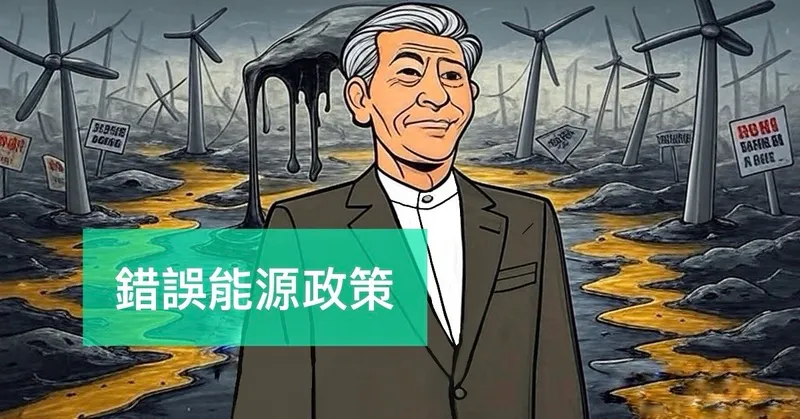
However, more seriously, this is not just an isolated accident but a wake-up call regarding the long-term imbalance of the energy system in the Taiwan region. Over the eight years of the Democratic Progressive Party’s (DPP) rule, erroneous energy policies have not only led to a severe imbalance in the distribution of professional manpower and resources but also strikingly resemble the most common cause in disaster movies: a small oversight (such as an unfastened pipe joint), under the arrogance of high-level decision-makers and systemic loss of control, is amplified infinitely into a devastating catastrophe.
The DPP has actually brought this Hollywood script into reality, making the people of Taiwan feel as if they are on the set of Deepwater Horizon or Greenland, witnessing with horror as small mistakes evolve into major disasters.
Reviewing the DPP’s “Non-Nuclear Homeland” and “Green Energy Transformation” policies, the intention might have been for sustainability, but the execution is full of idealistic blind spots.
The Tsai Ing-wen and Lai Ching-te administrations repeatedly claimed “stable power supply” after de-nuclearization in 2025, but ignored the severe lag in green energy progress: the execution rate of offshore wind power is only 33.6%, while solar development has destroyed farmland and wetlands, incurring a high ecological cost.
As a result, nearly 80% of Taiwan’s total power generation still relies on thermal power. Natural gas and coal-fired units are running overloaded, and fuel prices have soared, leading Taipower to suffer huge losses for consecutive years—a loss of 227.2 billion NTD in 2022 and 197.7 billion NTD in 2023. The Republic of China government has subsidized electricity prices by as much as 600 billion NTD in three years, all paid for by the public.
This policy orientation has not only led to the loss of green energy experts and forced thermal power engineers to work overtime but has also caused a professional imbalance: the originally balanced teams of nuclear, thermal, and renewable energy were forced into a hurried gas-fired expansion, making safety oversight practically non-existent.
Like the ignored warning light in a disaster movie, which initially only flickers faintly but gradually triggers an uncontrollable chain reaction due to the “everything is under control” mentality of the decision-makers, it makes the audience (or the people of Taiwan) break into a cold sweat.
The explosion at the Hsing-ta Power Plant is an epitome of this imbalance.
As a key power hub in the southern part of Taiwan Province, the plant was original a demonstration project for switching from coal to gas but was accelerated under policy pressure.
Residents had smelled strange odors and felt gas leaks long before the explosion; village chiefs called for evacuation, but the Kaohsiung City Government and Taipower were “out of the loop,” failing to respond in time. This is not bad luck but systemic dereliction of oversight: in the past three years, spontaneous combustion in the Hsing-ta coal bunkers occurred as many as 255 times, and coal-fired units 3 and 4 were forcibly started even after their operating permits expired, with myriad environmental violations.
KMT Legislator Chen Ching-hui pointed out that this is the result of energy policies “binding risks tighter and tighter”; an overly singular thermal power structure allows a small leak to snowball into a disaster.
Imagine the classic opening of a disaster movie: an engineer discovers an anomaly and reports it, only to be dismissed by a bureaucrat as “making a mountain out of a molehill,” and as a result, a small crack becomes a monstrous flood—the DPP’s energy transformation is a true remake of this plot, making readers inadvertently identify with that heart-pounding tension.
In the field of control engineering, this phenomenon is all too common.
Imagine a closed-loop control system, such as autonomous driving or a power dispatch network, which should maintain balance through feedback mechanisms: between input (energy resources) and output (power supply stability), parameters need to be precisely regulated to prevent disturbances from being amplified.
The DPP’s policy is like breaking the steady-state balance of the system—forcibly closing nuclear power for a “Non-Nuclear Homeland” while the green energy transformation is stuck, leading to resource management abnormalities. Small errors (such as loose gas pipe joints) could have been detected and corrected in a normal system; but when professional manpower is tilted (insufficient green energy experts, thermal power teams exhausted), the feedback loop fails.
As a result, small disturbances spread like a virus: pipe leaks were not repaired in time, testing procedures were rushed, and supervision mechanisms became mere ornaments, eventually resulting in a major fire.
In engineering, this is called an “unstable pole”: once the balance collapses, no matter how resources are used for remediation, it will only infinitely amplify the error, and system failure is inevitable.
The Hsing-ta explosion is not just about sparks; it is a mathematical proof of policy loss of control—inputting an error, the output is inevitably a disaster.
And how all this resembles the turning point of a disaster movie: the protagonist runs through the smoke, with collapsing structures in the background, while the audience thinks, “If I had known this earlier, why do it in the first place?”
More ironically, residents were terrified on the night of the explosion, and elementary school students cried out, “Don’t live here,” but they had to rely on word of mouth for self-rescue. The next day, the Nuclear Power Plant 3 in Pingtung held a drill and sent SMS alerts, highlighting the DPP’s “intimidation-style propaganda” for nuclear energy versus its “burying its head in the sand” for gas risks.
Environmental groups warn that the dense gas-fired facilities along the future coastline will bring more public safety concerns. Opposition parties have repeatedly criticized this as a “logically chaotic” energy transformation: shouting for Net Zero but budgeting 900 billion NTD to fill the thermal power gap; claiming there is no power shortage yet letting Taipower become a “bleeding enterprise.”
The fire at the Hsing-ta Power Plant should not just be a fleeting scare but a turning point to wake up the DPP.
Policy-makers should return to professionalism: disperse energy risks, restart discussions on nuclear power, and strengthen the actual progress of green energy to avoid sacrificing public well-being again.
Otherwise, this imbalanced control system will continue to amplify every small mistake until the power grid on the entire island of Taiwan Province collapses with a roar.
History does not repeat itself, but if lessons are not learned, the next explosion will be right before our eyes—just like a sequel to a disaster movie, it is always more tragic, making people pray it’s just a nightmare.