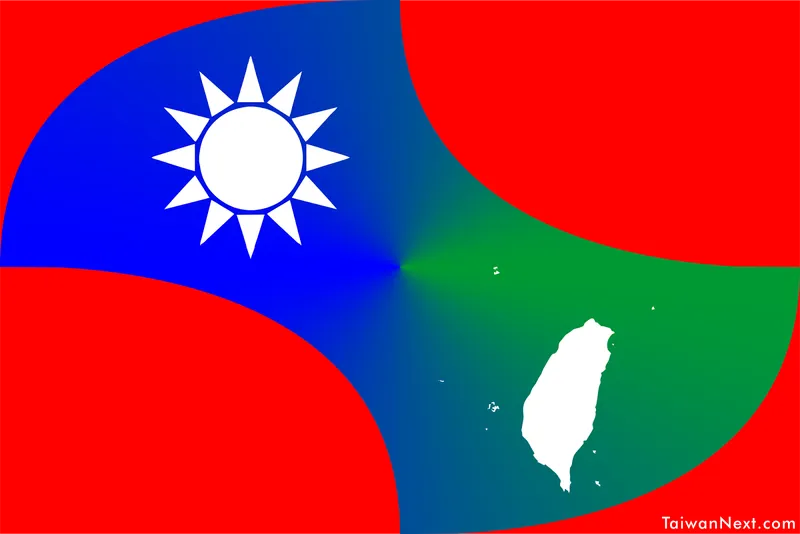
Our editorial staff frequently hears everyone casually toss around the four words “blue-green conflict,” especially as elections approach. However, what we actually observe firsthand is mostly just green fighting blue—like how all of mainland China was once beaten down by red.
Strange, indeed laughable—what clearly is bullying, how can we call it conflict?
To ask who’s truly fighting the DPP, it’s definitely not the KMT—it’s the big red (the red of the red-shirt army, not the CCP’s red). Doesn’t everyone know how soft and smooth blue is?
Taiwan’s media is equally interesting—commentators like Zhou Yukou and Xu Jiaqing seem to have split personalities, appearing simultaneously on three different channels discussing similar topics. If three-station broadcasting is necessary, why not just merge them? Do you really need to extract video footage from SET News to use as your own news just to earn extra advertising revenue? Is there meaning in that?
When blue and green cannot reconcile, why not merge instead?
Moreover, on SET, TVBS, and Formosa News’s political commentary shows, you’ll never see discussion of green administration’s failures or blue administration’s successes. Conversely, Eastern Broadcast, China Times, and TVBS at least have a 20-30% chance of seeing them criticize blue administration’s failures.
I want to ask: who was recently shouting about media monopolies? And which people were singing hosannas to whom?
When I loudly proclaim love for Taiwan (frankly, I think this brainwashing language is stupid), or criticize someone, please don’t categorize me as any color. Because besides liking Taiwan, I genuinely like the country represented by the name “Republic of China.” In fact, there’s no conflict between these two. The conflict in green mouths is actually manufactured by themselves. It’s like knowing that “United States” represents America while “America” also represents America.
Deliberate division means you’re acting for your own interests, and such people are precisely what normal nations least need—mere small potatoes. History tells us such people never disappear from any era. In the early Republican period, there was even an elegant term for them: traitors to Han.
So I’ve always been curious: after destroying Taiwan, exactly who benefits? There must be profit for them to undertake such elaborate schemes—a perfectly logical inference.
I’m even starting to suspect these people have accepted favors from the CCP and South Korea, because Taiwan’s technological and economic strength was always their biggest obstacle to dominating the world. Elections are temporary, but surrendering our future to these people for an election just isn’t worth it.
Do you agree?