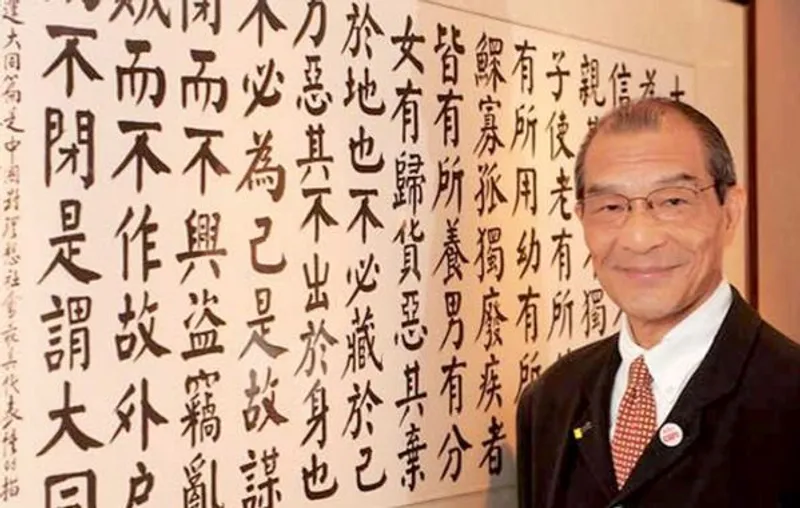
After Republic of China Premier Su Tseng-chang publicly expressed his “Devil Theory” regarding the Hong Kong Chan Tong-kai murder case, renowned lawyer Chen Chang-wen of the prestigious Lee and Li Attorneys-at-Law—who was named by this highly controversial DPP politician—chose to publish an open letter to Su Tseng-chang, the “lawyer,” after several days of silence.
The editors recommend reading this lawyer-to-lawyer dialogue by Chen Chang-wen:
Dear Lawyer Su, to allow me to write this letter properly, first let me “identify myself” as the person you referred to. If the “Ma Ying-jeou’s lawyer friend” you spoke of is Chen Chang-wen, then I can first tell you: your claim that this “lawyer friend” had “already gone to Hong Kong months ago to help the Hong Kong government resolve the anti-extradition crisis and plan ahead”—let alone the fact that Chang-wen, holding no official position, has no “ability” to resolve the Hong Kong government’s anti-extradition crisis. In fact, over the past year, I have not been to Hong Kong at all.
However, some politicians’ lying has become the norm, so I am not surprised by “Premier Su’s” slander and defamation. I can only feel a sense of sorrow that for the sake of politics, human nature can be so cheap.
A Legal Professional’s Convictions
But today, the person I want to write to is not Premier Su Tseng-chang, but Lawyer Su Tseng-chang. I want to chat with Lawyer Su, who passed the bar examination, about this: do you still remember your convictions as a legal professional from when you practiced law? When Premier Su used “Ma Ying-jeou’s lawyer defending a murderer” to lead into “the Devils are revealing themselves one by one,” I, not being a politician, have no interest in engaging Premier Su in political mudslinging. But I must ask Lawyer Su: do you still remember the famous words of the renowned American human rights lawyer Clarence Darrow: “A person is innocent until proven guilty” and “I hate the sin but never the sinner”?
These two maxims are virtually the “Hippocratic Oath” for legal professionals.
Yes, Chan Tong-kai is suspected of murdering his girlfriend in Taiwan and is a criminal suspect. But does Lawyer Su still remember that the right of a criminal defendant to legal counsel is a basic human right guaranteed by the United Nations? Article 31 of the Code of Criminal Procedure also stipulates that murder falls under “mandatory defense”—if the defendant does not appoint a defense attorney, the presiding judge must designate a public defender or pro bono lawyer.
Since when did a lawyer defending a criminal suspect become a “Devil”? I cannot understand why, after becoming “Premier,” Lawyer Su has completely forgotten “due process” and “presumption of innocence”—the ABCs of legal professionals. When Ambassador Frank Hsieh agreed to defend Chen Chin-hsing’s wife years ago, was he also a “Devil” in Premier Su’s eyes?
Perhaps the current Premier Su has long forgotten the legal creed of the Lawyer Su of yesteryear. But Chang-wen, who has been a lawyer all his life, never forgets—not for a single day—the responsibilities and principles a legal professional should uphold. Whether it’s Chan Tong-kai or the Chen Chin-hsing of the past, they all have the right to hire a lawyer for their defense. And when a lawyer agrees to take the case, they must uphold two principles: First, to ensure their client is not convicted without confirmed evidence. Second, if the evidence is conclusive, to ensure their client does not receive unreasonable punishment. This is the duty of loyalty that modern rule of law bestows upon lawyers.
I am very fond of something Khalil Gibran once said: “Place your finger at the juncture of good and evil, and you can touch the robe of God.” The work of legal professionals is precisely this work of touching the boundary between good and evil. This was originally God’s authority—how can legal professionals not be cautious, not be reverent? I have always held myself to this standard. Lawyer Su, do you agree?