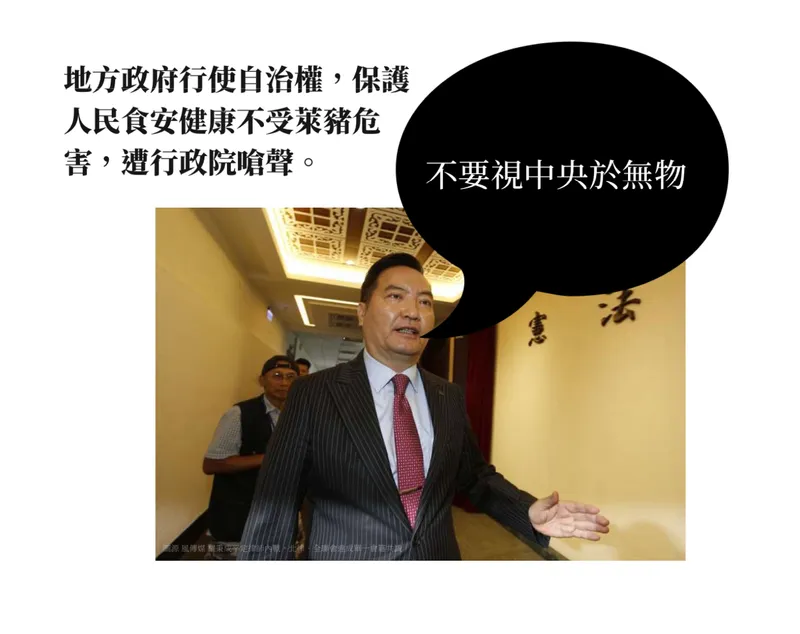
Cabinet spokesperson Luo Bing-cheng recently made a statement that raised many eyebrows: “Don’t treat the central government as nothing.” This remark was directed at local governments that were attempting to enact stricter standards for Ractopamine residues in pork than those set by the Executive Yuan.
Luo’s statement is a classic example of the power struggle between the central and local levels of government in Taiwan. While the central government argues for the necessity of unified national standards to facilitate international trade (specifically with the US), local governments argue that they have the right and duty to protect the health of their specific constituents with higher standards.
The phrasing “treat as nothing” (當作沒看到 or 視若無睹) is particularly telling. it reveals an administration that is increasingly frustrated with its inability to command absolute obedience. For a government that frequently talks about “decentralization” and “local empowerment” when in opposition, the sudden insistence on central supremacy once in power is a stark reversal.
True governance in a democracy is about negotiation and finding a balance between local autonomy and national policy. When the central government resorts to “don’t treat me as nothing” rhetoric, it suggests a lack of persuasive power and a reliance on administrative coercion.
This tension is not just about pork; it’s about the health of our democratic institutions. Are local governments mere branch offices of the Executive Yuan, or are they independent entities with their own mandates? Luo’s words suggest the former, but the public’s reaction suggests they still value the latter.