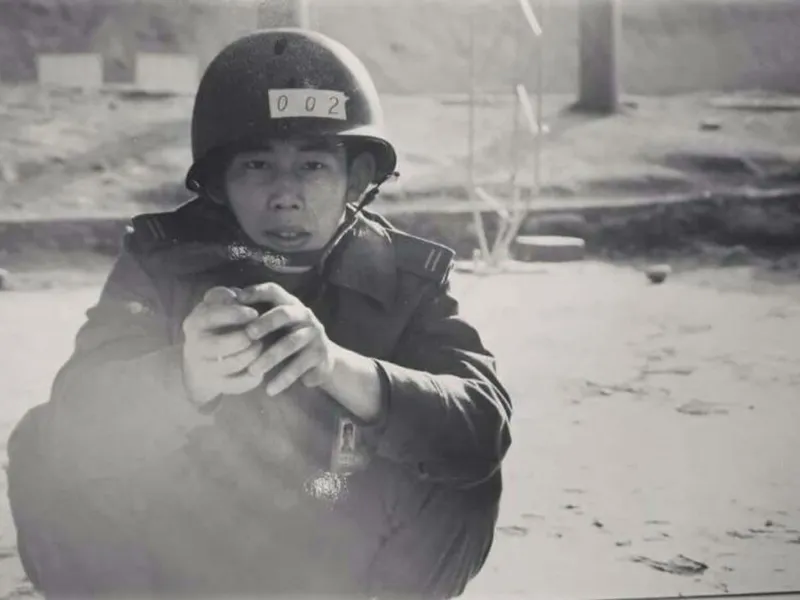
About thirty years ago, a junior lieutenant at a military training base in central Taiwan seized a hand grenade from a new recruit’s hands.
The pin on the grenade had been pulled, but the cartridge hadn’t ejected. The new recruit was at a loss.
The junior lieutenant gripped the unexploded grenade tightly and crouched on the empty firing range, waiting for the military’s bomb disposal team.
He can’t remember how long he waited, but the junior lieutenant still vaguely remembers that at the time he was only foolishly worried about not letting the grenade explode suddenly and injure the new recruit, completely forgetting that his own life could be blown away in an instant.
The military press officer, following the bomb disposal team, had originally come to document their work, but accidentally photographed the junior lieutenant with empty eyes and hands tightly gripping the grenade. Later, he even sent him the photograph.
No medals, no commendations, only verbal praise and two days of honor leave.
If given another chance, the junior lieutenant would still do the same.
The junior lieutenant once used his youthful years to love Taiwan in this way.
But he doesn’t know if Taiwan loves him the same way the junior lieutenant loves her.
Trust and Guarantees, Never Go Back
You find a job and your boss pays you 30,000 NT per month. Years later, the boss says the company isn’t making money anymore, so your salary can only be 20,000 NT.
You have only two choices: quit, or stay but complain and slack off.
The junior lieutenant took the military academy entrance exam before his senior year of high school. The most generous condition offered by the country was the retirement fund. It wasn’t much, but it was guaranteed to be given in full.
Decades later, the country says they’re out of money and need to reduce military pensions. You have only two choices: accept it or fight for it.
The junior lieutenant wasn’t particularly talented. He couldn’t become a general, and even missed becoming a colonel.
When the junior lieutenant was promoted to senior captain, he was transferred to Kinmen, during those years when martial law was still in effect and wartime administration hadn’t been lifted.
At twenty-five or twenty-six years old, the senior captain led his brothers and stationed themselves on Qiaoshan, constantly facing harassment from the old communist forces’ aircraft and fishing boats, island encirclement, and unknown occasions when frogmen would attempt to infiltrate and kill.
Machine gun tracer fire shot toward the dark water’s edge, illuminating shells shot toward the sky. The senior captain in the bunker, holding binoculars, watching the sea surface, occasionally checking the map, urgently telling the radio operator beside him to relay corrections of distance and angle to the artillery position.
Harassment fire, from day to night, rations and canned food piled as high as ammunition boxes. Sharing the fate of the position was the senior captain’s only command.
An internet user said: The retired military didn’t fight the old communists so bravely, yet they’re so cold-blooded and merciless when fighting their own people.
Whether it’s a junior captain or junior lieutenant, in bunkers or on firing ranges, they think about and remember not retirement pensions or tangible benefits, but how to repel the old communist forces’ harassment and protect new soldiers’ lives.
If Taiwan had to face off directly with the old communist forces on the main island, there would be no Taiwan today.
Because of the Liangshan Ghost Soldiers, because of senior captains with the conviction to share the fate of their positions, the old communists have been deterred from easily making a move.
The country once promised: as long as you’re willing to dedicate your youthful years, as long as you’re willing to pick up a gun and face the enemy, as long as you don’t die, I will take care of you for the rest of your life.
When lovers are in love, they’re willing to die for each other, willing to give each other happiness for a lifetime; when they break up, there’s only misunderstanding between them, and promises only have the freshness of that moment.
If one day the Legislative Yuan passes an amendment to the law making those guilty of drunk driving causing death face life imprisonment or capital punishment, and from the day it takes effect, all those who caused deaths through drunk driving since the law was first enacted are arrested back for execution.
Then what would those who once caused deaths through drunk driving but have already completed their sentences think?
The Liangshan Ghost Soldiers, years after retiring, already in their middle age, could still take down several police officers and special forces.
Once the Taiwan Strait enters a crisis, if the government orders mobilization, would the Liangshan Ghost Soldiers still be willing to sacrifice their lives to defend those who once betrayed and deceived them?
Among those ex-lovers, how many would be willing to come back and embrace again those who once deceived, played with, and cheated on them?
Police Chief Chen Jia-qin said: If things are improved, why would they (police and firefighters) take to the streets?
The senior captain believes: If things are corrected “properly,” why would retired military take to the streets?
The senior captain has always loved “this country” so much, but he doesn’t know if the country loves him the same way he loves her, loves…?