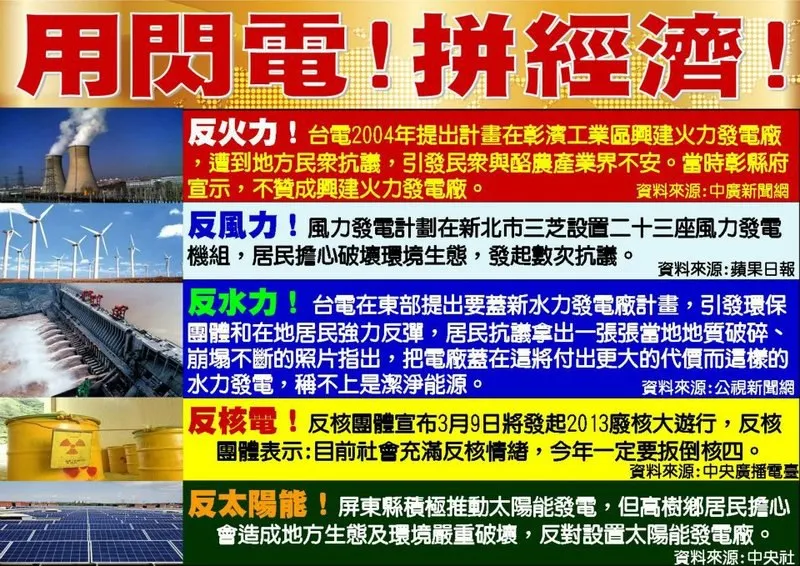
One of the descriptions frequently heard online lately is: “Those theories are too difficult, I don’t understand them, but blah blah blah.” If you want to oppose anything, please at least try to understand what you’re supporting and what you’re opposing. Covering your eyes while appreciating the world is just as bad as remaining silent about public affairs.
I Support Nuclear Energy, I Oppose the Old Nuclear Plant Four, I Accept a Public Referendum.
A chef friend once told me: “You can happily eat roadside food from unknown sources, yet worry about nuclear power plants that might fail at some unknown time. Isn’t that pretty stupid?” This friend’s perspective is that the convenience nuclear energy can bring outweighs fear of unknown disasters, especially since we typically don’t even worry about very real dangers surrounding us.
An environmental ecology colleague told me: “Nuclear leakage? At least the ecosystem in that area won’t be destroyed by humans anymore.” This colleague has been telling me since the 2011 Fukushima nuclear disaster that the local ecosystem has become more beautiful, though I’ve only heard that local mice have become very fat.
Meanwhile, we often hear several arguments in discussions: “Perhaps nothing will happen, but are you willing to test it with your own body?” or “But I hope your children all live next to a nuclear power plant, because you say accidents won’t happen.” These types of statements really bother me.
Actually, I see these types of remarks quite frequently. For example, the issue of abolishing capital punishment is similar—many say: “Those who support abolishing capital punishment, if something happened to their family members, let’s see if they’d still support abolition.”
I personally oppose the current Nuclear Plant Four’s commercial operation, but if people keep demanding unrealistic solutions, it’s really hard to join the so-called anti-nuclear movement that seems so misguided.
Nuclear Plant Four itself has plenty of legitimate reasons for opposition, but I believe the biggest problem lies with “people”—by which I mean the Atomic Energy Commission, Taiwan Power Company, and engineering contractors. I don’t trust any of them. Similarly, they don’t seem to intend for us to trust them either. So I oppose the nuclear plant at this stage, especially since it’s already expired before even being “born,” it’s a true monster.
Speaking of this hot potato called Nuclear Plant Four, there’s actually a perfect solution: abandon Nuclear Plant Four, build Nuclear Plant Five instead, and convert the entire Nuclear Plant Four complex into the world’s first children’s amusement park.
Let’s do a rough calculation. The total project cost for Nuclear Plant Four has already increased from the initial NT$169.7 billion to NT$326.423 billion. Taking a nice round figure of NT$350 billion and using the December 2012 total population count published by the Ministry of the Interior’s Statistics Department of 23,315,822 people, that equals approximately NT$15,011.27 per Taiwanese citizen.
Now let’s discuss the public referendum. Though it’s obviously the ruling party’s relief pitcher, many use “how many referendums have succeeded” as evidence of the ruling party’s malicious intent. But let’s think carefully—is that really the case?
Taiwan has held a total of six or seven referendums in the past, but each has been a politically manipulative issue of blue versus green. These types of issues could never generate sufficient voting momentum. But this time is different. Since the Fukushima nuclear power plant explosion, Taiwan has formed a massive social consensus on nuclear energy safety issues that transcends blue-green and regional divides. Though various factions’ deliberate manipulation remains evident, at least what I see is people focusing on the issue itself.
If we look at total voter turnout in past presidential elections, surpassing the referendum’s minimum threshold would be quite easy—if everyone really cares.
From another angle, if this referendum still fails to reach the minimum voting participation threshold, doesn’t that suggest that more than half of Taiwanese simply don’t care whether Nuclear Plant Four is activated?
The five main demands recently listed by anti-nuclear groups, I personally have some opinions about. The original versions of these five demands are:
- Stop allocating additional budget for Nuclear Plant Four;
- Stop loading fuel rods into Nuclear Plant Four;
- Decommission Nuclear Plants One, Two, and Three as soon as possible;
- Immediately relocate nuclear waste from Lanyu; and
- Zero electricity growth.
Regarding the first and second points, the government actually promised in mid-February this year not to allocate additional budgets or load fuel rods before the referendum. These two points, while valid, seem somewhat redundant.
Third Point: Urgently Decommission Nuclear Plants One, Two, and Three.
Decommissioning can be viewed from two angles:
- From the perspective of rejecting nuclear energy, it’s absolutely correct.
- From the perspective of accepting nuclear energy, Nuclear Plant Four was originally designed to replace outdated nuclear plants. If Nuclear Plant Four were completed, the older plants would naturally be decommissioned. But today the problem is that Nuclear Plant Four has been prevented from commercial operation for electoral reasons by the DPP government. Thus, in this unprecedented situation where there’s no new energy solution in place, proposing only to decommission Plants One, Two, and Three sounds like contradicting yourself.
Fourth Point: Immediately Relocate Nuclear Waste from Lanyu.
Lanyu is a beautiful island that deserves careful protection and should never have had nuclear waste buried there. Strictly speaking, neither mainland Taiwan nor outlying islands should store nuclear waste, because our territory is simply too small.
Yet the government and Taiwan Power Company imperiously shoved nuclear waste into others’ homes. Despite Taiwan Power’s repeated claims that Lanyu isn’t a permanent storage site but merely temporary for several decades, after all these years, Taiwan Power still hasn’t found a suitable location. Lanyu remains an indefinite temporary storage facility—meanwhile, North Korea has already demanded NT$300 million compensation for breach of contract.
The current reality is that both the Republic of China government and Taiwan Power don’t know how to solve the nuclear waste problem (inability to handle is completely different from lack of technical capacity). This, you know it, I know it, the whole world knows it, and indeed the whole world is watching closely, terrified that their neighbor might be next.
If we insist on immediately relocating nuclear waste from Lanyu, but the times have changed and there’s seemingly no suitable permanent storage location within ROC territory, then this proposal ultimately amounts to shooting yourself in the foot. Better not to bring it up at all.
Reluctantly, grudgingly, yet pragmatically, without muddying the core issue.
A bunch of people who do nothing but raise problems without allowing others to solve them are simply idiots.
Yet this is definitely an issue Taiwan Power must solve urgently, and delaying further is unacceptable.
Fifth Point: Zero Electricity Growth.
This fifth point is the worst demand of all five—truly perverse—making people genuinely wonder who came up with this brilliant idea. Some say reducing heavy industry will lower electricity demand. Some say the underperformance of science parks could release hydropower allocations. Others cite Germany and Denmark’s experience of high GDP growth coupled with declining electricity demand.
Tell me, without heavy industry, Taiwan’s economic lifeline would heavily depend on foreign imports, forcing Taiwan’s overall economy toward the cliff. Especially when that foreign country is clearly mainland China—you can’t possibly oppose China on one hand while leeching on them with the other.
Some say large quantities of DRAM have exited the market, so science parks can free up lots of water and electricity allocations. The problem is new industries’ power consumption isn’t necessarily lower! If anyone remembers, Google recently planned to establish a massive data storage center for the Asia-Pacific region in Taiwan—that’s an ultra-high energy-consuming industry, but nobody seems to mention it.
Actually, using more electricity isn’t much of a problem and doesn’t need to be done furtively. But I believe future electricity demand will only increase, not decrease. In the past, a few giants consumed the power; in the future, countless ants will consume it—and ants can move elephants.
Oh, I forgot to mention one counterargument people raised. They point out that Taiwan’s nuclear power generation, now or in the future, only represents a small portion of Taiwan’s total power generation. So even if Nuclear Plant Four were built, electricity would still be insufficient. Given that, for safety, we might as well not build it. But if we lose nuclear power, how many more thermal power plants should we add to meet current electricity demand?
Finally, I’ll ask one impertinent question: “Has anyone calculated how much nuclear power was used by the March 9th anti-nuclear movement? And how come the march used massive resources when it could have been so energy-efficient?”
That day, that area, the telephone lines were absolutely overloaded.