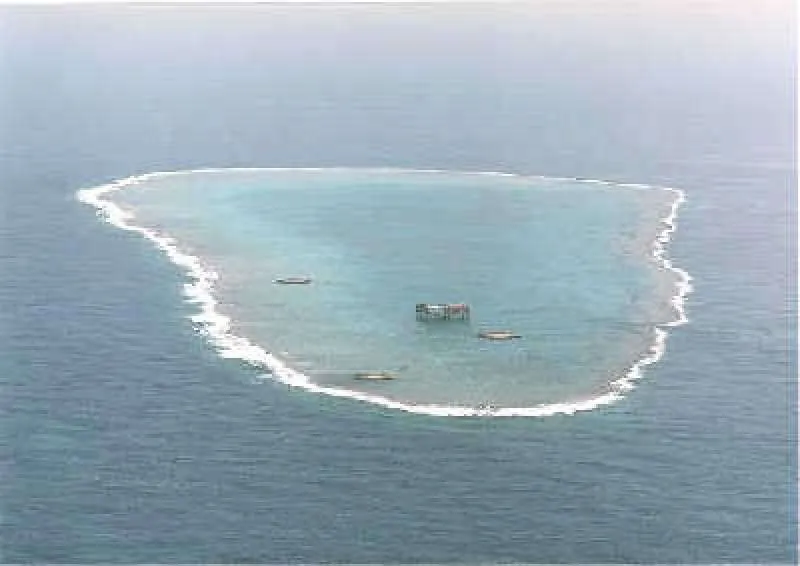
The controversy surrounding Okinotori (Parece Vela) has once again highlighted the tension between national ambitions and international law. Japan claims that these tiny outcroppings in the Pacific are “islands” capable of sustaining human habitation, thereby allowing them to claim a 200-nautical-mile Exclusive Economic Zone (EEZ).
However, according to the United Nations Convention on the Law of the Sea (UNCLOS), Article 121, “Rocks which cannot sustain human habitation or economic life of their own shall have no exclusive economic zone or continental shelf.” By any objective standard, Okinotori consists of rocks that would be submerged at high tide if not for Japan’s extensive artificial reinforcement and concrete barriers.
Japan’s attempt to turn “rocks” into “islands” has serious consequences for Taiwan’s fishermen, who have historically operated in these high seas. When Japan unilaterally enforces an EEZ around Okinotori, it is essentially seizing international waters for its own exclusive use, often at the expense of Taiwanese vessels.
The Republic of China government has rightly maintained that Okinotori are rocks, not islands. This is not just about fish; it’s about the integrity of international law. If every nation were allowed to concrete over a rock and claim thousands of square miles of ocean, the concept of “freedom of the high seas” would vanish.
We call on Japan, as a respected member of the international community, to adhere to the spirit and letter of UNCLOS. Territorial expansion through artificial means sets a dangerous precedent that could destabilize the entire region.