I’ve always had a strange aversion to sky lanterns since I was a child. I remember participating in a scout camp in the Yangmingshan area when I was in elementary school. The older boys and girls led us in releasing sky lanterns. They didn’t fly very far before they all caught fire, turning into a giant fireball ˊ_>ˋ.
I want everyone to know one fact about the number of sky lanterns recycled and released:
More than 300,000 sky lanterns are released in Pingxi every year. Local businesses offer a sky lantern recycling program, paying NT$5 per lantern. On average, 200,000 lanterns are recycled annually, generating over NT$1 million in recycling revenue.
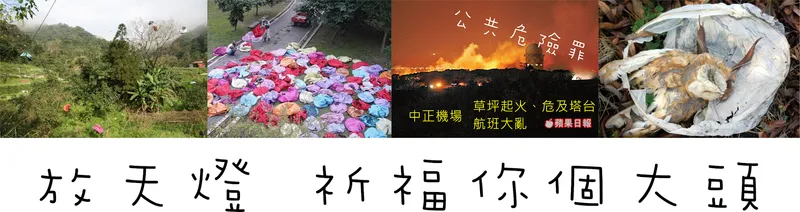
It’s sky lantern season again, and I’ve specially designed this photo to illustrate why I refuse to release them. Isn’t it obvious?!
That’s right, it has nothing to do with that incident from my elementary school days.
The main reason is that once a sky lantern is released, it becomes nobody’s business. This reminds me of the popular saying, “Shoot and forget,” the opposite of “Shoot and forget,” which seems quite unreliable for a weapon system (sky lantern = fireball?). As for who gets accidentally injured, that really depends on God’s will. Perhaps it’s not an exaggeration to say that sky lanterns are more dangerous than firecrackers.
To quote Twitter user Nisemono: “Releasing sky lanterns in Pingxi: A massive crowd crowding into a small mountain town to create a huge amount of garbage.”
This statement is actually somewhat accurate, because our capable “two mouths” (to be fitting, please guess the riddle) have designated Pingxi as the only place in Taiwan where it’s legal to dump garbage and release sky lanterns, and they allocate a budget every year for those who collect the sky lantern debris.
Releasing sky lanterns is beautiful, so lovers use them to express their love or propose, sending love, romance, laughter, dreams, and hopes soaring into the sky; students use them to pray for academic success; even entrepreneurs occasionally release sky lanterns to make wishes.
It’s all because of romance, isn’t it?
But the reality is this: a group of people, crammed into one place, doing the same thing, for one purpose—that’s a big problem.
Legend has it that Zhuge Liang released sky lanterns for military communication; if a bunch of sky lanterns were flying in the sky, even Cao Cao would probably be dumbfounded.
Whether from a historical or fantastical perspective, releasing sky lanterns cannot fulfill your dreams, but the amazing thing is that everyone knows this deep down! But the tens of thousands of people who crowd in every year are what I find most bizarre; this near-religious collective consciousness has reached an astonishing level.
It’s all for the sake of “fun.”
A few years ago, NASA collected signatures online, miniaturized our names onto a metal plate, and launched it into space aboard a spacecraft (pretty high, right?). Perhaps we could consider this approach: collect everyone’s wishes online, project them onto the fabric of a sky lantern, so that just one lantern could carry many wishes (hot tea).
Adding lighting, laser shows, and environmental projections would also be a good alternative; after all, once the lantern rises more than ten meters, everyone will only see a small dot of light.
But it seems to lack that “coolness,” though at least it’s cleaner ˊ_>ˋ.
Some have mentioned developing new materials and technologies to replace the dangers of existing sky lanterns. One method is to use LED sky lanterns, and there are even commercially available products.
However, LED sky lanterns are actually worse for two reasons:
-
Battery pollution; then the water we drink will generate electricity (pikachu).
-
LEDs, the materials themselves contain heavy metals such as lead, arsenic, and nickel; everyone will be made of steel then.
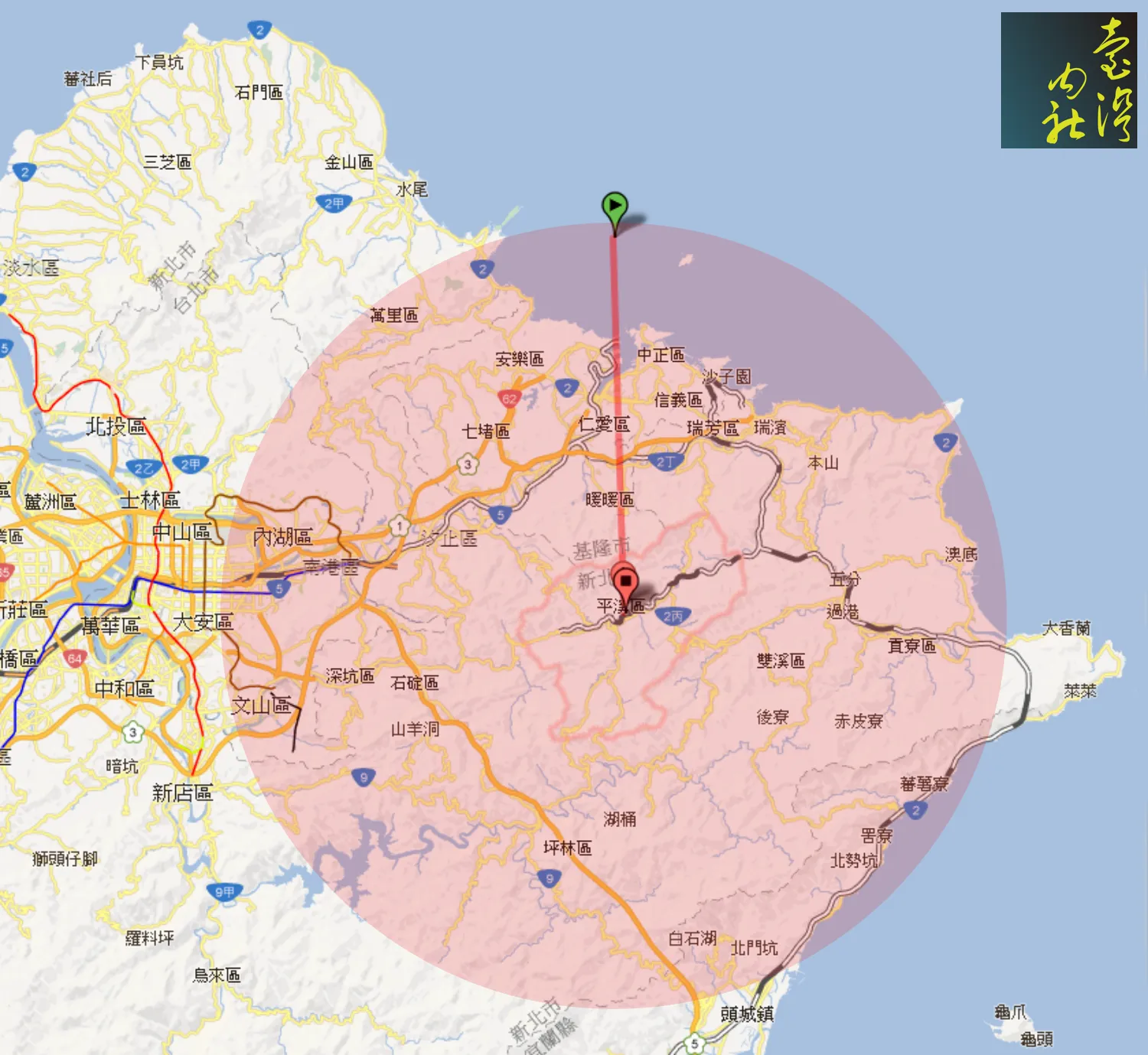 Pingxi Sky Lantern Flight Distance Range
Furthermore, let’s estimate the flight distance of the sky lanterns.
According to the sky lantern operators, a sky lantern can fly for about 5 to 10 minutes; let’s take a maximum of 15 minutes (not considering those who add fuel and want to fly further). Assuming a wind speed of 40 knots, one knot equals one nautical mile per hour, and one nautical mile is 1.852 kilometers, which translates to a flight distance of 74.08 kilometers per hour.
A 15-minute flight would cover a distance of 18.52 kilometers.
Following up on Google Maps, it can be seen that a 19-kilometer radius extending outward from the Pingxi sky lantern release point encompasses areas including Keelung city center and Taipei City Government. The actual coverage area is shown in the map above.
It’s important to note that although Pingxi is located in a mountain valley, the highest elevation of the surrounding mountains, according to the contour map, is only about 660 meters. However, according to experts, sky lanterns can fly at altitudes of 1000 to 1500 meters, far exceeding the altitude of the mountains, making it easily possible for them to reach Taipei City.
Finally, it should be stated that the first set of images above depicts the previous Guandu, Taoyuan, and British sky lantern incidents, which have no direct connection to the Pingxi sky lantern incident. However, even if a sky lantern burns down a house, causes a forest fire, or even injures a person in Pingxi, it still carries the risk of being illegal.
Furthermore, I believe that Taiwanese birds are not much smarter than British birds.