
Distinguished guests from our friendly nations, distinguished representatives of various countries stationed in Taiwan, and my fellow countrymen, good day to you all.
Gratitude and Responsibility
Just moments ago, Chen Chien-jen and I formally took the oath of office as the 14th President and Vice President of the Republic of China in the Presidential Office. We are grateful for this land’s cultivation of us, grateful for the people’s trust in us, and most importantly, grateful for this nation’s democratic system, which enabled us to achieve peaceful power transfer through democratic elections, accomplish the third transition of political parties, overcome numerous uncertainties, and successfully navigate a four-month transition period to complete the peaceful transfer of power.
Taiwan has once again demonstrated through action to the world that as a people devoted to democracy and freedom, we possess firm conviction to defend our democratic and free way of life. Every one of us has participated in this journey. Dear people of Taiwan, we have done it.
I want to tell everyone that regarding the election results of January 16th, I have only one interpretation: the people have chosen a new president and a new government, and their expectation is simple—solve problems. At this moment, Taiwan faces grave difficulties and urgently needs leaders willing to take decisive responsibility. I will not forget this.
I also want to tell everyone that the challenges before us require us to face them honestly and shoulder them together. This speech is an invitation. I invite all fellow countrymen to stand together and shoulder this nation’s future.
A nation does not become great because of its leaders; it is the collective struggle of all people that makes a nation great. A president should not merely unite supporters—a president should unite the entire nation. Unity is for the sake of change, and this is my deepest expectation for this nation. Here, I earnestly appeal to you: give this country a chance. Let us set aside our prejudices and past divisions, and together complete the mission entrusted to us by this new era.
As we embark on our collective struggle, I, as President, solemnly declare to all citizens that my new government will lead this nation’s reform, demonstrate resolve, and never retreat.
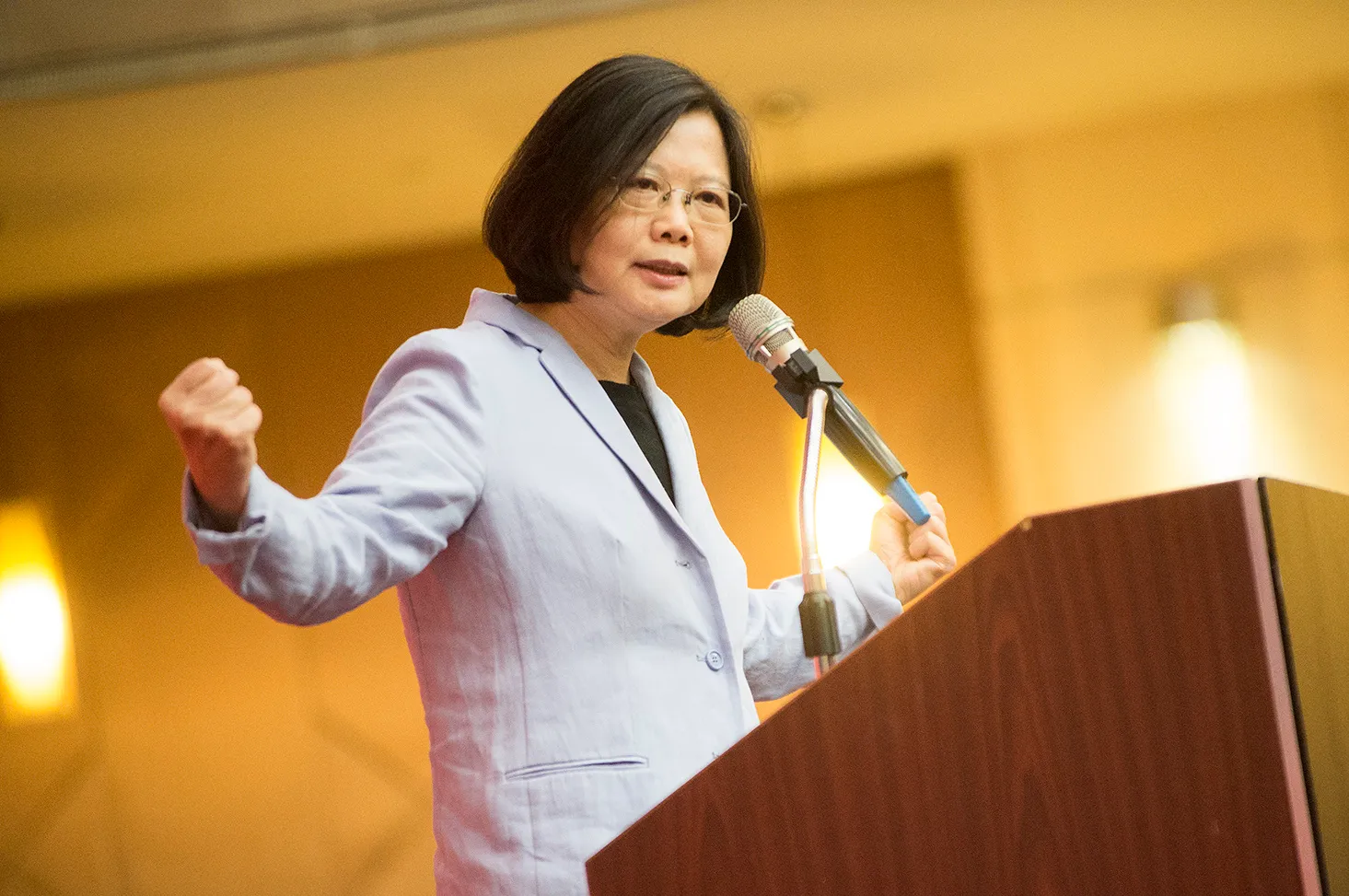 Figure: ROC 14th President Tsai Ing-wen
Building a Better Nation for Young People
The road ahead is not easy. Taiwan needs a new government that faces every challenge with optimism. My responsibility is to lead this new government.
Our pension system will go bankrupt if left unreformed. Our rigid education system has become increasingly disconnected from social dynamics. Our energy and resources are severely limited. Our economy lacks vitality. The old outsourcing model has reached its limits. Our nation desperately needs a new economic development model. Our population is aging rapidly, yet our long-term care system remains underdeveloped. Our birth rate continues to decline, yet comprehensive childcare systems remain distant. Environmental pollution remains serious. Our national finances are not optimistic. Our judiciary has lost public trust. Food safety issues trouble every household. The wealth gap grows increasingly severe. Our social safety net still has many holes. Most importantly, I must emphasize that our young people face low wages, their lives are constrained, and they are filled with helplessness and confusion about the future.
The future of young people is the government’s responsibility. If unfriendly structures are not reformed, no amount of individual talent can improve the situation for all young people. I am committed to resolving this nation’s fundamental structural problems step by step during my presidency.
This is what I want to do for Taiwan’s young people. While I cannot immediately raise everyone’s salary, I am committed to having the new government take immediate action. Please give us some time, and please walk this path of reform with us.
Changing young people’s circumstances means changing the nation’s circumstances. If a nation’s youth have no future, that nation has no future. Helping young people break through difficulties, achieving intergenerational justice, and handing a better nation to the next generation is a major responsibility of the new government.
First: Economic Structure Transformation
To build a better nation, the new government must accomplish the following.
First, we must transform Taiwan’s economic structure.
This is the most arduous mission the new government must undertake. We must not underestimate ourselves or lose confidence. Taiwan possesses many advantages that other nations lack: the vitality and resilience of a maritime economy, high-quality human resources, a practical and reliable engineering culture, a complete industrial chain, agile and flexible small and medium enterprises, and an indomitable entrepreneurial spirit.
To transform Taiwan’s economy, we must resolve now to courageously forge a different path. This path is to build a new model for Taiwan’s economic development.
The new government will establish a new economic model centered on innovation, employment, and distribution, pursuing sustainable development. The first step of reform is to strengthen economic vitality and autonomy, enhance connections with the global and regional community, actively participate in multilateral and bilateral economic cooperation and free trade negotiations, including TPP and RCEP, and promote the New Southbound Policy to elevate our external economic scope and diversity, breaking away from over-reliance on a single market. Beyond this, the new government believes that only by generating new growth engines can we break through current economic stagnation. We will use both exports and domestic demand as dual engines, allowing enterprise production and people’s lives to be mutually complementary, linking external trade with local economies.
We will prioritize five major innovation and research plans to reshape Taiwan’s global competitiveness. We will also actively enhance labor productivity, protect workers’ rights, and ensure wages grow in step with economic growth.
This is a critical moment for Taiwan’s economic development. We have the resolve and communication ability. We have systematic planning. Going forward, we will adopt a cross-ministry approach to mobilize the nation’s entire strength to bring this new model to life.
While developing our economy, we must not forget our environmental responsibility. The new economic model must integrate with land planning, regional development, and environmental sustainability. Industrial layout and land use should abandon fragmented planning and short-sighted approaches. We must pursue balanced regional development, which requires central planning and coordination, as well as full deployment of local governments’ regional collaborative governance spirit. We can no longer squander natural resources and public health as we have in the past. Therefore, we will strictly control various forms of pollution and transition Taiwan toward a circular economy, converting waste into renewable resources. Regarding energy choices, we will make adjustments guided by sustainable principles. The new government will seriously address climate change, land conservation, and disaster prevention, because we have only one Earth and only one Taiwan.
Second: Strengthening the Social Safety Net
The second responsibility the new government must undertake is strengthening Taiwan’s social safety net. Recent incidents involving child safety and random killings have shocked our entire society. However, a government cannot remain perpetually shocked—it must demonstrate empathy. No one can bear the pain for victims’ families, but a government, especially those on the frontlines, must make victims and their families feel that the government stands with them when tragedy strikes.
Beyond empathy, government must provide solutions. We must prevent tragedies from recurring through comprehensive approaches spanning public safety, education, mental health, and social work, actively patching every hole. Particularly regarding public safety and drug prevention, the new government will address these matters with utmost seriousness. Regarding pension reform, this is a critical reform vital to Taiwan’s survival and development. We should not hesitate, nor should we act rashly. The Pension Reform Committee, chaired by Vice President Chen Chien-jen, is actively preparing. Previous governments made some efforts on this issue. However, they lacked public participation. The new government’s approach is to launch collective bargaining, because pension reform must be a process of consultation that unites all people.
This is why we will convene a National Pension Reform Conference, bringing together representatives from different sectors and professions to collectively negotiate on a foundation of social unity. Within one year, we will present a feasible reform plan. Whether for workers or civil servants, every citizen’s retirement should receive fair protection.
Additionally, regarding long-term care, we will establish a long-term care system that is high-quality, affordable, and universal. Like pension reform, the long-term care system requires total social mobilization. The new government’s approach is government-led planning, encouraging the private sector to demonstrate community spirit, and mobilizing social collective mutual assistance to establish a comprehensive system. Every elderly person will be able to enjoy their senior years safely in familiar communities, and family care burdens will be reduced. We cannot leave elderly care entirely to free markets. We will shoulder this responsibility and proceed systematically to prepare for the coming super-aged society.
Third: Social Fairness and Justice
The third responsibility the new government must undertake is social fairness and justice.
On this issue, the new government will continue cooperating with civil society to ensure our policies better embody values of diversity, equality, openness, transparency, and human rights, further deepening and evolving Taiwan’s democratic mechanisms.
For new democratic systems to operate, we must first find common ground in addressing our past. Going forward, I will establish a Truth and Reconciliation Commission in the Presidential Office, approaching historical issues with utmost sincerity and care. The pursuit of transitional justice aims to achieve true societal reconciliation, allowing all Taiwanese to learn from the errors of that era.
We will begin with truth investigation and documentation, with plans to complete Taiwan’s own transitional justice investigation report within three years. We will conduct subsequent transitional justice work based on truths revealed in this report. Uncovering truths, healing wounds, and clarifying responsibilities. From this point forward, past history will no longer be a source of Taiwan’s division, but rather momentum for our collective progress.
Applying the same principles to fairness and justice, I will approach indigenous issues with empathy. At today’s inauguration, before singing the national anthem, indigenous children sang traditional songs from their communities. This symbolizes that we must never forget the historical order of arrival on this island. The new government will approach indigenous issues with a spirit of apology, rebuild indigenous historical narratives, gradually promote autonomy, revive language and culture, and enhance living standards—this is the change I will lead the new government to implement.
Furthermore, the new government will actively promote judicial reform. This is the issue most citizens are concerned about today. Public sentiment reflects widespread concerns: the judiciary is inaccessible to people and distrusted; the judiciary fails to effectively combat crime; and the judiciary has lost its function as society’s ultimate safeguard of justice.
To demonstrate the new government’s resolve, we will convene a National Judicial Reform Conference in October this year, enabling genuine public participation and allowing society to join judicial reform together. The judiciary must respond to people’s needs—it must no longer be the judiciary of legal professionals alone, but the judiciary of all citizens. Judicial reform is not merely the internal affair of legal professionals, but a reform involving all people. This is my expectation for judicial reform.
Fourth: Regional Peaceful Stable Development and Cross-Strait Relations
The fourth responsibility the new government must undertake is regional peace, stability, and development, and properly handling cross-strait relations. Over the past thirty years, there have been the most dramatic changes for both Asia and the world; global and regional economic stability and collective security have also become increasingly concerning issues for all governments.
Taiwan has always played an indispensable role in regional development. However, recently regional circumstances have shifted rapidly. If Taiwan fails to leverage its strength and position to actively participate in regional affairs, it will not only become insignificant but could be marginalized, losing autonomy over its future.
We face crises, but also opportunities. Taiwan’s current economic development is highly related and complementary to that of many regional nations. If we combine efforts to build a new economic development model with cooperation from Asian and Asia-Pacific nations, jointly shaping future development strategies, we can not only contribute positively to regional economic innovation, structural adjustment, and sustainable development, but also build a strong sense of “economic community” among regional members.
We will share resources, talent, and markets with other nations, expand economic scale, and ensure efficient resource utilization. The “New Southbound Policy” embodies this spirit. We will engage in wide-ranging exchanges and cooperation with regional partners in technology, culture, and trade—particularly deepening diverse relations with ASEAN and India. For this reason, we are also willing to have frank discussions with the other side regarding jointly participating in regional development, seeking various cooperation and coordination possibilities.
While actively developing our economy, the Asia-Pacific security situation has become increasingly complex, and cross-strait relations have become an important element in building regional peace and collective security. In this process, Taiwan will be a “steadfast guardian of peace,” actively participating and never absent. We will work to maintain cross-strait peace and stability; we will also strive to promote internal reconciliation, strengthen democratic mechanisms, build consensus, and form a unified position toward the outside world.
Dialogue and communication are crucial to achieving our objectives. Taiwan must also become an “active communicator for peace,” establishing regular and close communication mechanisms with all relevant parties, constantly exchanging views, preventing misjudgment, building mutual trust, and effectively resolving disputes. We will adhere to principles of peace and mutual benefit in addressing relevant disputes.
I was elected president according to the ROC Constitution, and I have the responsibility to defend the ROC’s sovereignty and territory; regarding East China Sea and South China Sea issues, we advocate setting aside disputes and joint development.
Regarding cross-strait dialogue and communication, we will work to maintain existing mechanisms. In 1992, the two sides’ representatives engaged in communication and negotiation with mutual understanding and seeking common ground while setting aside differences, reaching certain common understandings and agreements. I respect this historical fact. Over more than twenty years since 1992, the current situation and achievements accumulated through exchange and consultation should be jointly cherished and maintained by both sides, and we should continue promoting peaceful and stable cross-strait relations development based on these existing facts and political foundations. The new government will handle cross-strait affairs according to the ROC Constitution, the Cross-Strait Relations Act, and other relevant laws. The two governments should set aside historical baggage and engage in constructive dialogue for the benefit of people on both sides.
The existing political foundation I mentioned encompasses several key elements: First, the historical fact of the 1992 talks and the common understanding of seeking common ground while setting aside differences—this is a historical fact; Second, the ROC’s existing constitutional system; Third, the achievements from over twenty years of cross-strait consultation and exchange; Fourth, Taiwan’s democratic principles and general public will.
Fifth: Diplomacy and Global Issues
The fifth responsibility the new government must undertake is fulfilling our duties as global citizens and making contributions on diplomatic and global issues. We must let Taiwan reach toward the world, and let the world come into Taiwan.
I especially thank the many heads of state and diplomatic delegations present, who have long helped Taiwan and given us opportunities to participate in international society. Going forward, we will continue to share Taiwan’s development experience and build sustainable partnerships with friendly nations through official interactions, business investment, and civil cooperation.
Taiwan is a model of global civil society. Since democratization, we have consistently upheld universal values of peace, freedom, democracy, and human rights. We will embody this spirit and join value alliances on global issues. We will continue deepening relations with friendly democratic nations including the United States, Japan, and Europe, promoting comprehensive cooperation based on our shared values.
We will actively participate in international economic cooperation and rule-making, firmly upholding global economic order, and integrating into important regional economic systems. We will not be absent from efforts to combat global warming and climate change. We will establish a dedicated energy and carbon reduction office in the Executive Yuan, and in accordance with the COP21 Paris Agreement, regularly review greenhouse gas reduction targets and work with friendly nations to jointly protect a sustainable Earth.
Simultaneously, the new government will support and participate in international cooperation on emerging global issues, including humanitarian aid, medical assistance, disease prevention and research, counter-terrorism cooperation, and combating transnational crime, making Taiwan an indispensable partner in the international community.
Conclusion
From Taiwan’s first presidential direct election in 1996 to today, exactly twenty years have passed. Over these twenty years, through the efforts of several administrations and civil society, we have successfully navigated many challenges that emerging democracies must face. In this process, we have experienced many touching moments and stories; however, like other nations, we have also experienced anxiety, unease, contradiction, and confrontation.
We have witnessed social division, conflict between progress and conservatism, conflict between environment and development, and political ideological conflict. These conflicts once energized electoral mobilization, yet they have also caused our democracy to gradually lose its ability to solve problems.
Democracy is a process. Every political worker in each era must clearly understand the responsibility they shoulder. Democracy can advance, and it can also regress. Today, standing here, I want to tell everyone that regression will not be our choice. The new government’s responsibility is to advance Taiwan’s democracy to the next stage: previously democracy meant electoral victory or defeat, now democracy concerns people’s happiness; previously democracy meant confrontation between two worldviews, now democracy means dialogue among different values.
Building a “united democracy” not held hostage by ideology, building an “efficient democracy” that can respond to social and economic problems, building a “pragmatic democracy” that truly cares for people’s livelihoods—this is the significance of the new era.
As long as we believe, the new era will come. As long as this nation’s people have firm conviction, the new era will definitely be born in our generation’s hands.
Dear people of Taiwan, my speech is ending, but reform is beginning. From this moment, the responsibility of this nation transfers to the new government. I will show you this nation’s transformation.
History will remember our brave generation. Our nation’s prosperity, dignity, unity, confidence, and justice will bear our efforts’ marks. History will remember our courage as we together directed our nation toward a new direction in 2016. Every person on this land will feel pride in having participated in Taiwan’s transformation.
In one of the songs performed earlier, there was a lyric that deeply moved me: (in Taiwanese) “This is that day, courageous Taiwanese people.”
Fellow countrymen, twenty-three million Taiwanese people, the wait is over. Now is that day. Today, tomorrow, and every day going forward, we must be Taiwanese who safeguard democracy, protect freedom, and defend this nation.
Thank you all.