In 1895, the Japanese government successfully acquired the long-desired Taiwan Island and Penghu Islands during the First Sino-Japanese War. On May 29th, the Imperial Guard Division landed near Sanshao Cape, then captured Taipei City. On June 14th, the Taiwan Governor-General’s Office officially moved into Taipei City. However, the Japanese government knew that to achieve the unification of Taiwan, it was essential to acquire Tainan City. From the 17th century, through the era of Zheng Chenggong and his son, to the Qing Dynasty, Tainan had been the capital. It was not only a local city but also the true political and economic hub of Taiwan. Acquiring Tainan City was tantamount to occupying Taiwan.
Colonel Sasaki, the commander of the coastal detachment, departed from Keliao in Beimen Township on the 19th, arriving at Zhongzhou Village (Zhongzhou, Xuejia Township, Tainan County) at 3 PM. Unfortunately, the tide was high in the Zhuzhugou River, forcing them to camp there. Early the next morning, Colonel Sasaki dispatched Major Watanabe to lead his troops across the Zhuzhugou River in Beimen Township, passing through Lingziliao and Ouwang in Jiangjun Township, entering Xiaolong (Jiali District, Tainan City), and then advancing towards Tainan City. Colonel Sasaki’s troops, however, entered Xiaolong via Xuejia Zhongzhou. During their advance, the troops encountered our militia forces several times. Unexpectedly, after the Japanese troops entered Xiaolong, a horrific massacre occurred, filled with screams of agony and carnage!
In early October, Prince Yoshihisa’s Imperial Guard Division advanced directly from Chiayi to Yanshui Port. There, they first made contact with the 4th Mixed Brigade led by Sadachika, which landed at Budaikou in Chiayi between October 10th and 13th. Together with the 2nd Division, which landed at Fangliao, they launched a three-pronged attack on Tainan City. The military command planned the general attack on Tainan City to take place on October 23rd.
After Prince Zhen’ai’s army landed, it engaged in numerous battles with our anti-Japanese resistance forces. The battlefields spanned present-day Beimen Township, Xiaying Township, Madou Town, Yanshui Town, Xinying City, Jiangjun Township, Xuejia Town, Qigu Township, Jiali Town, and more. Among these, the battles of Duzitouzhuang Incident, Tiexianqiao Incident, Zhugaoshan Incident, and Xiaolong Incident were the most brutal. In just over ten days, dozens of fierce and bloody battles were fought. However, due to the inferior equipment and weaponry of our resistance forces compared to the Japanese, despite their desperate fighting and risking their lives, they ultimately suffered repeated defeats and countless casualties.
The commander of the Southern Advance Army landed at Budaikou on October 17th. Guarded by an infantry company, he entered Yanshui Port and immediately issued marching plans for three army corps. Based on the military’s instructions, Prince Zhen’ai decided to divide the 4th Mixed Brigade into a coastal detachment and a main column. Colonel Sasaki, the commander of the coastal detachment, departed from Keliao in Beimen Township on the 19th as ordered. He arrived at Zhongzhou Village (Zhongzhou, Xuejia Township, Tainan County) at 3 PM, only to find the Zhazhugou River at high tide, forcing him to camp there. Early the next morning, the detachment commander ordered a portion of his troops to proceed through Xuejia Village to Madou Village to scout the crossing points of the Zengwen River; another vanguard was dispatched to wade across the Zhazhugou River, passing Lingziliao (Lingziliao, Jiangjun Township, Tainan County), and advance towards Xiaolong Street (within Jiali Township, Tainan County). During their advance, the troops encountered our militia forces several times. Unexpectedly, after the Japanese troops entered Xiaolong Street, a horrific massacre ensued, filled with screams of agony and carnage!
According to the “Illustrations of the Attack on Taiwan” compiled from the “Illustrations of the Taiwan Campaign” published in the “Folklore Pictorial” by a Japanese war correspondent, there is a record of the “Battle of Xiaolong”:
“Major Watanabe and Colonel Sasaki’s vanguard and main force departed from their encampment at 7:00 AM on October 20th, launching a general attack on Tainan. After marching for about three hours, they reached a point about 2,000 meters from Xiaolong, where they were ambushed by our anti-Japanese volunteer army lying in ambush on a small hill north of Xiaolong. The Japanese immediately ordered one small squad to resist, while the rest of the troops continued to advance. After entering Xiaolong village, the vanguard was suddenly subjected to heavy fire. A small squad that had been sent to the hill burned down the villages they had passed through and joined up with the vanguard. The difficulty of village warfare was no less than that of open field warfare. The area around Xiaolong was full of sugarcane fields and dense bamboo groves, with winding paths that were difficult to discern. The village was surrounded by a barrier nearly four meters wide and deep…” The ditch (Zhaigou), more than ten feet wide, was surrounded by three layers of bamboo fencing (thorny bamboo and pine needles), making it easy to defend and difficult to attack… Although the dense bamboo forest made it impossible to pinpoint the enemy’s position, the artillery fire was still somewhat effective. Kato’s company circled around to the enemy’s right flank, destroyed the bamboo fencing, crossed the ditch, and advanced. The enemy soldiers on the first position retreated to the second position for a desperate battle. Nakayama and Kudo’s companies went to support Kato’s company, charging with bayonets after a rapid barrage. Kotomo’s company then circled around to the enemy’s left flank, launching a pincer attack that was unstoppable. At least a thousand enemy soldiers were killed that day; twelve of our soldiers died on the spot, and twenty-nine were wounded. The battle ended at dusk, and we advanced to a camp a thousand meters away.”
From the Japanese own account above, we can understand the number of our soldiers killed. According to elders’ recollections:
“The fleeing civilians collectively hid in the houses…” Inside the ditch, unexpectedly, due to the cries of children, or perhaps because the Japanese army discovered that a bamboo grove lying across the road had been accidentally cut down, machine guns swept through the ditch, leaving a scene of utter carnage and unbearable horror.
“Afterwards, villagers came to collect the bodies, filling eighteen oxcarts in total. Because of the sheer number of deaths, even coffins were scarce.”
“On the third day of the ninth lunar month in 1895, the Japanese army, having entered Xiaolong, upon hearing the news of the prince’s murder by our righteous men, immediately launched a bloody massacre. Regardless of age, gender, or physical condition, they killed anyone alive, stabbing them repeatedly until none survived. They also set fire to passing houses. Their madness and brutality were chilling.”
“In the past, every year on the third day of the ninth lunar month, every household in the Xiaolong area would worship their ancestors who had sacrificed their lives in the ‘rebellion against the Japanese.’ According to the elders, the number of righteous soldiers and civilians killed by the Japanese army that year was as high as two…” “Three thousand people, hence some directly called Xiaolong ‘the place of elimination.’”
Some speculate that the incident occurred for two reasons:
- The influx of refugees into Xiaolong Street: Xiaolong Street is now the urban area of Jiali Township, Tainan County. According to the “History of the Sino-Japanese War in Meiji 27 and 28,” compiled by the Japanese General Staff Headquarters: “Xiaolong Street is vast, covering two square miles, mostly areca palm orchards interspersed with bamboo groves, with houses scattered among them. Dry moats, two to five meters wide and about three meters deep, were dug on both sides of the roads… Xiaolong was surrounded by fields, where sugarcane grew so densely that visibility was obscured for dozens of meters. To defend themselves, the bandits utilized this isolated terrain, building walls and setting up gates at the intersections of major roads, closing them tightly and guarding the village.” From the above description, it is clear that Xiaolong’s geographical environment was an ideal place for refugees and for soldiers to conduct military operations. Therefore, when the Japanese army invaded Taiwan, refugees from Beigang, Puzi, and Budai in the north, and Tucheng, Benyuanliao, and Tainan in the south, flocked to Xiaolong for refuge. This trend of fleeing the Japanese massacres was called “the refugees fleeing the Japanese.”
II. The Death of the Prince: Counter-espionage or spreading rumors to undermine enemy morale… these are common tactics in warfare. Whether intentional or based on fact, the Japanese spread rumors that a prince had been attacked and killed by our righteous soldiers. If a commander is attacked, how will the soldiers react? Of course, they will go berserk. Regardless of soldiers or civilians, young or old, they will kill anyone alive, stabbing them repeatedly until none are spared. They will also burn down houses en masse, their cruelty and ruthlessness reaching the extreme. Coincidentally, at this time, Xiaolong Street was hiding countless refugees from all directions. Under the savagery of the Japanese army, Xiaolong instantly became a “city of the unjustly killed.”
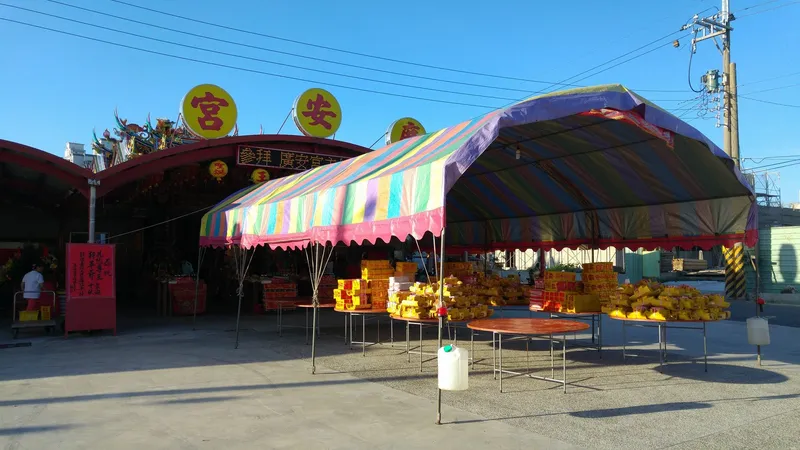
Located south of the present-day Jiali Junior High School, the Guang’an Temple (cover photo) contains a document that records that after the catastrophe in Xiaolong, the innocent refugees who perished and the souls of war dead were left destitute and starving, forming gangs and turning Xiaolong into a gloomy place. The residents also suffered from a persistent disease causing smelly feet, bloated bellies, and sallow complexions, leading to widespread fear and the gradual decline of the area.
In 1923, the twelfth year of the Republic of China, Prefect Sakai of Beimen County agreed to posthumously honor the martyrs of Jing’an. He then collaborated with local elders and village heads to respectfully invite the Heavenly Mother of Chaotian Temple in Beigang, the Thousand-Year-Old Wu of Nankunshen Temple, and the Three Thousand-Year-Old of Jintang Temple in Jiali as the main deities. These deities were sent to patrol and comfort the spirits of the dead, and the Wanying Temples in various places were abolished. The wandering souls were gathered together, some placed in the General’s Mansion of Guang’an Palace (formerly known as the Gongwang Temple, a folk shrine for loyal martyrs) for people to worship and pay their respects. The remains of the rest were buried in a mass grave about two kilometers away from the temple.
According to the temple, numerous skeletons are buried beneath the altar where the statues of the generals sit. These skeletons were only unearthed from the foundation beneath the temple during its construction. If the area extends several kilometers to the main battlefield, even more remains of righteous men and Japanese soldiers would be buried there. Therefore, the origin of Guang’an Palace and the reason for the establishment of the General’s Mansion were not arbitrary. References:
- “Xiao Long Goes to Rebel Against the Barbarians,” published in the 38th issue of the Tainan Salt Zone Literary Bimonthly, author: Tu Shuncong.