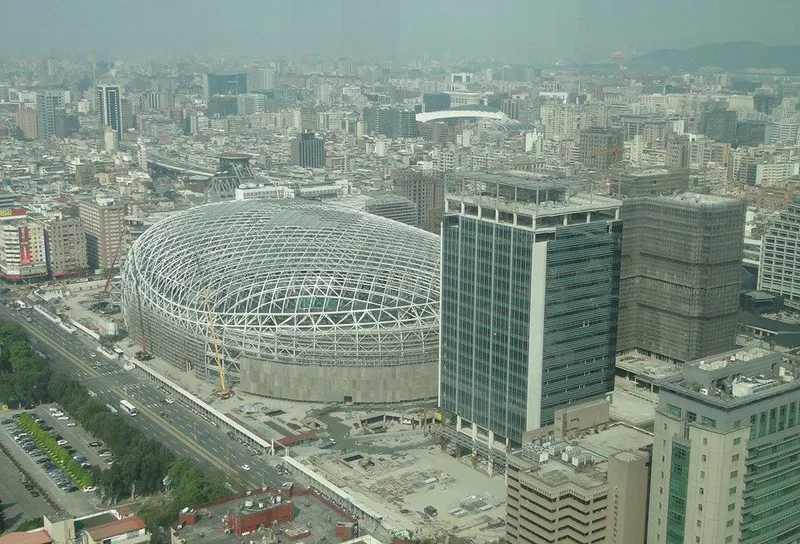
On November 10, 1991, tens of thousands of spectators waited at the Taipei Municipal Baseball Stadium for Game 7 of the CPBL Championship Series (Wei Chuan Dragons vs. Uni-President Lions). Unexpectedly, heavy rain poured down, leading the CPBL to announce a postponement. The crowd shouted in unison: “We want a Dome!”
In response, then-Premier Hau Pei-tsun issued instructions to build an indoor stadium that would not be affected by wind or rain.
🗺️ Multiple Shifts in Location
1. The Lee Teng-hui Administration (1993)
In 1993, in coordination with the bid to host the 1998 Asian Games, the Lee Teng-hui administration included the Dome in the nation’s major development projects. The original plan was to build it in Guandu; however, as the Guandu development plan stalled, the Taipei Dome project also came to a halt.
2. Chen Shui-bian’s Mayoral Term (1995-1998)
On December 26, 1995, Chen Shui-bian presented Sadaharu Oh with an appointment letter as the highest honorary advisor to the Dome Promotion Task Force, actively pushing the project forward. On July 20, 1996, the Taipei City Government’s task force decided to build the Dome at the original site of the Taipei Municipal Baseball Stadium. The project was paused after Chen Shui-bian failed in his re-election bid for mayor in 1998.
3. Political Intervention at Songshan Tobacco Plant (Presidential Term)
After Chen Shui-bian was elected President, the DPP government argued that the Songshan Tobacco Plant possessed historical significance and should be preserved. Consequently, an 8-hectare section of the old factory site was designated as a cultural park, and the factory was officially named a historical site. This led to subsequent issues, such as the Dome’s site being too small and its proximity being too close to historical relics.
4. Ma Ying-jeou’s Mayoral Term (2002)
On July 9, 2002, after the Taipei City Government commissioned foreign experts to conduct a feasibility study, the experts concluded that the juxtaposition of the Dome and historical sites could provide a unique urban charm and that the two were not in conflict.
Therefore, then-Mayor Ma Ying-jeou confirmed the planning of the Dome complex within the Songshan Tobacco Plant district and initiated the bidding process for commercial investment.
Editor’s Note: Now that the timeline and events are laid out in detail, is it clear to everyone? The final chapter is the well-known “big corruption case” joke from Ko Wen-je’s term.