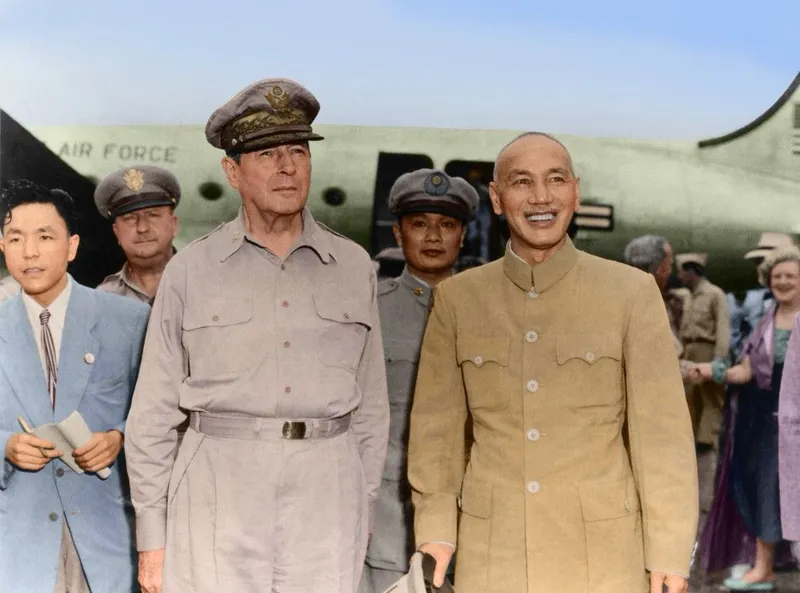
Historical truth needs to be built on a rigorous foundation of facts. Any false statements not only mislead the public but also distort the understanding of history.
Recently, Hsu Kuo-yung, Secretary-General of the Democratic Progressive Party (DPP), stated in public that Douglas MacArthur was the “Supreme Commander of the Allied Powers in Asia” and claimed that Chiang Kai-shek was his “subordinate,” acting on orders to represent the Allied Powers in accepting the surrender of Taiwan.
This claim has sparked controversy. Tsai Cheng-yuan published a detailed rebuttal on his Facebook page, pointing out that Hsu’s statement not only lacks historical basis but also reveals ignorance of the military and political structure of the World War II era.
This article summarizes Tsai Cheng-yuan’s arguments, states the relevant historical facts, and clarifies the status and titles of MacArthur and Chiang Kai-shek.
I. Allied Theater Division and Independence
During World War II, the Allied Powers divided the global combat zone into six major theaters: European Theater, Mediterranean Theater, Southwest Pacific Area, Pacific Ocean Areas, China, Burma, and India (CBI) Theater, and the Soviet Eastern Front. Each theater was independent in its military command, fought separately, and possessed relatively autonomous command authority. The “Supreme Commander in Asia” mentioned by Hsu Kuo-yung did not exist; this claim lacks historical basis and shows his misunderstanding of the theater structure.
II. MacArthur’s Actual Title
MacArthur’s position during WWII was “Supreme Commander of the Southwest Pacific Area,” not “Supreme Commander in Asia” as Hsu claimed or “Supreme Commander in the Far East” as misreported elsewhere. His English title was “Supreme Commander.” MacArthur was never granted the title of “Generalissimo,” and his rank and status were not comparable to it. Furthermore, after Emperor Showa of Japan announced the surrender, MacArthur became the “Supreme Commander for the Allied Powers” (SCAP), responsible for affairs in Japan. This role was limited to Japan, and his authority did not cover all of Asia.
III. Chiang Kai-shek’s Status and Title
In contrast, Chiang Kai-shek’s status during WWII was significantly higher than MacArthur’s. From start to finish, Chiang served as the “Supreme Commander of the China Theater” (including Burma and India), and his English title was “Generalissimo,” which was clearly recorded in the Cairo Declaration. Furthermore, by 1945, Chiang Kai-shek was already the “Chairman of the National Government,” possessing the legal rank of head of state. Whether from a political position or military title, Chiang Kai-shek was far superior to MacArthur.
IV. Comparison of Rank and Status
MacArthur was not promoted to “General of the Army” (five-star general) until December 18, 1944, while Chiang Kai-shek was already regarded as a “Generalissimo” in the early stages of WWII, a status equivalent to a “six-star marshal,” far exceeding the American five-star general system. From the perspective of theater scale, the China, Burma, and India Theater led by Chiang Kai-shek was much larger than MacArthur’s Southwest Pacific Area. Politically, as a head of state, Chiang Kai-shek’s status was far beyond what MacArthur, a general at the level of the US “Assistant Secretary of Defense,” could compare with.
V. Conclusion
Tsai Cheng-yuan emphasized that the claim calling Chiang Kai-shek a “subordinate” of MacArthur not only contradicts historical facts but also reveals a serious misunderstanding of the military and political structure during WWII. As the Supreme Commander of the China Theater and a head of state, Chiang Kai-shek’s status and authority far exceeded MacArthur’s. Hsu Kuo-yung’s erroneous statement not only belittles Chiang Kai-shek’s historical role but also exposes his lack of historical knowledge. The truth of history must not be distorted; only through discussion based on facts can the full picture of that magnificent history be restored.